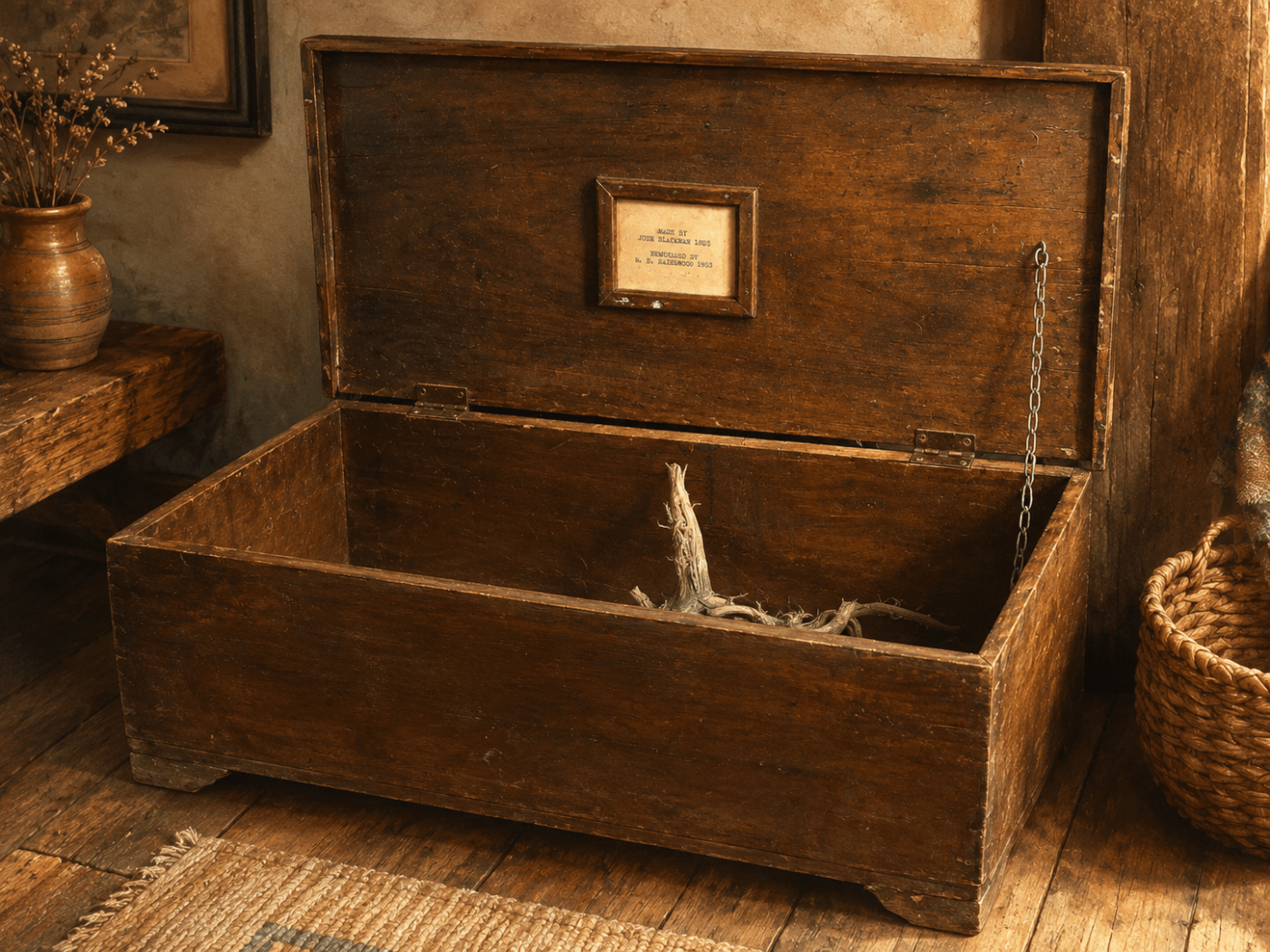
For more than two hundred years, a wooden chest has survived in my mother’s family. Made in 1823 by a man named John Blackman, it passed quietly from one generation to the next until it eventually came into my mother’s care. Its boards carry the scratches, stains, and softened edges of age, but they also preserve something far more valuable—a family mystery. Who was John Blackman, and why had a chest bearing his name remained among our Hazelwood descendants for so long?
The chest came down through the family of Martha Jane Blackman and her husband, Warrick Jefferson Hazelwood. From them, it passed through their son William Benjamin Hazelwood, then to his daughter Imogene Hazelwood, and finally to my mother. Each generation protected it, even as the story of its earliest owners gradually faded.
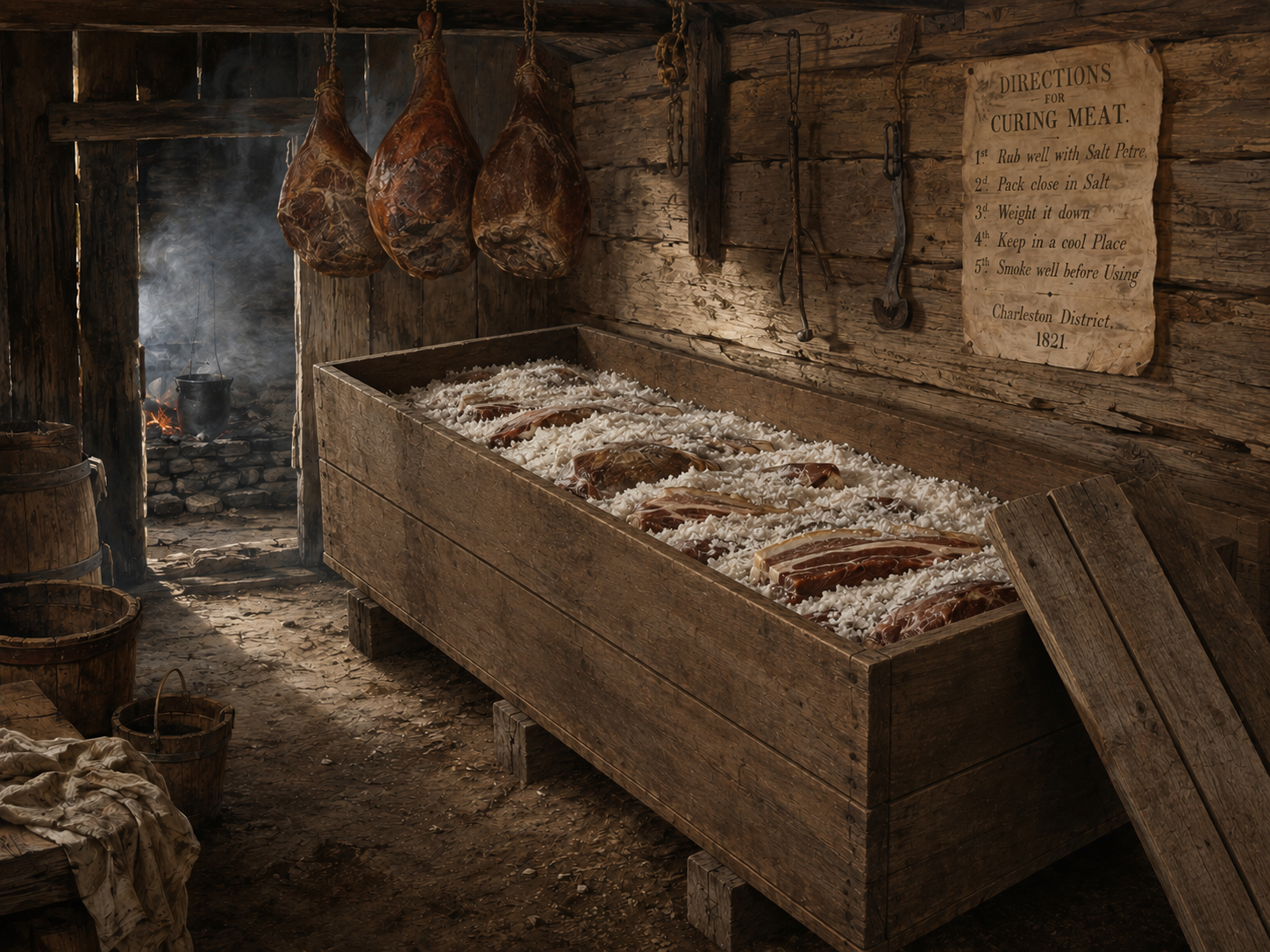
According to family lore, the chest did not begin its life as a chest at all. It was fashioned from an older wooden salt box, or possibly a salting trough, once used in the curing and preservation of meat. In a time when useful timber was rarely wasted, the worn container was cut down and given a new purpose. Its boards were reshaped and joined together to create a smaller chest intended for a baby’s clothing.
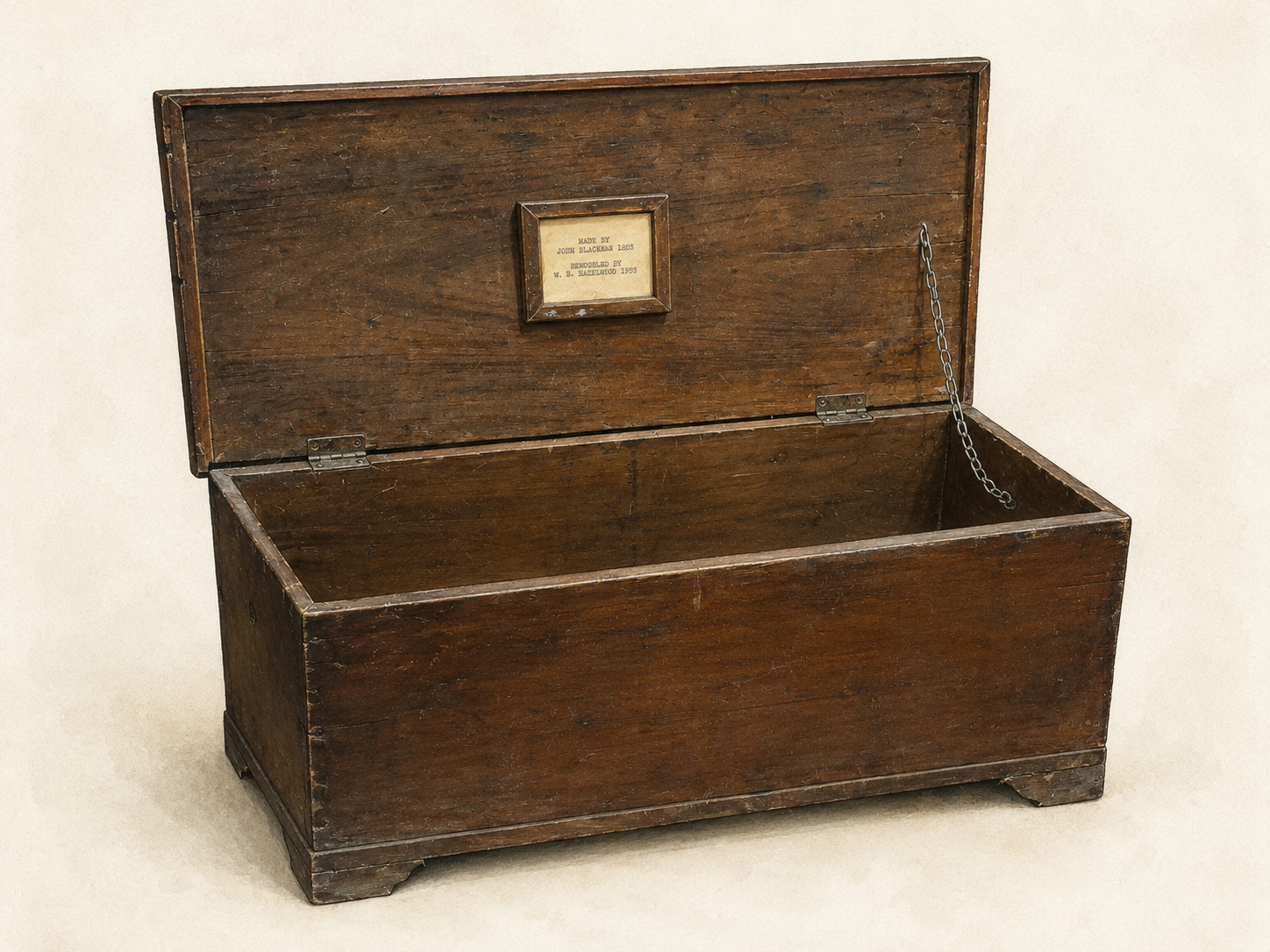
That story gives the old relic a special warmth. Before factory-made furniture filled ordinary homes, families often made use of what they already had. A piece of wood that had once served the practical needs of the household could be transformed into something meant to protect an infant’s gowns, blankets, and other treasured belongings. The chest was therefore more than a piece of furniture. It represented thrift, craftsmanship, and preparation for a new life entering the family.
Someone gathered those little garments and placed them inside. Someone lifted its lid with hopes for the child whose belongings it held. Generations later, the baby clothes were gone, but the chest remained.
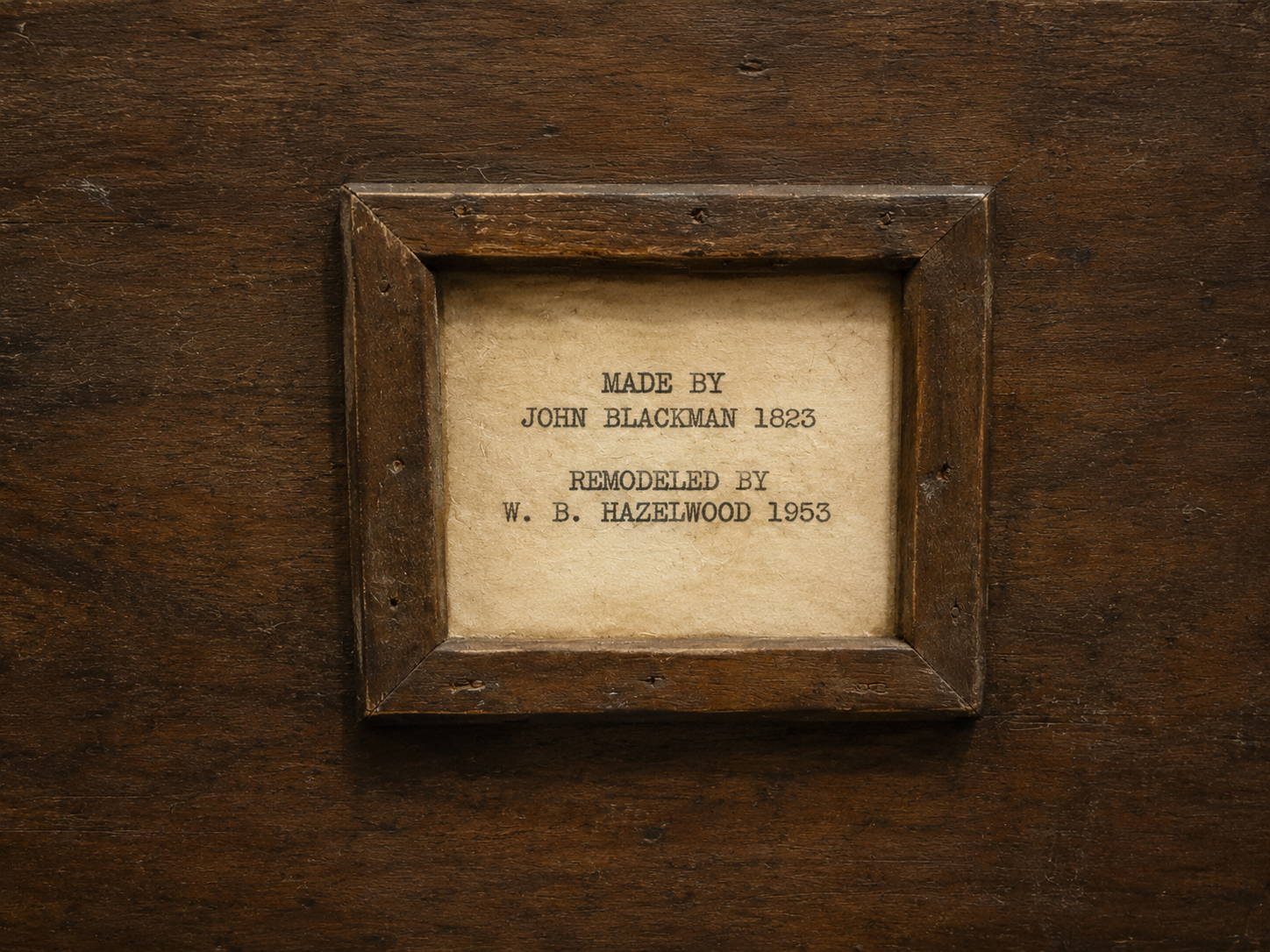
The inscription identified John Blackman as its maker, yet the path by which the chest descended offered a different kind of evidence. Its survival among the descendants of Martha Jane Blackman suggested that it had once belonged to her Blackman family before passing into the Hazelwood line through her marriage. The chest seemed to preserve a connection to a particular branch of the family, even when the written records did not clearly explain that connection.
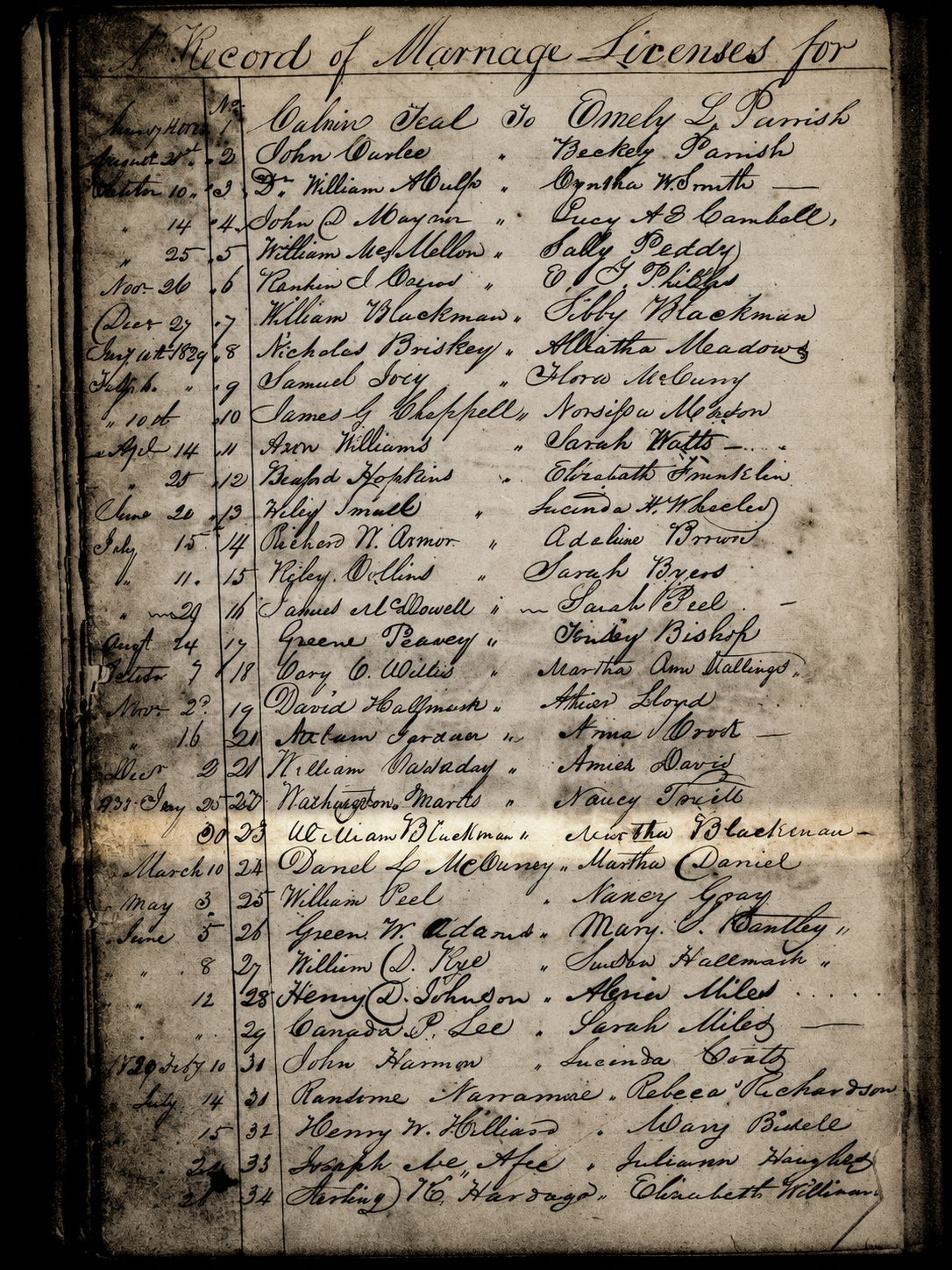
At first, tracing Martha Jane backward appeared straightforward. She was the daughter of William B. Blackman. But her mother was not a woman from an unrelated family.
William B. Blackman had married Martha Blackman on 30 January 1830 in Harris County, Georgia.
That unexpected Blackman-to-Blackman marriage changed the nature of the search. There was no longer just one Blackman ancestry to follow, but two. The old chest might have descended through William’s family, through Martha’s family, or through relatives connected to both. What had begun as a search for the identity of John Blackman now opened into a larger mystery involving two Blackman branches—and the possibility that the chest had quietly preserved a family relationship for two centuries.
Two Blackman Lines Come Together
Between 1828 – 1829, a small group of related Blackman families left Lancaster County, South Carolina, and moved southwest into Harris County, Georgia. Among the men who made that journey were Joseph Blackman, Burrell Blackman, Nathan Blackman, Joel Blackman, and Jonathan Blackman.
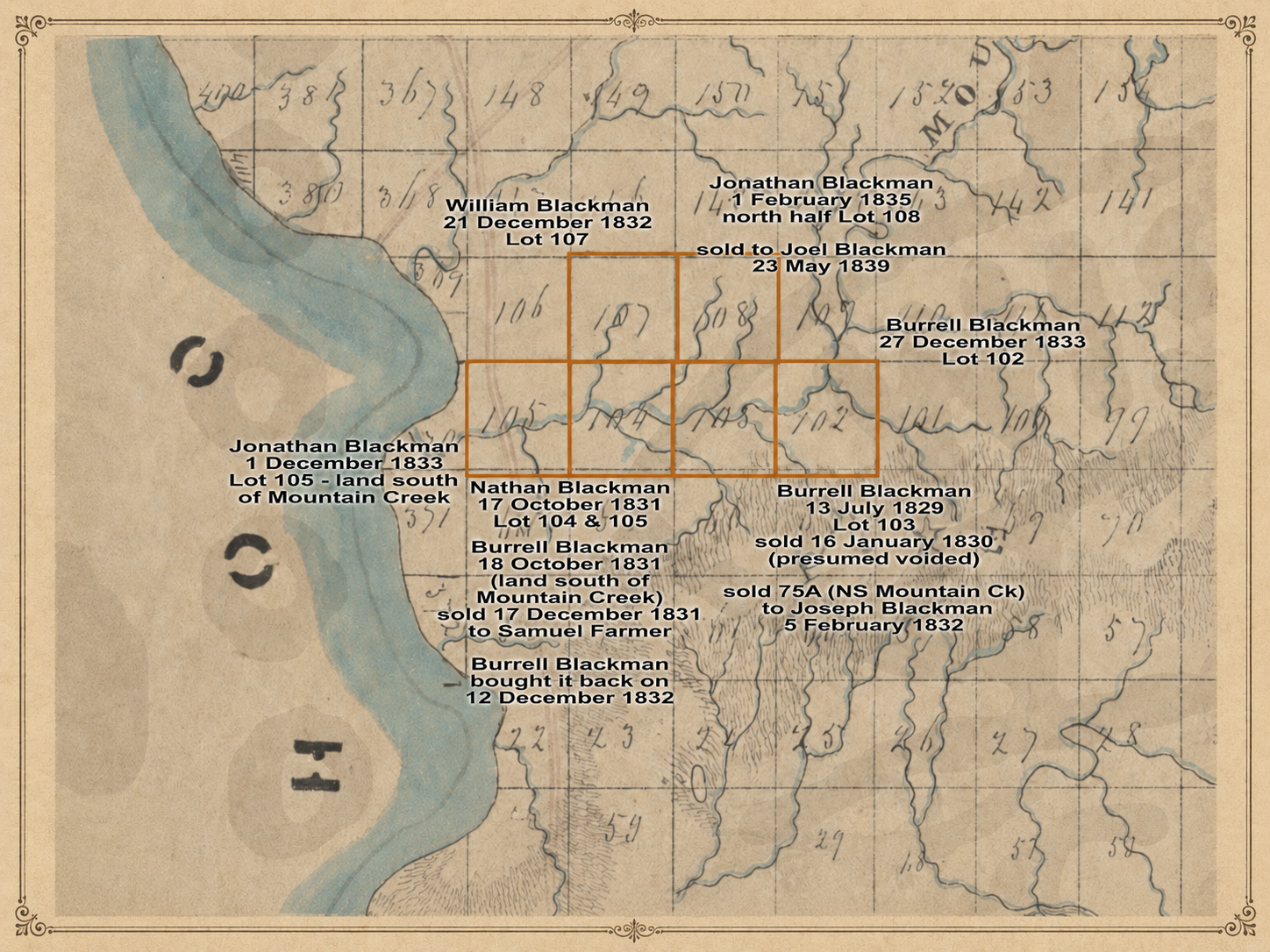
They settled near the mouth of Mountain Oak Creek, where the stream emptied into the Chattahoochee River along Georgia’s western border. Their migration was not simply the movement of five unrelated households that happened to share a surname. These men had lived near one another in South Carolina, and several had already appeared together in land records and other family associations. Their arrival in the same corner of Harris County suggests an extended family moving as a community and carrying its older relationships into a new state.
Somewhere within this group were the childhood homes of William B. Blackman and Martha Blackman, the couple whose marriage would eventually bring two Blackman branches together.
William was probably born between about June 1809 and June 1810. Martha was probably born between about June 1812 and June 1813. Both consistently reported South Carolina as their birthplace, making Lancaster County the most likely setting for their early childhoods.
The question was simple to ask but difficult to answer:
Which of the five Blackman households contained William and Martha in 1820?
The 1820 census did not identify children by name. It recorded only the number of males and females within broad age groups. Even so, those categories allow us to test whether William or Martha could have occupied a particular household.
DNA Points Toward Nathan
Modern DNA evidence provided the first important clue.
The author shares multiple autosomal DNA matches with descendants of Bedford Garris and Susannah Garris. Their daughter, Winifred Garris, married Nathan Blackman on 9 October 1807 in Lancaster County.
Those matches do not, by themselves, name William B. or Martha as Nathan’s child. Autosomal DNA can point toward a family branch without always identifying the precise parent-child connection. Nevertheless, the repeated Garris connections strongly suggest that the ancestry of either William or Martha passed through Nathan Blackman and Winifred Garris Blackman.
If William and Martha truly represented two different Blackman branches, one of them should logically fit within Nathan’s 1820 South Carolina household.
Martha can be tested first.
Born about 1812 or 1813, she would have been approximately seven or eight years old when the 1820 census was taken on 7 August. She should therefore appear as a ‘female under ten’.
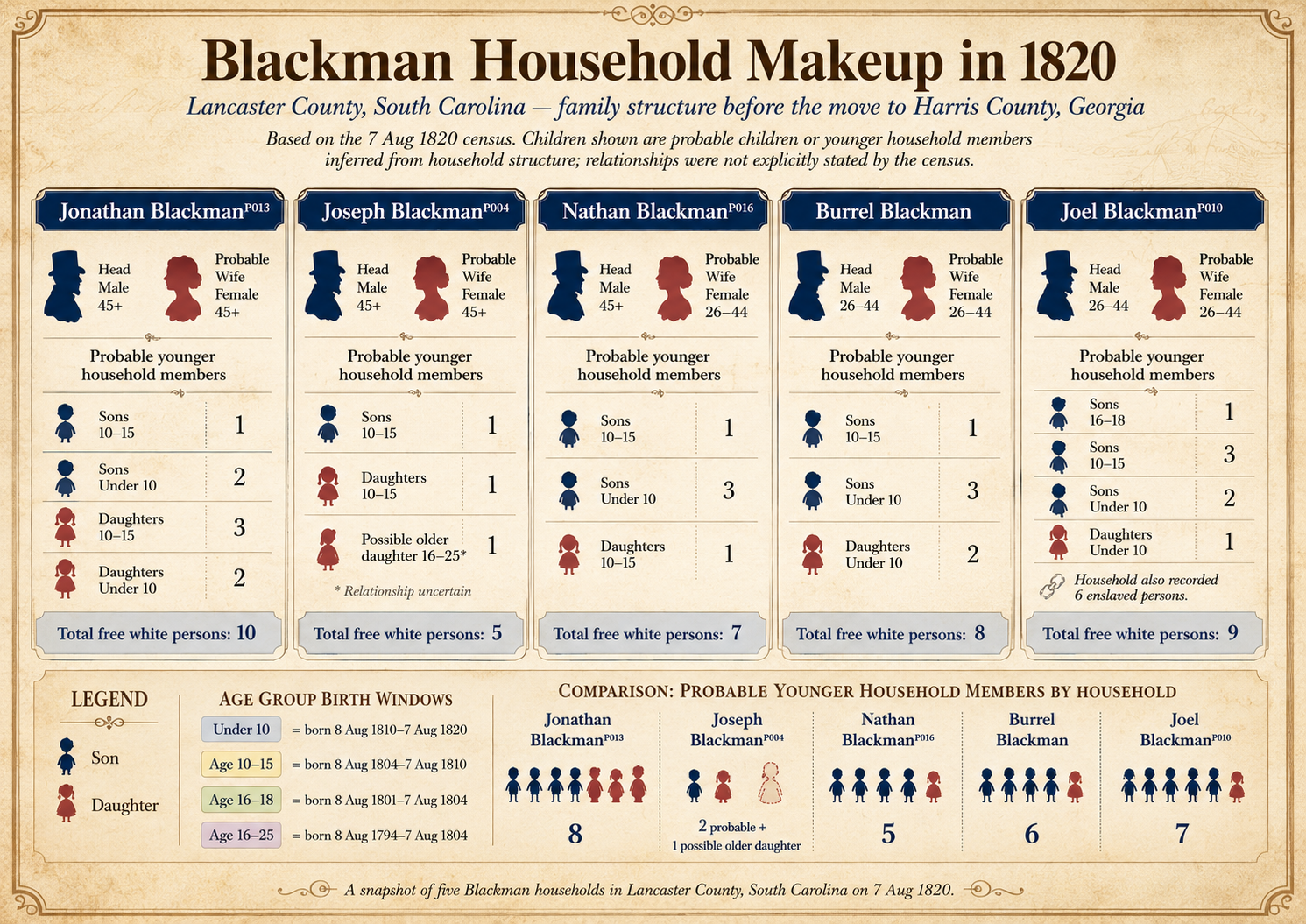
Nathan’s household contained no females under ten.
It did include one girl aged ten through fifteen, but Martha was almost certainly too young for that category. Born about 1812 or 1813, she would have been only seven or eight years old when the census was taken in August 1820. Unless her age was seriously misstated, Nathan’s household structure argues against Martha being his daughter.
That turned the attention toward William.
A closer calculation places William at about ten or eleven years old in August 1820. He should therefore appear in the ‘male aged ten through fifteen’ category rather than among the boys under ten.
Nathan’s household contained exactly: One male aged ten through fifteen.
That unnamed boy fits William remarkably well.
Nathan was not the only Blackman whose household contained a boy of William’s age. Joel Blackman had three males aged ‘ten through fifteen’, so his household also had to be considered. Those three positions, however, have been provisionally reconstructed as:
- Elijah Blackman, born about 1804
- James R. Blackman, born about 1805
- John C. Blackman, born about 1810
If those identifications are correct, Joel’s three older-boy positions are already accounted for. That makes Joel a much less likely father for William B. Blackman.
Nathan’s household presents a cleaner fit. He had only one male in the correct age category, and William’s calculated birth range places him directly within that single position. Nathan also had three younger boys under ten, but William was probably just old enough to fall into the next category.
When the DNA matches to the Garris family are considered alongside the 1820 census, a coherent possibility emerges:
William B. Blackman was probably the unnamed boy aged ‘ten through fifteen’ in the 1820 household of Nathan Blackman and Winifred Garris Blackman.
This remains a reasoned identification rather than direct documentary proof. No known record has yet been found explicitly naming William as Nathan’s son. Census ages can also be imperfect, and the reconstructed identities of Joel’s sons remain subject to further evidence. Even so, William’s age, South Carolina birthplace, migration to Harris County, exact fit within Nathan’s household, and the Garris DNA evidence all point in the same direction.
The Chest Points Toward Martha’s Family
If William belonged to Nathan’s household, then Martha must be sought among the other Blackman families.
That brings the old wooden chest back into the story.
For generations, the chest was preserved as a family heirloom, passing through Martha Jane Blackman and Warrick Jefferson Hazelwood, then through their son William Benjamin Hazelwood, to Imogene Hazelwood, and eventually to my mother.
The chest bears the name of John Blackman and the date 1823. Its survival among Martha Jane’s descendants suggests that it entered the Hazelwood family through one of her Blackman parents.
If William’s line points toward Nathan, the chest may preserve evidence from Martha’s side of the marriage.
In 1820, Martha would have been a girl under ten. Among the five Blackman households later associated with the move to Georgia, several contained girls in that age category:
- Jonathan Blackman had two females under ten.
- Burrell Blackman had two females under ten.
- Joel Blackman had one female under ten.
- Nathan Blackman and Joseph Blackman had none.
The census alone therefore cannot identify Martha’s father. She could fit numerically within the households of Jonathan, Burrell, or Joel.
The inherited chest, however, adds a family clue that the census cannot supply. Its path through Martha Jane’s descendants appears to point most naturally toward the ancestry of her mother, Martha Blackman, and the working family reconstruction leads toward Jonathan Blackman’s household.
Jonathan had two unnamed daughters under ten in 1820. Martha, then about seven or eight, fits one of those positions.
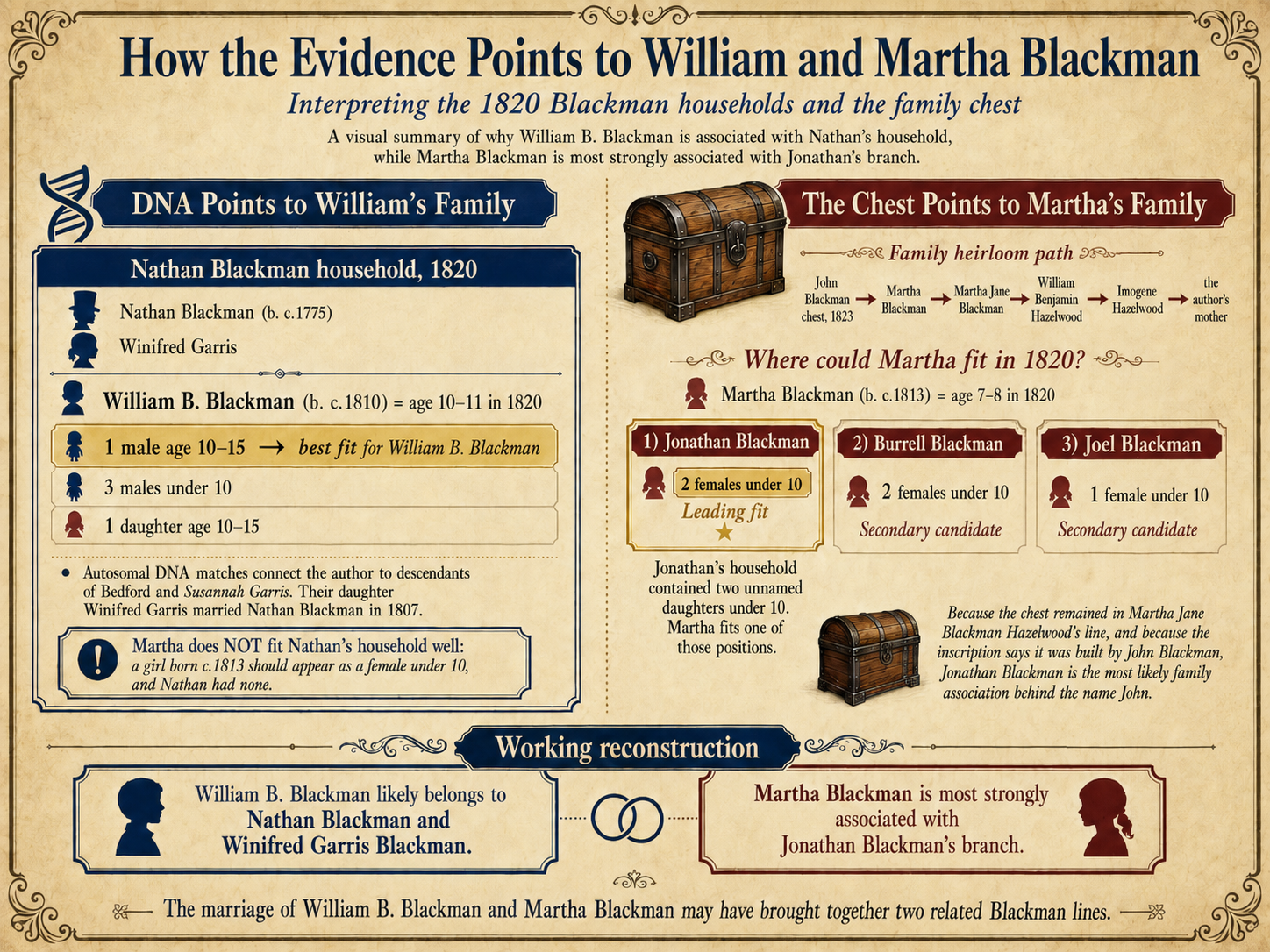
This creates a balanced explanation for the two forms of evidence: DNA points toward Nathan as the father of William B. Blackman, while the family chest points toward Jonathan’s branch as the family of Martha Blackman.
What Did the Name “John Blackman” Preserve?
The name written on the chest deserves closer attention because it was added long after the chest was first made.
William Benjamin Hazelwood remodeled the chest and added the inscription identifying it as having been made in 1823 by John Blackman. William Benjamin would not ordinarily have possessed first-hand knowledge of the man who made a chest decades before his own birth. The name had to come from someone older who knew the chest’s history.
The most natural source was his mother, Martha Jane Blackman Hazelwood. Yet Martha Jane was born after Jonathan Blackman—the man now suspected of being her maternal grandfather—had died. She could not have known him personally either. The story therefore appears to have passed through at least three generations:
Martha Blackman told her daughter Martha Jane Blackman, who later passed the story to her son William Benjamin Hazelwood.
That chain of transmission makes the remembered name more important, not less. Families may forget dates, places, and details, but the name attached to a treasured object often survives because the person held a meaningful place in the family’s history.
This makes it somewhat less likely that “John Blackman” was merely a distant uncle, unrelated craftsman, or another Blackman whose connection to the family was incidental. Such a person’s name could certainly have been remembered, but it would be harder to explain why that name remained attached to the chest through Martha, Martha Jane, and William Benjamin.
The more natural possibility is that the name referred to someone central to Martha Blackman’s immediate family.
John and Jonathan were historically separate given names, so the inscription cannot simply be treated as proof that they were the same person. Still, names passed orally through several generations were sometimes shortened, simplified, or remembered in the form commonly used within the household. It is therefore possible that Jonathan Blackman was known informally within the family as John, or that his longer name became shortened as the chest’s story passed from mother to daughter and then to grandson.
Another possibility is that the chest was made by a close male relative actually named John. However, that explanation would require an additional reason why his name, rather than Jonathan’s, remained so strongly associated with a chest that descended through Martha’s family.
The inscription should therefore be treated not as a perfect contemporary record, but as a valuable piece of oral family evidence:
The chest was remembered within Martha Blackman’s family as having been made by a man called John Blackman, and that identity was important enough to survive through at least three generations before William Benjamin Hazelwood committed it to the wood.
When that oral tradition is considered alongside Jonathan Blackman’s 1820 household—which contained two girls under ten, one of whom could have been Martha—the name on the chest becomes a meaningful clue pointing toward Jonathan’s branch. It does not yet prove that Jonathan was the maker, but it makes the connection more substantial than the name of a random or peripheral Blackman relative.
Another Blackman-to-Blackman Marriage
Before turning to the final reconstruction of William and Martha’s parentage, another marriage within this same family group deserves attention.
William B. Blackman and Martha Blackman may not have been the only couple in Harris County formed by two members of the wider Blackman family. A similar pattern appears in the marriage of William R. Blackman and Sibby Blackman who married on 27 December 1828 in Harris County, Georgia.
The 1820 census offers a provisional way to place them within the earlier Lancaster County households.
William R. Blackman, born about 1807, would have been approximately thirteen years old in 1820. Joseph Blackman’s household contained exactly one male aged ten through fifteen, making William R. a reasonable candidate for that position.
Sibby Blackman, born about 1811, would have been about nine years old. Jonathan Blackman’s household contained two females under ten, and Sibby could have been one of those two girls.
This produces a possible family arrangement in which:
William R. Blackman was a son of Joseph Blackman, while Sibby Blackman was a daughter of Jonathan Blackman.
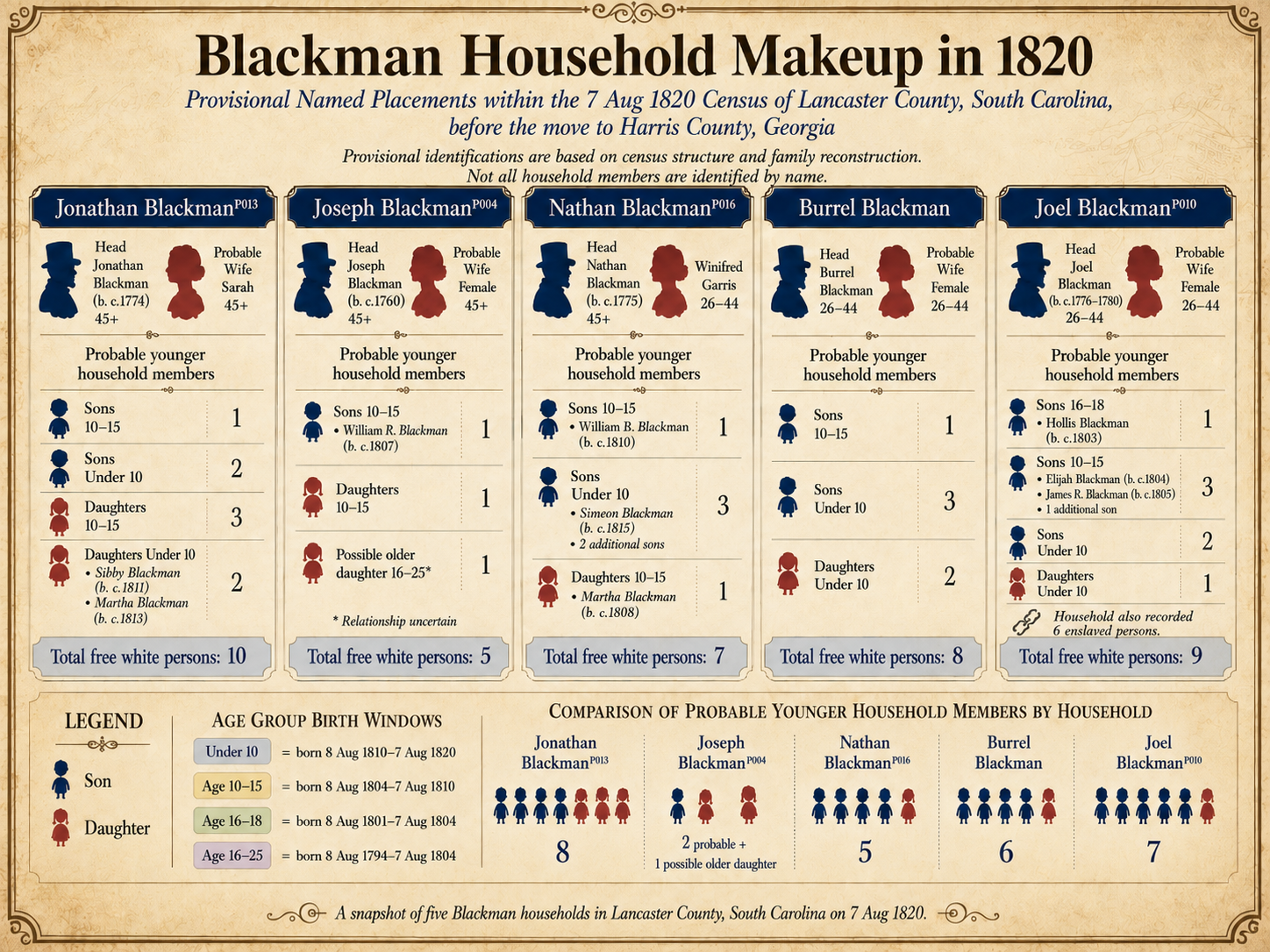
These identifications remain provisional, since the 1820 census did not name children. Even so, the ages fit the available household positions and provide an important parallel to the proposed marriage of William B. Blackman and Martha Blackman.
If Sibby was indeed Jonathan’s daughter, then Jonathan’s family had already participated in—or at least accepted—another marriage joining two different Blackman branches. That does not prove that Jonathan personally arranged or granted permission for such marriages, nor does it establish how closely the couples were related. It does, however, show that a Blackman-to-Blackman marriage would not have been out of place within this extended family network.
The five Blackman households had migrated together from Lancaster County to the same part of Harris County. They lived near one another, shared a common surname, and likely maintained close family and social ties. In such a tightly connected community, young people would naturally have known members of neighboring Blackman households from childhood. Marriages between different branches of the same extended family could therefore occur without being regarded as unusual, especially when the precise relationship was distant enough to be socially and legally acceptable.
The possible marriage pattern can be viewed this way:
- Joseph’s presumed son, William R., married Jonathan’s presumed daughter, Sibby.
- Nathan’s presumed son, William B., may have married Jonathan’s presumed daughter, Martha.
If both reconstructions are correct, Jonathan’s daughters married sons from two other Blackman households within the same migration group. That repeated pattern would make the William B. Blackman and Martha Blackman marriage considerably more plausible. Rather than being an isolated or unlikely event, it would reflect the close-knit family environment in which these Blackman families lived.
It also strengthens the possibility that the chest traveled through Jonathan’s family. Sibby and Martha may have been sisters or close female relatives raised in the same household, while their husbands came from neighboring Blackman branches. The old chest, the repeated marriages, and the clustered migration all point toward a family whose separate branches remained closely intertwined after their move to Georgia.
None of this independently proves Martha’s place in Jonathan’s household. But the marriage of William R. and Sibby provides valuable context. It shows that the proposed union of William B. and Martha was not merely possible—it may have been part of a broader pattern already present within the Blackman family.
A Working Reconstruction
The evidence presently supports the following family arrangement:
William B. Blackman was probably a son of Nathan Blackman and Winifred Garris.
Martha Blackman was probably a daughter of Jonathan Blackman and his wife Sarah, whose first name is known but whose maiden identity remains unresolved.
Neither relationship has yet been established by a record explicitly naming the parent and child. The conclusions instead rest upon the combined weight of census ages, household structure, migration, inherited family history, and DNA evidence.
Taken separately, each clue leaves questions. Together, they form a compelling story.
The DNA evidence explains why descendants of William and Martha carry connections to the Garris family. Nathan’s 1820 household contains one boy of exactly William’s expected age. Martha cannot be placed in Nathan’s household, but she fits one of the two unnamed girls in Jonathan’s family. The old chest, preserved through Martha Jane Blackman’s descendants, provides a tangible connection to the other Blackman branch.
What first appeared to be conflicting evidence may instead preserve both sides of the same marriage.
William carried the ancestry of Nathan Blackman and Winifred Garris. Martha may have carried the ancestry of Jonathan Blackman. Their marriage united the two lines, and their daughter Martha Jane inherited both.
The chest then passed with her into the Hazelwood family, carrying one branch of that history in its boards, while DNA preserved the other.
 digging our roots