Donna Ruff was born on 4 June 1878, most likely in or near the small community of Borden Springs in Cleburne County, Alabama.
She was the daughter of Louisa F. “Hester” Ruff, an unmarried woman born about 1849, also in the Borden Springs area. Hester was a daughter of Jackson R. Ruff and Phoebe Putman Ruff, whose families had lived in the region for many years.
Beyond these basic family connections, little is presently known about Hester’s early life. No surviving family account explains her childhood, her education, or how she supported herself as a young woman. The identity of Donna’s father is also unknown.
For the first several years of Donna’s life, the historical record remains nearly silent. Then, in the spring of 1882, her name appeared in a series of papers filed before the Probate Court of Cleburne County.
Donna was not yet four years old.
A Petition Concerning a Young Child
On 29 March 1882, a Cleburne County man named William C. Knighten filed a written petition before Probate Judge T. J. Burton.
Knighten informed the court that Hester Ruff was the mother of a female child named ‘Dona Ruff‘ and that both mother and daughter resided within the county. His petition also provided Donna’s exact age, stating that she would become four years old on 4 June 1882.
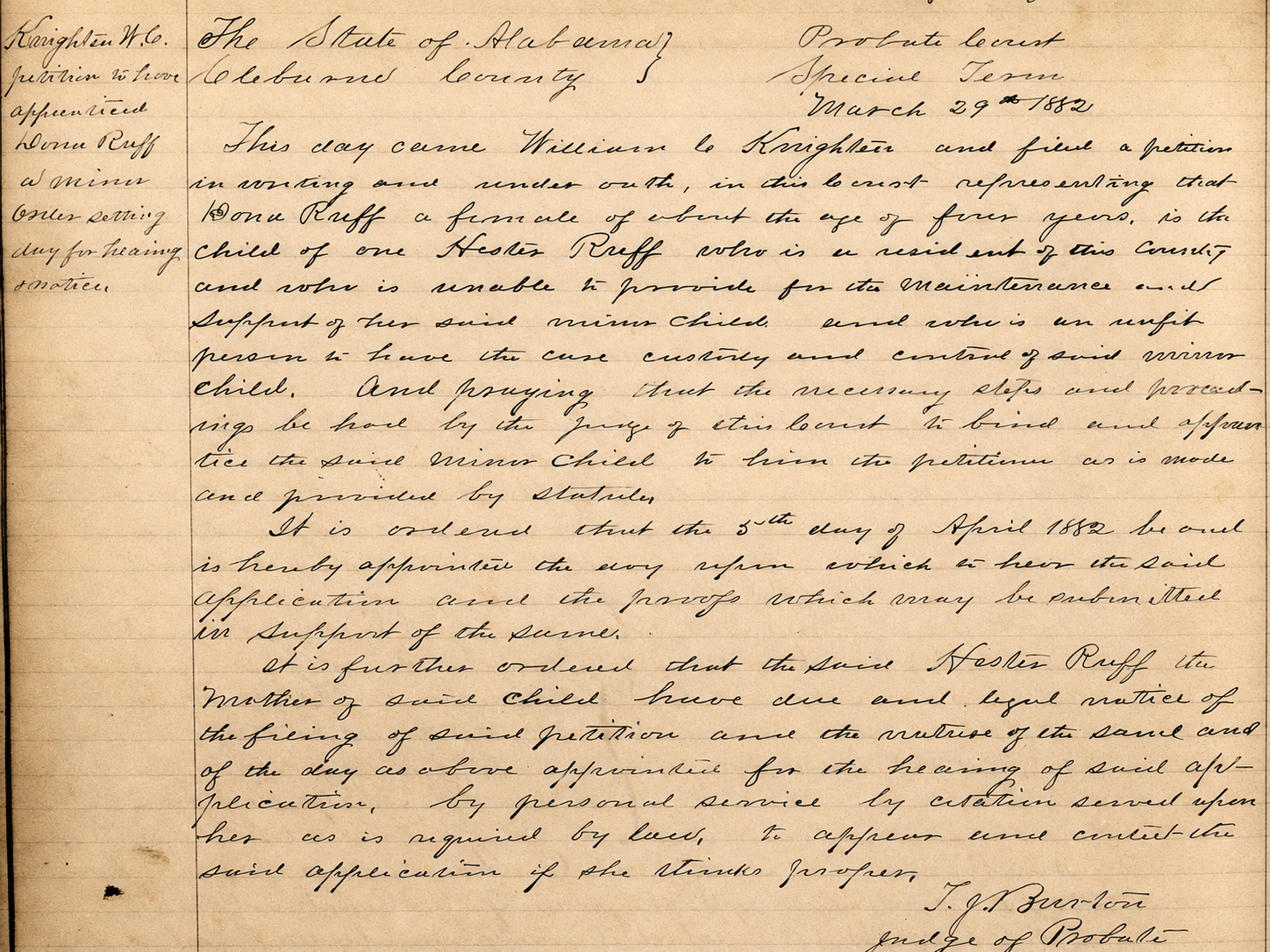
The reason for the petition was stated plainly: Hester was allegedly unable to provide for and support her daughter.
Knighten therefore asked the court to bind Donna to him as an apprentice until she reached eighteen years of age. He represented himself as an adult resident of Cleburne County who was financially able, personally suitable, and willing to assume responsibility for the child.
The petition did not accuse Hester of cruelty, abandonment, criminal behavior, or mistreatment. It did not claim that Donna was in immediate physical danger. The issue presented to the court was Hester’s poverty—or, in the formal language of the proceeding, her inability to maintain and support her child.
What Apprenticeship Meant for Donna
To modern readers, the word apprentice usually brings to mind an older child or young adult learning a trade. Donna, however, was only three years old when Knighten filed his petition. She was clearly too young to begin any meaningful occupational training.
In cases such as Donna’s, apprenticeship served as a legal method of placing a poor or dependent child under the control of another household. The receiving adult became responsible for the child’s maintenance and upbringing. At the same time, that adult gained authority over the child’s residence, conduct, education, and eventual labor.
This was not an adoption in the modern sense. The court did not declare William C. Knighten to be Donna’s father, nor did it formally change her surname. Throughout the proceeding, she remained ‘Dona Ruff‘, the daughter of Hester Ruff.
Even so, the practical consequences were substantial. If the order was carried out as written, Donna would spend nearly all of her childhood under Knighten’s authority and within the Knighten household.
Hester Ruff Receives Notice
On the same day that Knighten filed his petition, Judge Burton issued a formal notice to Hester Ruff.
The notice informed her that Knighten had asked the court to have Donna apprenticed to him on the grounds that Hester was unable to provide for the child. A hearing was scheduled for 5 April 1882.
Hester was advised that she could appear before the court and oppose the petition. She could attempt to prove that she was able to support Donna, or she could present evidence that Knighten was unsuitable to receive the child.
The notice was served on Hester on 30 March 1882, apparently by furnishing her with a copy. This establishes that she was alive, living in Cleburne County, and made aware of the proceeding involving her daughter.
What the papers do not preserve is Hester’s response.
We do not know whether she opposed the arrangement, reluctantly accepted it, or believed it might provide Donna with greater security. We do not know whether she lacked transportation, money, legal assistance, or the confidence to challenge the petition.
Her failure to appear should not automatically be interpreted as agreement. The surviving file records the actions of Knighten and the court, but it does not preserve Hester’s voice.
The Hearing of 5 April 1882
The matter came before Judge Burton on 5 April 1882.
The court recorded that Hester had received proper legal notice but had failed to appear. The judge then conducted what the order described as a “full and satisfactory investigation.”
Following that inquiry, the court accepted the principal claims of Knighten’s petition. Judge Burton found that Hester Ruff was unable to maintain and support Donna. He also found that William C. Knighten was able and competent to assume the child’s care and control.
Donna was then formally bound to Knighten as an apprentice until she reached eighteen years of age.
The articles of apprenticeship placed Donna’s care, custody, control, management, and residence under Knighten’s authority. This was not merely permission for Donna to stay temporarily in his home. The order gave him broad legal control over where she lived and how she was raised.
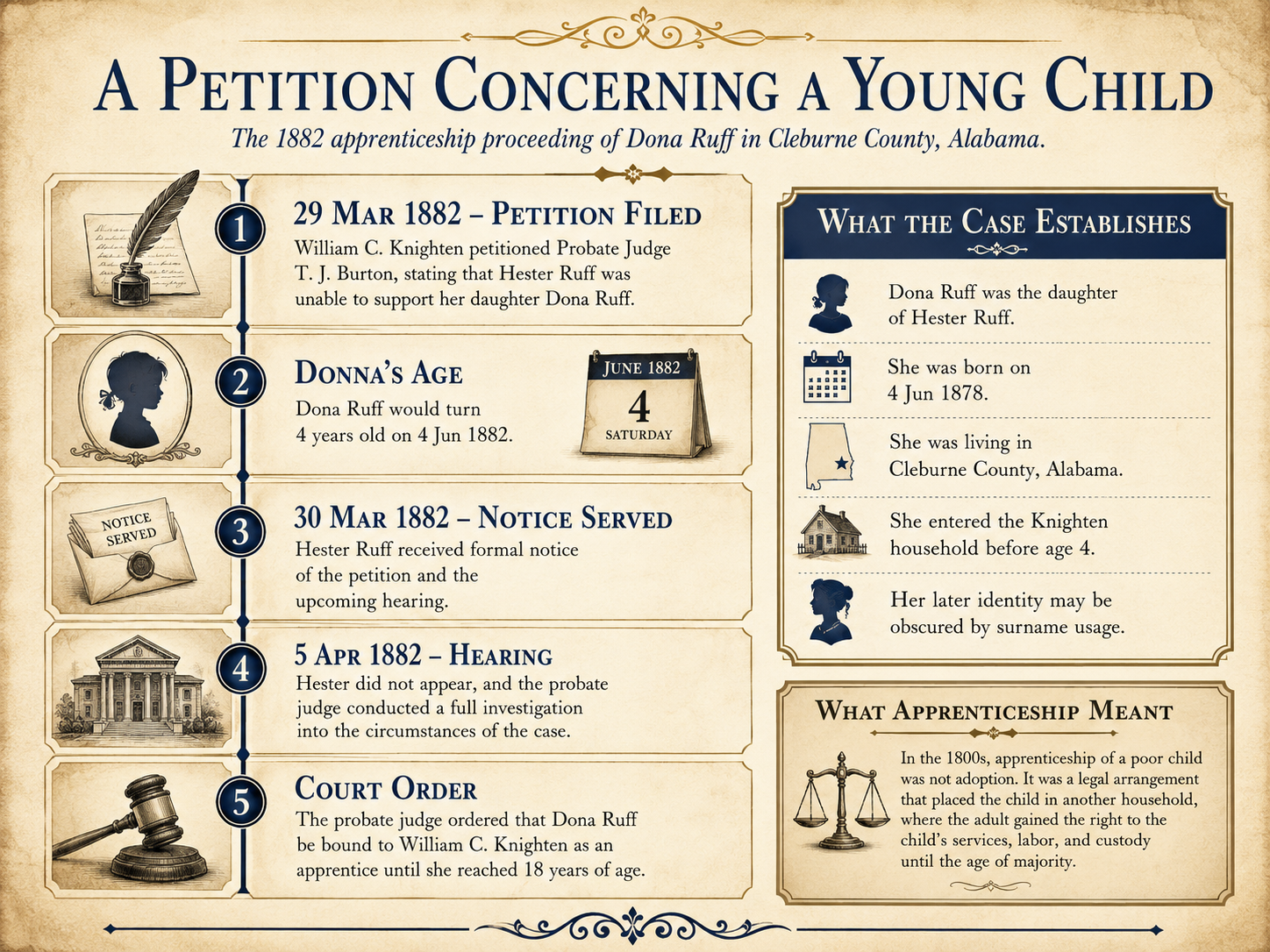
What the Case Establishes
The 1882 proceeding provides several firm facts about Donna’s early life.
She was born on 4 June 1878 and was the daughter of Hester Ruff. Mother and daughter were living in Cleburne County when Donna was a small child. In March 1882, William C. Knighten petitioned the probate court to have Donna placed under his authority. Hester received notice but did not attend the hearing. On 5 April, the court approved the petition and bound Donna to Knighten until she reached eighteen.
The case also establishes that Donna entered the Knighten household before her fourth birthday. If she remained there as ordered, most of the childhood she could remember would have been spent not in a Ruff household, but in a Knighten one.
The Questions Left Behind
The file leaves many important questions unanswered.
Why did William C. Knighten take an interest in Donna? Was he related to Hester or connected to the Ruff family in some other way? Had Donna already been living with the Knightens before the petition was filed? Did Hester continue to visit or maintain a relationship with her daughter?
The records do not say.
They also do not tell us what name Donna used after entering Knighten’s household. Although the court continued to identify her as ‘Dona Ruff‘, everyday life may have been different. A child raised from the age of three by another family could easily become known by that family’s surname. A given name might also be shortened, replaced, or remembered differently in later records.
After the apprenticeship proceeding, Donna becomes difficult to locate under the name Donna Ruff.
That disappearance does not necessarily mean that she died or left the area. It may mean that the child continued her life under a name that no longer clearly revealed her Ruff origins.
The Knighten Household in 1900
By the time of the 1900 federal census, William C. Knighten had moved away from the Borden Springs community and settled near Piedmont, just across the ridge in Calhoun County. Although the move was not especially far, it placed the family in a more developed town while keeping them within the same general region where Donna Ruff had spent her earliest years.
William was enumerated as the head of the household with his wife, Arminda J. Knighten. The couple reported that they had been married for twenty years. Living with them were four children:
- Sulta A. Knighten, born in May 1884;
- William C. Knighten, born in January 1887;
- Joseph N. Knighten, born in December 1891; and
- Charlie S. Knighten, born in March 1894.

One detail in the census initially appears especially important. Arminda reported that she had given birth to five children, but that only four were still living in 1900.
At first glance, that statement might lead a researcher to wonder whether Donna had once been treated as another daughter in the Knighten household and whether her absence from the census meant that she had died before 1900. After all, Donna had been placed under William Knighten’s care while still a very young child, and it would be natural to ask whether she had eventually been absorbed into the family as one of their own.
The wording of the census question, however, requires caution. The enumerator was asking how many children Arminda had personally given birth to, not how many children she had raised or cared for within her household. Donna, as the biological daughter of Hester Ruff, would not ordinarily have been included in Arminda’s reported number of children born.
More importantly, another record appears to account for the missing fifth child.
In the Borden Springs Church Cemetery is a small grave marker inscribed:
“Infant Daughter of W. C. and A. J. Knighten, Born & Died Feb. 4, 1888.”
The initials correspond with William C. Knighten and Arminda J. Knighten, and the child’s birth and death occurred between the births of their son William in 1887 and Joseph in 1891. This infant daughter was almost certainly the fifth child reported by Arminda in 1900—the one who was no longer living.
The cemetery record therefore helps resolve one possible interpretation of the census. The deceased child counted in Arminda’s total was most likely her infant daughter born in 1888, not Donna Ruff.
That conclusion leaves Donna’s fate unanswered. She does not appear in William Knighten’s household under the name Donna Ruff in 1900, but the census also gives no indication that she had died. Instead, the record simply shows that by 1900 William and Arminda were living with their four surviving biological children. To determine what became of the young girl placed in William’s care eighteen years earlier, the search must continue beyond the Knighten household as it was recorded under familiar names.
A New Name Appears in the Piedmont Journal
More than thirty years after the 1900 census, a newspaper obituary introduces a woman whose family connections bring the investigation back to William C. Knighten’s household.
In the Friday, 21 July 1933, edition of the Piedmont Journal, an obituary appeared under the headline “Mrs. Ella Nolen Dies Suddenly.” The article reported that Ella Nolen, age fifty-five, had died suddenly on the evening of 11 July 1933 at her home in the Ball Play community.
According to the account, Ella had eaten a hearty supper and was talking with members of her family when she suffered what was described as an attack of heart trouble. She died about an hour later, before a physician could arrive. Although she had recently complained of feeling unwell and had consulted her doctor, the newspaper noted that during the several days before her death she had appeared to be feeling unusually well.
The obituary stated that Ella had been born and raised in Cherokee County, Alabama, and had lived for many years in the Gnatville community. She was buried at Goshen Cemetery following funeral services held there the following Wednesday morning.
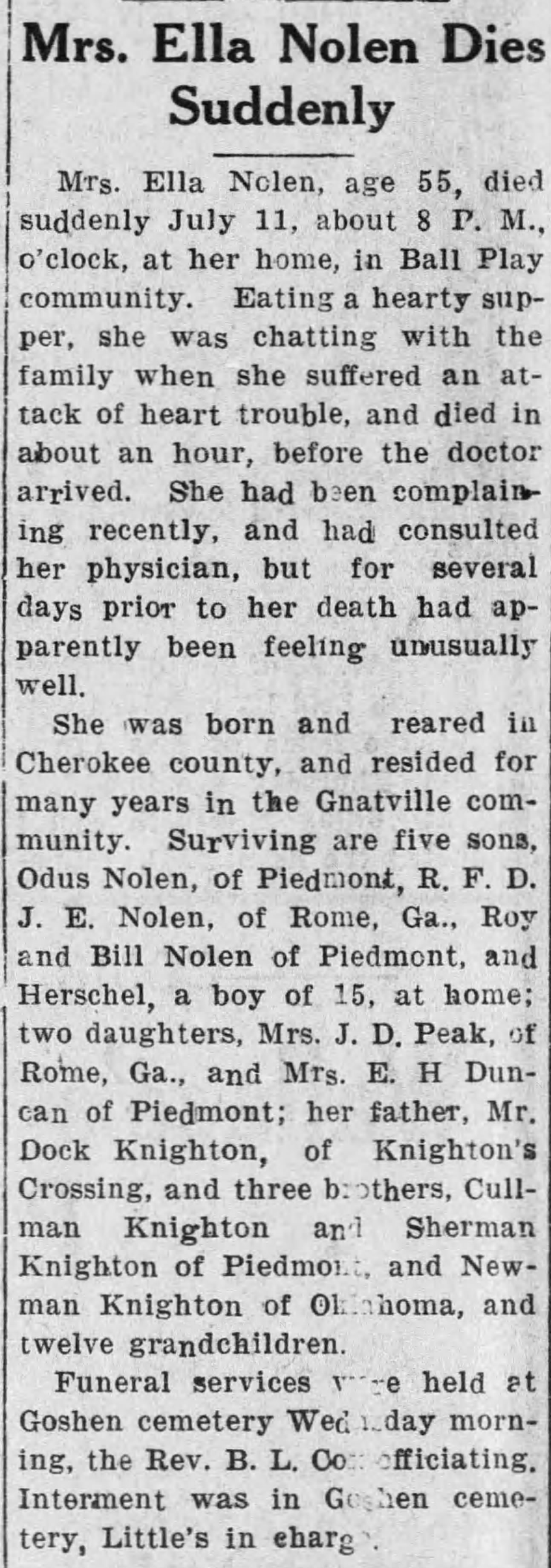
The article named a large surviving family. Ella left five sons:
- Odus Nolen [Otis Vernon Nolen], of Piedmont;
- J. E. Nolen [Joseph Ellis Nolen], of Rome, Georgia;
- Roy Nolen, of Piedmont;
- Bill Nolen [Theron Earl Nolen], of Piedmont; and
- Herschel Nolen, age fifteen, who remained at home.
She also left two daughters:
- Mrs. J. D. Peak [Margaret Sulta Nolen], of Rome, Georgia; and
- Mrs. E. H. Duncan [Nellie Nolen], of Piedmont.
The obituary further reported that Ella was survived by twelve grandchildren.
For this investigation, however, the most important portion of the obituary is the identification of her father and brothers.
The Knighton Family Connection
The newspaper identified Ella’s father as:
Mr. Dock Knighton, of Knighton’s Crossing
It also named three surviving brothers:
- Cullman Knighton, of Piedmont;
- Sherman Knighton, of Piedmont; and
- Newman Knighton, of Oklahoma.
At first glance, these names suggest that Ella’s maiden name was probably Knighton. More importantly, the names can be compared with the children living in William C. Knighten’s household in the 1900 census.
That comparison produces a striking pattern.
The son recorded in 1900 as William C. Knighten later appears to have been known as William Cullman Knighton. The younger son Charlie S. Knighten can be identified as Charlie Sherman Knighton, while Joseph N. Knighten appears to have been Joseph Newman Knighton.
In other words, the three brothers named in Ella’s obituary correspond closely with the three sons of William C. Knighten and Arminda Knighten recorded in 1900:
The newspaper’s Dock Knighton therefore appears to have been William C. Knighten himself. “Dock” was evidently the name or nickname by which he was known later in life.
The spelling of the surname varies between records. The 1882 apprenticeship papers and the 1900 census generally use Knighten, while the 1933 obituary uses Knighton. Such spelling changes were common, especially when names were recorded by clerks, census enumerators, and newspaper editors. The variation does not outweigh the close agreement of the family members’ names.
A Daughter Missing from the Census
The obituary clearly places Ella within the family of William C. Knighten and Arminda Knighten. It identifies William—then known as Dock—as her father and names William Cullman, Charlie Sherman, and Joseph Newman as her brothers.
Yet Ella was not listed in William Knighten’s household in the 1900 census.
This absence is important. If Ella had been the biological daughter of William and Arminda, she would have been about twenty-one or twenty-two years old in 1900 and may already have married or established a household elsewhere. Her absence alone would therefore not be unusual.
The greater difficulty is Arminda’s report that she had given birth to five children, four of whom were living. The four surviving biological children appear to be the daughter Sulta and the sons William, Joseph, and Charlie. The fifth was almost certainly the infant daughter born and buried in 1888.
That leaves no obvious place among Arminda’s reported children for Ella.
The obituary nevertheless treats Ella as a daughter of Dock Knighton and a sister of his three sons. This may indicate that family and community relationships were expressed differently from strict biological relationships. A child raised from an early age in the Knighten home could naturally have regarded William as her father and his children as her brothers, even if she had entered the household under another name.
For the first time, the later records therefore present a woman whose family identity fits the circumstances created by the 1882 apprenticeship of Donna Ruff.
The obituary does not prove that Ella Nolen and Donna Ruff were the same person. It does, however, establish that Ella belonged—socially and within family memory—to the same Knighten household into which Donna had been placed as a three-year-old child.
A Daughter Remembers Her Mother as Donna
Ella Nolen’s obituary did not name every surviving child. One daughter who appears to have been inadvertently omitted was Helen Fay Nolen, born on 4 April 1917 in Piedmont, Alabama. Helen’s relationship to Ella is documented in both the 1920 and 1930 federal censuses, where she appears in the household as a daughter of Caleb Burton Nolen and Ella Nolen.
Helen’s Social Security records preserve several versions of her own name. In December 1936, she appeared as both Helen Fay Nolan and Helen Nolan Duncan, showing that she had already taken the Duncan surname by the time of her Social Security registration. Later records also identify her as Helen Duncan, Helen Simpson, and Helen Fay Nolen.
The more important discovery, however, is found in the parental information Helen supplied.
Her father was recorded as:
Caple B. Nolen [Caleb Burton Nolen]
Her mother was recorded as:
Donna E. Knighton
That entry changes the direction of the investigation.
Was Ella Nolen Also Known as Donna?
Until this point, the later records had identified the woman as Ella Knighton or Ella Nolen. Yet her own daughter remembered—or officially reported—her mother’s name as Donna E. Knighton.
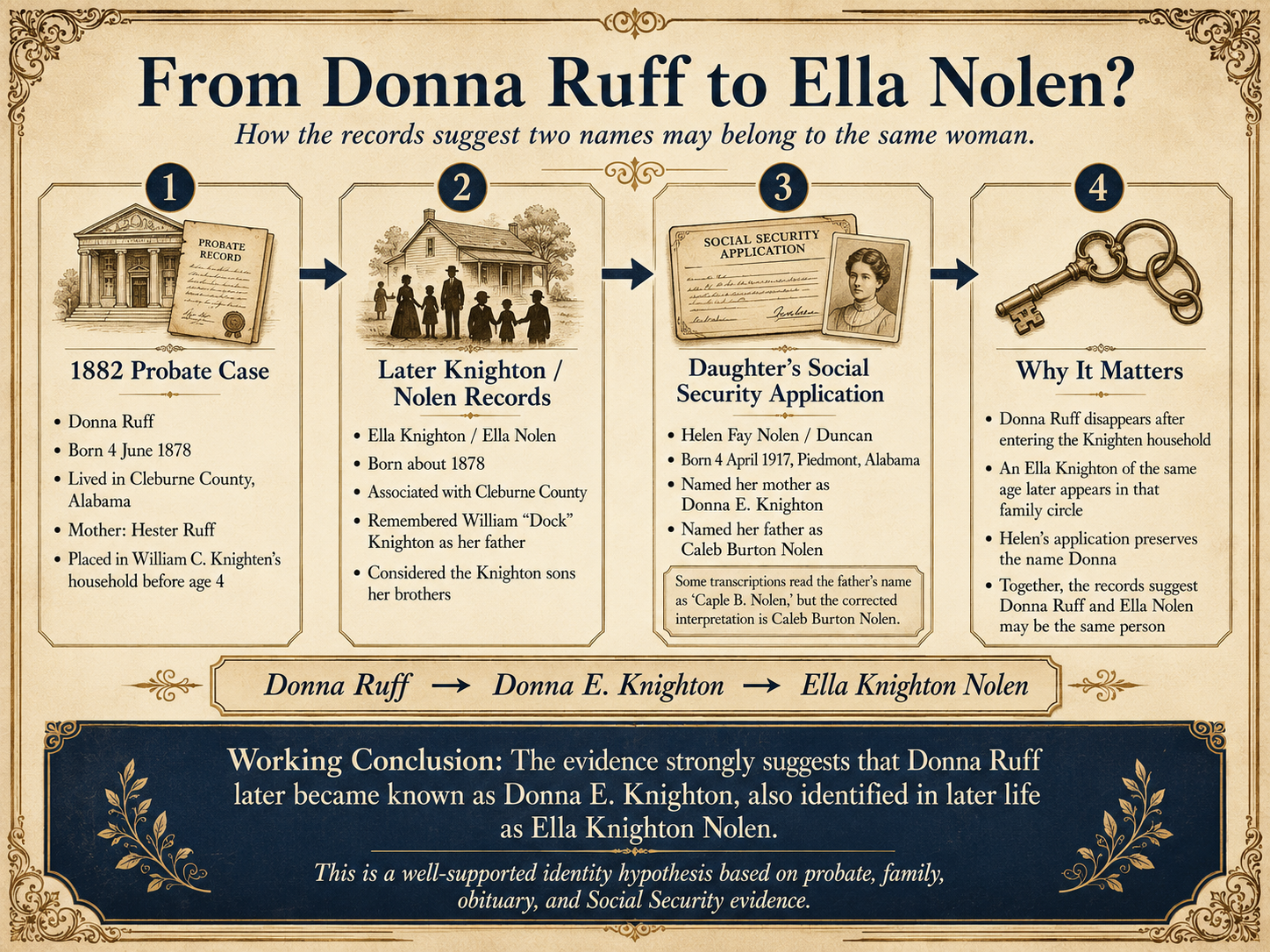
This raises several possibilities.
Ella may have been born as Donna Knighton and later used Ella as her everyday name. Her full name may have been Donna Ella Knighton, with the middle name eventually becoming the name by which she was best known. It is also possible that Donna and Ella were used interchangeably within the family, even though only one of those names appeared in most public records.
The record does not reveal what the middle initial E represented. Still, the possibility that it stood for Ella is difficult to ignore:
Donna E. Knighton
Ella Knighton Nolen
More importantly, the appearance of the name Donna brings us directly back to the little girl placed in William C. Knighten’s household in 1882.
That child was Donna Ruff.
A Direct Link Between the Two Identities
The Social Security record does not, by itself, state that Donna E. Knighton had originally been Donna Ruff. It does, however, create a direct bridge between the two identities.
The 1882 probate case tells us that:
- Donna Ruff was born in 1878.
- She lived in Cleburne County.
- Her mother was Hester Ruff.
- Before Donna turned four, she was placed under the care and control of William C. Knighten.
The later records tell us that:
- Ella Nolen was born about 1878.
- She was associated with Cleburne County.
- She considered William “Dock” Knighton her father.
- She regarded his biological sons as her brothers.
- Her daughter identified her not simply as Ella, but as Donna E. Knighton.
The combination is significant. The young Donna Ruff disappears from the records after being placed in the Knighten household, while an Ella Knighton of the same approximate age later appears as a member of that family. Helen’s Social Security record then supplies the missing given name by identifying her mother as Donna.
For the first time, the evidence suggests that Donna and Ella may not have been two different women. They may instead represent two names used by the same person.
Ella’s Death Record Adds Another Clue
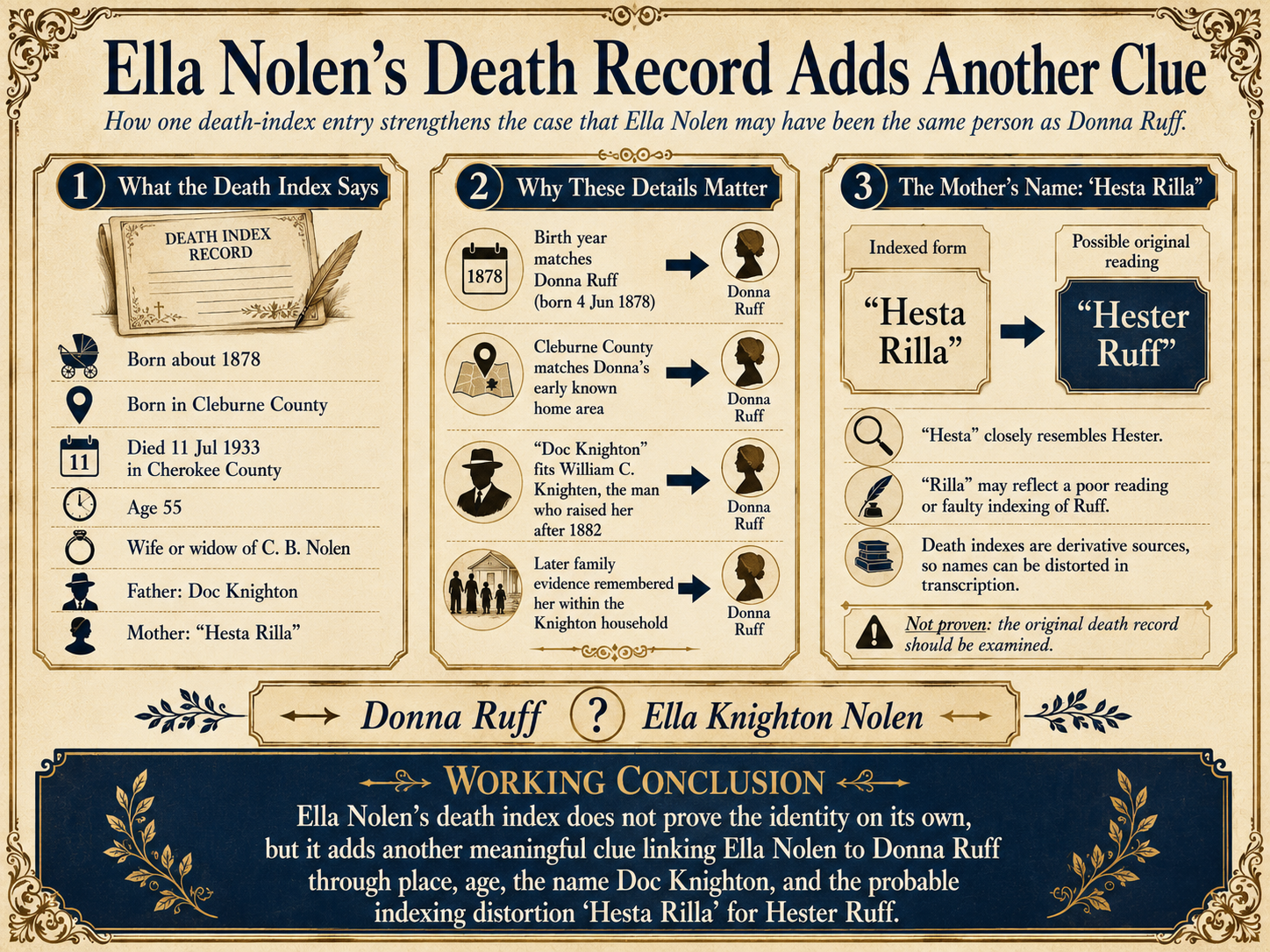
An entry in the Alabama Deaths and Burials Index provides an additional set of details concerning Ella Nolen.
The index records that Ella:
- was born about 1878;
- was born in Cleburne County;
- died on 11 July 1933 in Cherokee County;
- was fifty-five years old;
- was the wife or widow of C. B. Nolen;
- had a father named Doc Knighton; and
- had a mother recorded as Hesta Rilla.
The birth information closely matches what is known about Donna Ruff. Donna was born on 4 June 1878, probably in the Borden Springs or Palestine area, both within Cleburne County at that time.
The father’s name also agrees with Ella’s obituary. Doc Knighton was evidently William C. Knighten, the same man who took legal custody of Donna in 1882. This does not necessarily mean he was her biological father. It may instead show that, after raising her from early childhood, he was remembered within the family as her father.
The name of Ella’s mother is even more intriguing.
“Hesta Rilla” and Hester Ruff
The death index records Ella’s mother as Hesta Rilla. No woman by that exact name has yet been identified in the Knighton family.
The entry may be a faulty interpretation of a handwritten original. Death indexes are derivative sources: information was copied or extracted from earlier records, sometimes from difficult handwriting. Names were especially vulnerable to errors when the indexer was unfamiliar with the family.
“Hesta” closely resembles Hester, the known mother of Donna Ruff.
“Rilla” is less certain, but it could represent a badly interpreted or poorly written form of Ruff. A handwritten surname, especially one copied from a death certificate or family record, could easily have been misread during indexing.
The possibility is therefore:
Hesta Rilla = Hester Ruff
That reading cannot yet be treated as proven. The original death record, rather than the online index alone, would need to be examined to determine exactly what was written. Even so, the resemblance is meaningful when considered alongside all the other evidence.
The woman called Ella was born about 1878 in Cleburne County. Her father was recorded as Doc Knighton. Her daughter knew her as Donna E. Knighton. Her mother’s name was indexed in a form that may preserve a distorted version of Hester Ruff.
The Identity Begins to Take Shape
No single record completely resolves the question. The conclusion emerges from the way the records fit together.
Donna Ruff was placed with William C. Knighten before her fourth birthday. She then disappears under the Ruff surname.
Ella Knighton later appears within William’s family and is recognized as a sister to his sons. Her age and birthplace correspond with Donna’s. Her daughter identifies her as Donna E. Knighton. Finally, Ella’s death information appears to name a mother whose garbled identity may have been Hester Ruff.
Taken together, the evidence strongly suggests that the woman remembered publicly as Ella Knighton Nolen may have entered the Knighten household as Donna Ruff.
The remaining question is not simply whether Donna became a Knighton. It is how, when, and why the child called Donna Ruff came to live the rest of her life as Ella Nolen.
Following Donna Home
The surviving records never provide a single document that plainly states, “Donna Ruff later became Ella Knighton Nolen.” Instead, the answer emerges gradually, through records created at different times and for different purposes.
For now, the strongest interpretation of the evidence is that Donna Ruff and Ella Knighton Nolen were the same woman. Born into the Ruff family, Donna entered the Knighten household before her fourth birthday and appears to have grown up as one of their own. Within that family she became known as a daughter and sister, and at some point she came to use Ella as the name by which she was remembered publicly.
Her story also reminds us that family relationships were not always recorded in simple biological terms. William Knighten may not have been Donna’s birth father, yet later records called him her father. His sons may not have been her biological brothers, yet they were remembered as her brothers. Those descriptions reflect the family life Donna appears to have known after 1882.
The court papers began as a record of poverty and legal separation, written almost entirely in the voices of men. They tell us little about what Hester felt as her daughter was placed in another household, and they tell us nothing about Donna’s memories of her mother. Yet by following the records forward, Donna’s identity begins to reappear.
She did not vanish from history. She seems to have continued her life under another name—as Donna E. Knighton, better known to her family and community as Ella Knighton Nolen.
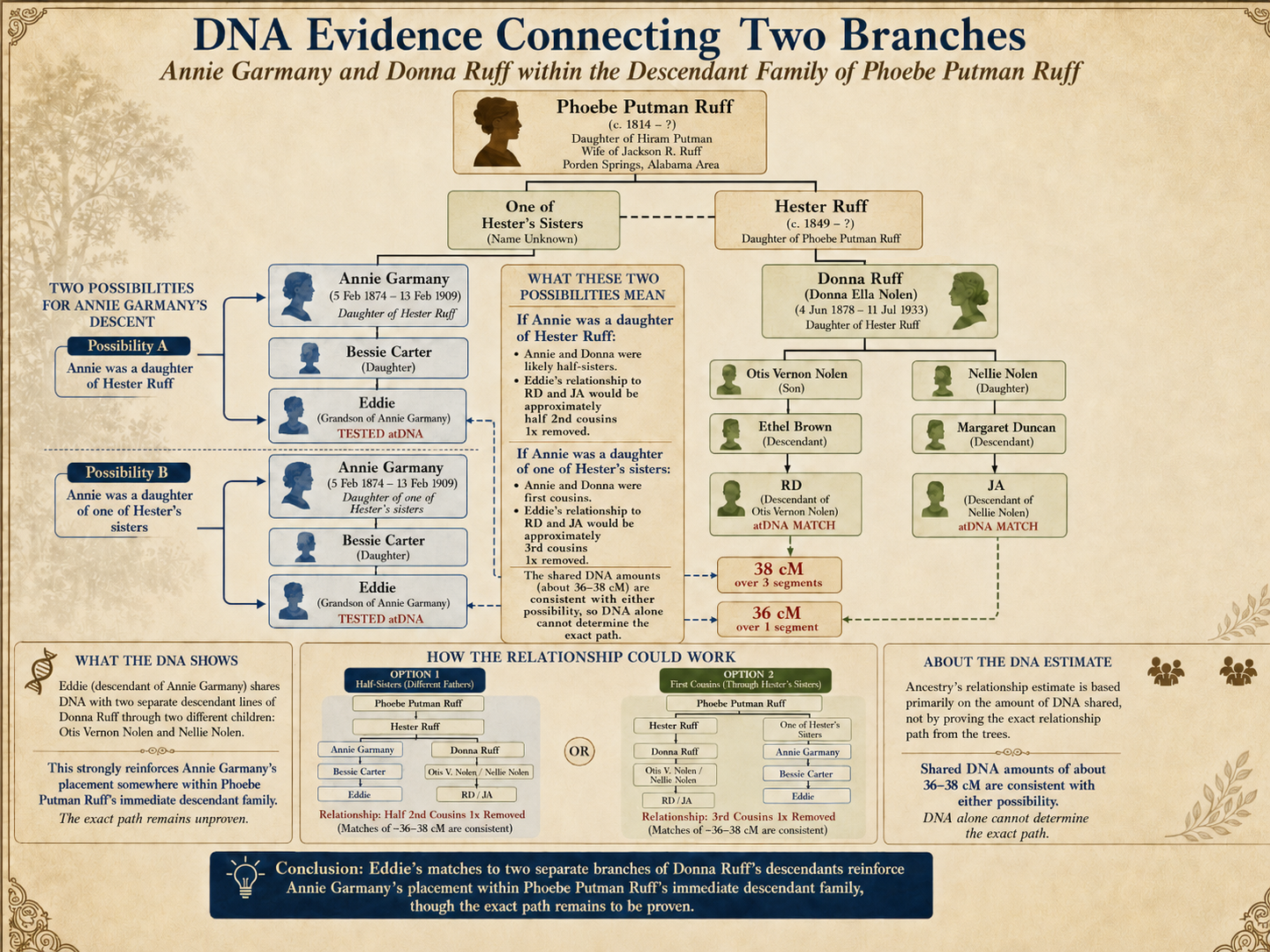
DNA Evidence Linking Annie Garmany and Donna Ruff
 digging our roots
Leave a comment