
Phoebe Putman was born circa 1814, probably in Barren County, Kentucky, near present day Tompkinsville. She was the daughter of Hiram Putman and Louanna Mercer.
Her mother’s given name has commonly been repeated in derivative family trees as Loamy or Louamy. However, a clearer entry in the 1866 Alabama State Census appears to record her as Louanna Putman and presently is the best supported reconstruction of her given name, while Loamy and Louamy are retained as variant forms.
Phoebe’s given name appears only a few times in the surviving records, and its spelling was not consistent. It has been recorded as Phieba, Feraba, and Ferby—forms that may look unrelated at first glance, but which fit a broader Southern pattern of phonetic spelling associated with the name Phoebe or its older form, Phebe.
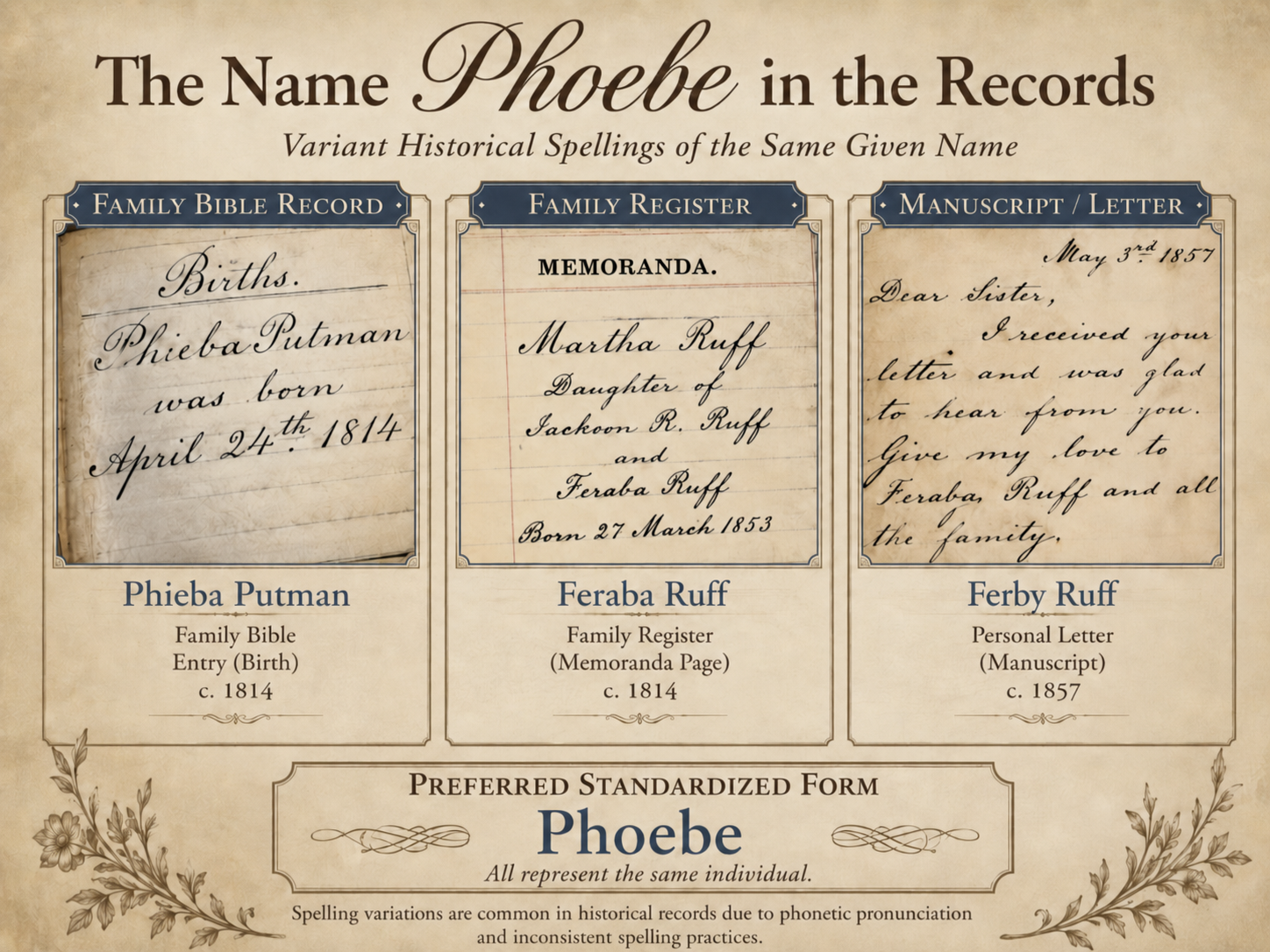
During the eighteenth and nineteenth centuries, clerks often wrote names as they heard them, especially when the individual could not provide or verify a preferred spelling. In Southern records, the opening “Ph” sound in Phoebe was frequently rendered as F, while local pronunciation could produce forms such as Pheby, Pherby, Ferby, Fereby, or Feraba. For that reason, the several spellings attached to Phoebe should not be treated as evidence of different women. Instead, they are best understood as phonetic attempts to record the same uncommon name.
There may also be a deeper family meaning behind the choice. Phoebe appears to have had a grandmother whose own name was styled in records as Fereby or a similar form. Although the evidence does not prove that the younger Phoebe was named for her grandmother, the resemblance is strong enough to make that possibility worth considering. Naming a daughter or granddaughter for an older female relative was a common family practice, and the continuation of this unusual name across generations may preserve a small but meaningful part of the family’s identity.
For this reason, Phoebe is used here as the preferred standardized form of her name, while Phieba, Feraba, and Ferby are retained as historical variants. This approach respects the spellings found in the original records without allowing inconsistent clerk renderings to obscure the identity of the woman herself. It also provides an important clue for future research: records concerning Phoebe or her grandmother may be found under any of these related phonetic forms.
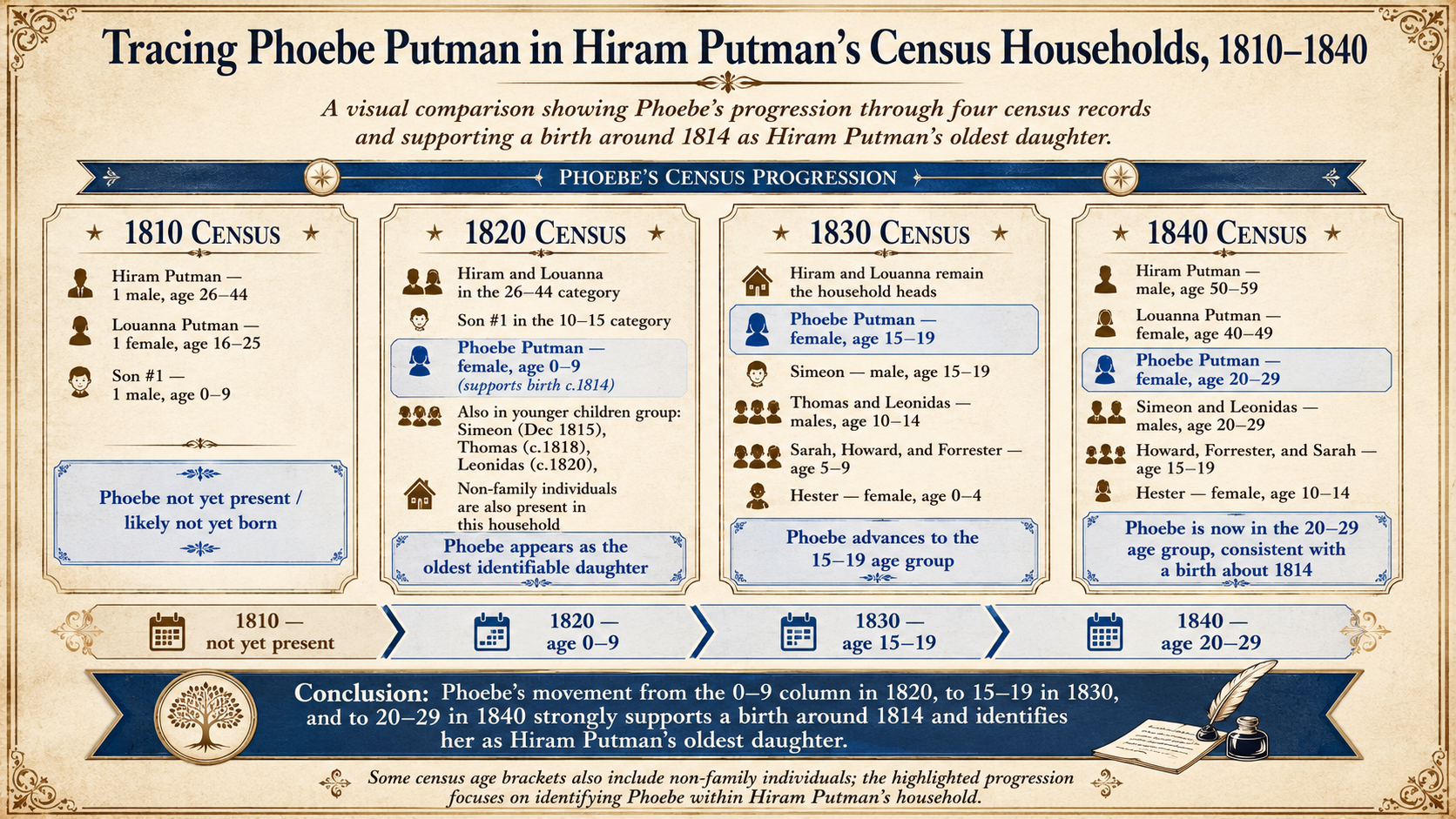
In conducting a comparative census analysis, it is strongly suggested that Phoebe Putman was born around 1814 and was the oldest daughter of Hiram Putman and Louanna Mercer Putman. Tracing the household across the 1820, 1830, and 1840 census records shows a consistent progression in the age category of the eldest identifiable daughter, moving from the 0–9 column in 1820, to 15–19 in 1830, and then to 20–29 in 1840. This pattern fits well with a birth about 1814 and aligns with Phoebe’s place in the family as the oldest daughter still in the household during those years. While early census records do not name each household member individually, the overall household structure and age progression provide strong evidence for identifying Phoebe within Hiram Putman’s family.
For generations, Phoebe Putman has been largely absent from published accounts and online family trees concerning the family of Hiram Putman and Louanna Mercer Putman. In many reconstructions of the family, she is omitted altogether, leaving the impression that she never existed. Yet the surviving records tell a different story.
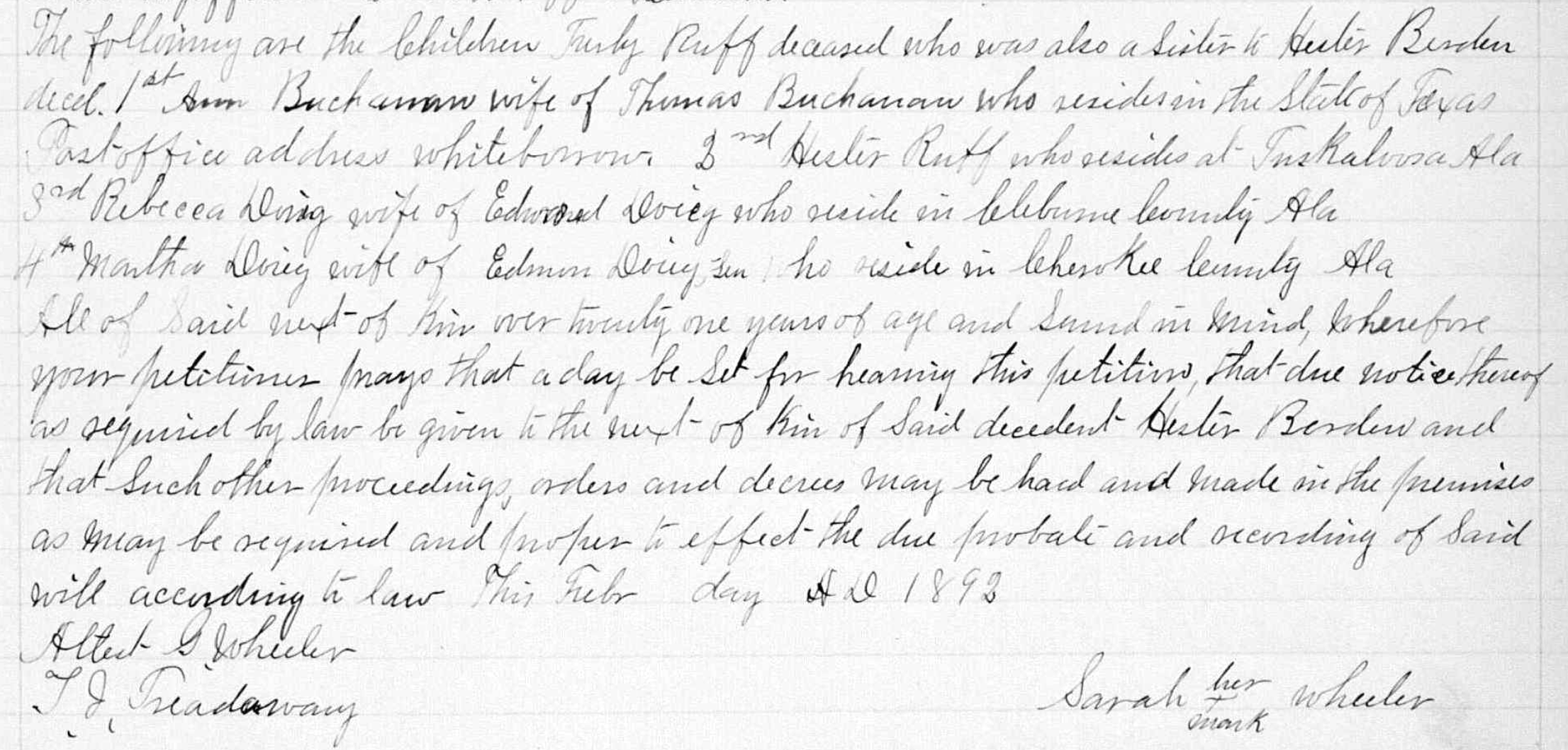
One of the most important pieces of evidence appears in an 1892 affidavit given by Sarah A. Putman Wheeler, a known daughter of Hiram and Louanna. The affidavit was submitted during the settlement of the estate of Sarah’s sister, Hester Putman Borden, and identifies Hester’s next of kin, together with their places of residence. Because Sarah was speaking from firsthand knowledge of her own family, her sworn statement carries far greater evidentiary value than later family histories or copied online trees.
This document provides direct family testimony connecting Phoebe to the Putman household. It identifies her as a sister of Sarah and Hester and therefore as a daughter of Hiram Putman and Louanna Mercer Putman. When considered alongside the census records that trace an unnamed eldest daughter through Hiram’s household in 1820, 1830, and 1840, the affidavit helps restore Phoebe to her rightful place in the family.
Phoebe was not truly missing from history; rather, her identity had been overlooked, obscured by early census records that named only the head of household and by later genealogies that repeated an incomplete list of Hiram and Louanna’s children. Sarah Wheeler’s affidavit allows Phoebe to be recognized once again—not as a speculative addition, but as a documented member of the Putman family.
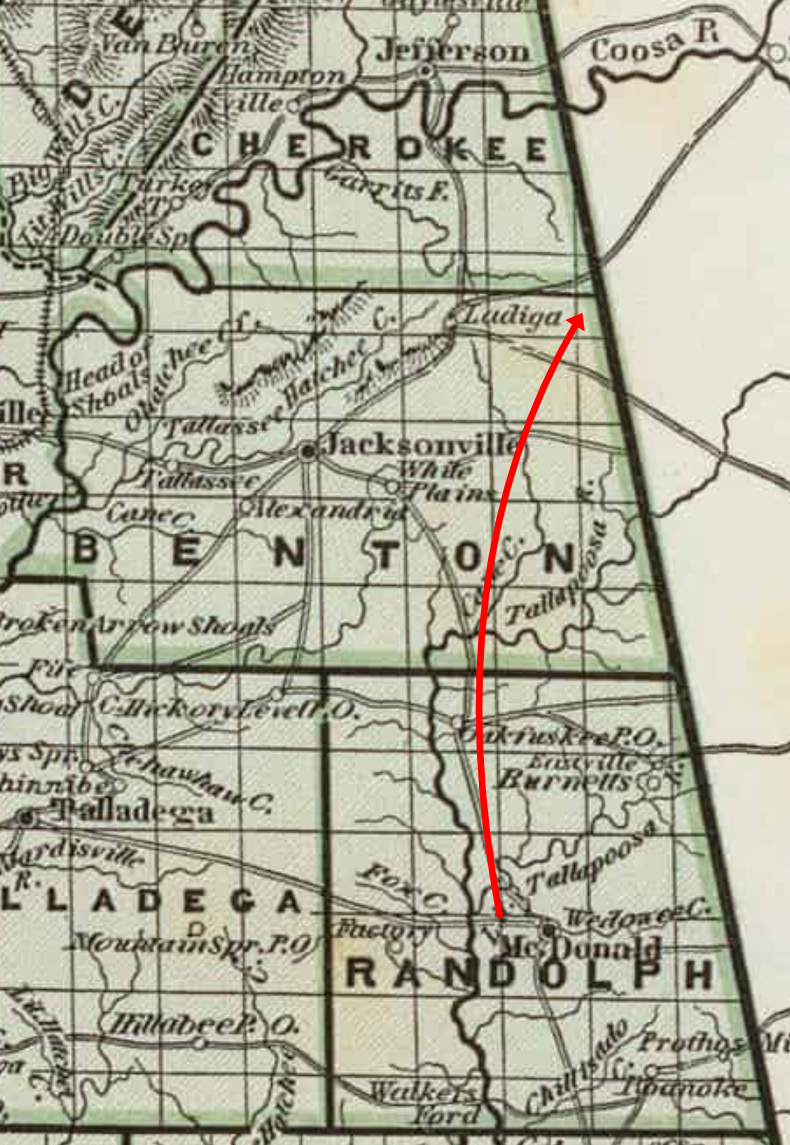
Phoebe Putman migrated with her parents to Hamilton County, Tennessee, in the late 1820s. By 1840, when she was about twenty-six years old, the family had moved again, this time to Randolph County, Alabama.
Their arrival came during a period of rapid change in eastern Alabama. Randolph County had only recently been formed from lands ceded by the Muscogee Creek Nation in 1832. During the years that followed, Creek families were dispossessed and forcibly removed westward, while American settlers moved into the newly organized county. Roads, farms, mills, churches, and small communities soon began appearing across a countryside that had long been home to Creek towns and settlements.
For the Putmans, the move south may have offered the promise of affordable land and a fresh beginning among relatives and neighboring families making the same migration. The wooded hills, fertile creek bottoms, and abundant springs of northeastern Alabama were well suited to small farms and livestock. Although no surviving record explains exactly why Hiram Putman chose Randolph County, the family’s move followed a broader migration route used by settlers traveling from Tennessee, Georgia, and the Carolinas into newly opened areas of eastern Alabama.
Around 1841, Phoebe is believed to have married Jackson R Ruff. No marriage license has yet been located, but the marriage likely occurred in Alabama. By about 1844, the couple appears to have moved with members of the Putman family to the Borden Springs area of Benton County, just north of Randolph County.
Phoebe’s husband was most often identified in historical records simply as J. R. Ruff.
In the 1860 census, while the family was living near Heflin in what later became Cleburne County, his given name appears to have been written as “Jeffr” leading many family historians to assume that his full name was Jefferson Ruff.
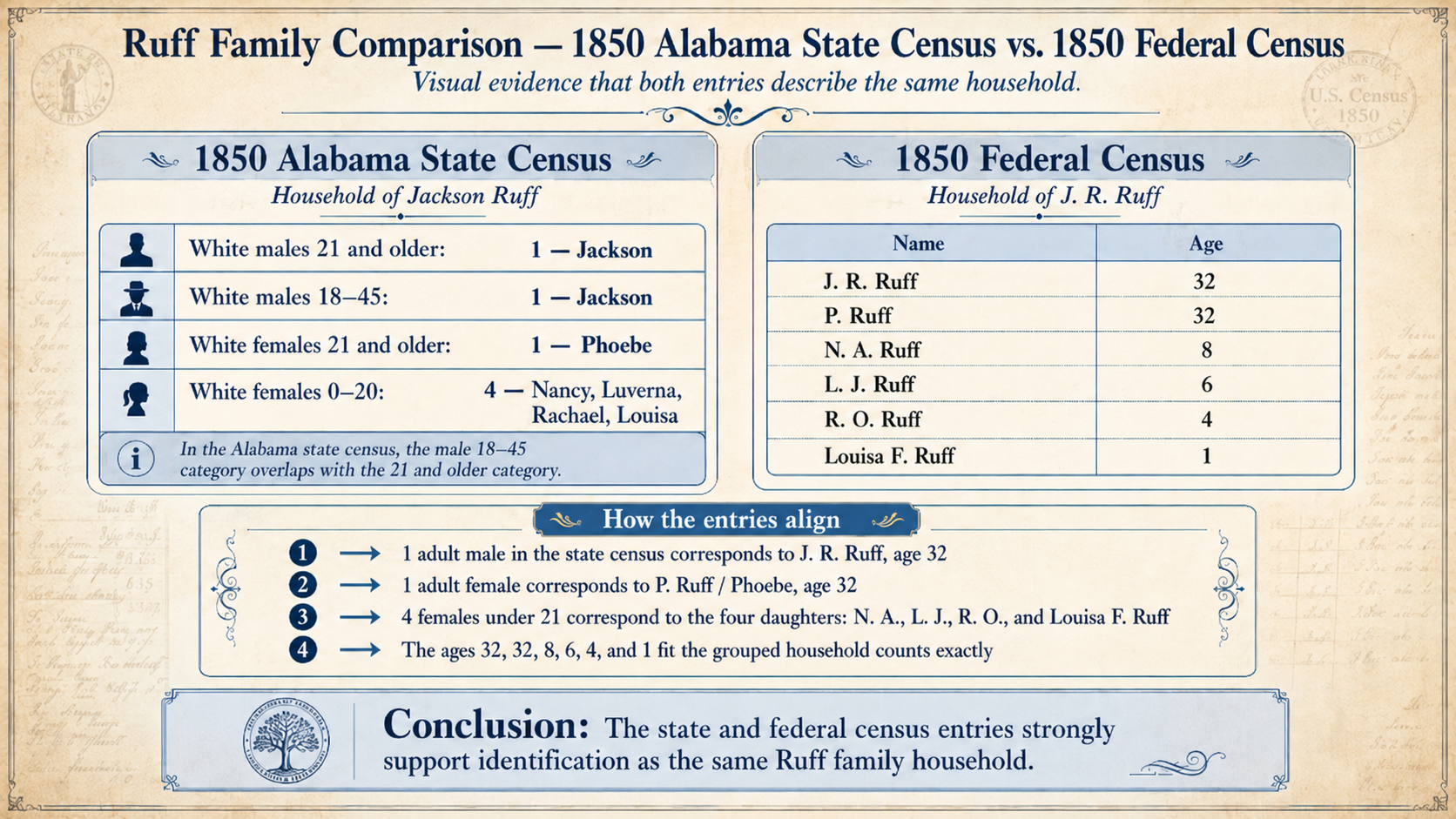
However, a comparison of the family’s 1850 Federal Census household with the 1850 Alabama State Census for Benton County strongly suggests that the same man was recorded there as Jackson Ruff.
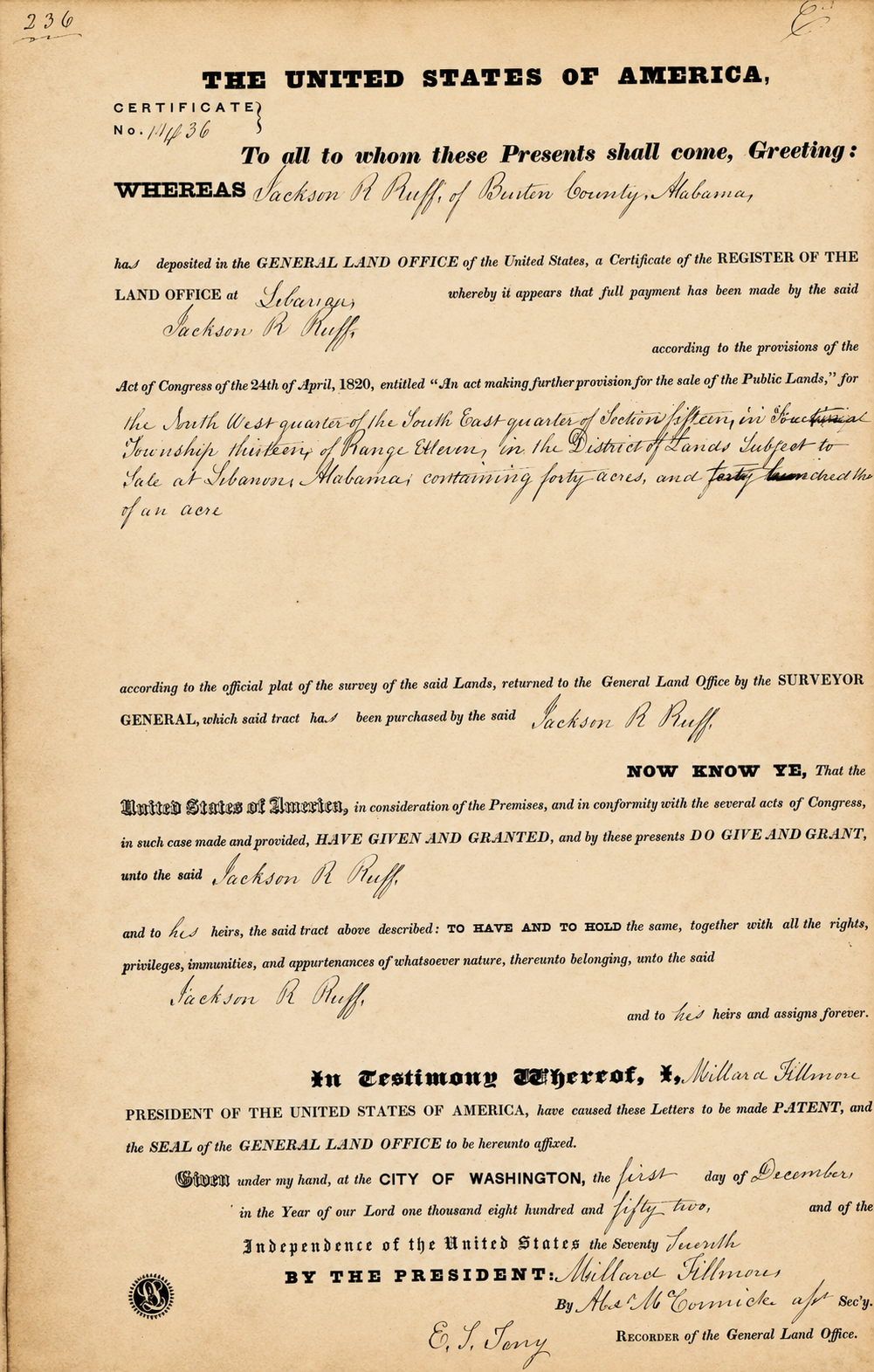
That identification is further supported by a BLM GLO cash-sale patent issued to Jackson R. Ruff on 1 December 1852 in Benton County, Alabama, for 40.4 acres described as the NW¼ of the SW¼ of Section 15, Township 13 South, Range 11 East.
This tract lay on Terrapin Creek, just south of the present-day location of the Borden Springs Hotel site and Putman Springs, placing Jackson R. Ruff in exactly the area where the Putman family had settled. Taken together, these records strongly support Jackson R. Ruff as Phoebe’s husband, while the name Jefferson appears to be a later interpretation of the abbreviated 1860 census entry.
It appears that Phoebe’s husband, Jackson R. Ruff, died sometime between the 1866 Alabama state census and the 1870 federal census. In 1866, the household still included an adult male consistent with Jackson, but by 1870 Phoebe Putman Ruff was enumerated without him and was living with three of her daughters. Although no death record has yet been located, the change in household composition strongly suggests that Phoebe had been widowed during those four years.
Phoebe Putman Ruff herself may have died sometime between 1870 and 1880, although this remains unproven. The circumstances surrounding Annie Garmany, a young girl believed to have belonged to Phoebe’s immediate family line, provide an important clue. Annie was reportedly born on 4 February 1874 and is believed to have been the daughter of one of Phoebe’s daughters. By 1880, Phoebe no longer appears in the census, while young Annie was living in the household of Phoebe’s youngest sister, Hester Putman Borden.
The larger family story may be one of relatives stepping in during a time of loss or disruption. Hester’s care of Annie suggests that the extended Putman family remained closely connected and that, when Annie’s mother or grandmother was no longer able to care for her, responsibility passed to another woman within the family. This arrangement does not prove that Phoebe had died, nor does it identify Annie’s mother, but it supports the possibility that Phoebe was no longer living—or was otherwise unable to provide care—by 1880. Hester’s household may therefore preserve more than a census entry; it may reflect the family’s effort to protect and raise a young child after an earlier generation had begun to disappear.
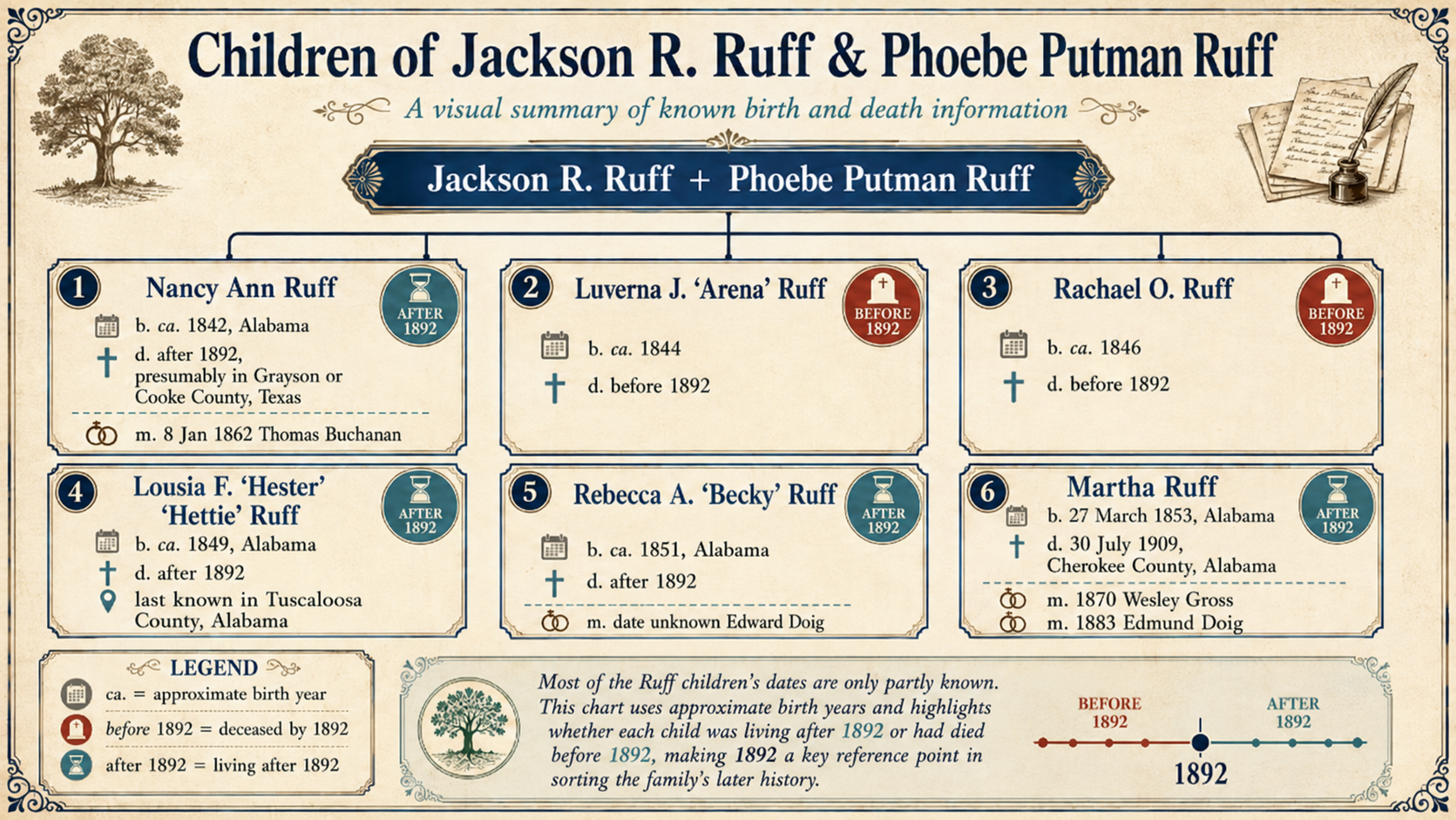
Jackson R Ruff and Phoebe Putman Ruff had the following children:
Nancy Ann Ruff, b. ca. 1842, Alabama; d. after 1892 presumably in Grayson or Cooke County, Texas
Luverna J ‘Arena’ Ruff, b. ca. 1844, d. before 1892
Rachael O Ruff, b. ca. 1846, d. before 1892
Lousia F ‘Hester’ ‘Hettie’ Ruff, b. ca 1849, Alabama; d. after 1892; last known to be in Tuscaloosa County, Alabama
Rebecca A ‘Becky’ Ruff, b. ca 1851, Alabama; d. after 1892
Martha Ruff, b. 27 March 1853, Alabama; d. 30 July 1909, Cherokee County, Alabama
DNA Evidence Connecting Phoebe Putman to Annie Garmany
The surviving records restore Phoebe Putman to the family of Hiram Putman and Louanna Mercer Putman, but they do not answer every question about what became of her descendants. One of the most important remaining questions concerns Annie Garmany, born in 1874. Annie was later raised in the household of Phoebe’s youngest sister, Hester Putman Borden and further identified as Hester’s second niece, suggesting a close family connection. Because Annie’s mother has not yet been conclusively identified in the written record, autosomal DNA offers another way to examine the problem.
Autosomal DNA is inherited from all branches of the family tree. With each generation, the amount passed down becomes smaller and more irregular because DNA is randomly divided and recombined. This means that distant cousins do not all share the same amount of DNA, even when their documented relationships are identical. Nevertheless, when several descendants from different branches of the same family are compared, patterns can sometimes emerge.
For this study, DNA matches from the author, and his great-uncle Eddie were compared with known descendants of several children of Hiram and Louanna Putman: Phoebe Putman, Forrester Putman, Howard Putman, Thomas Putman, and Sarah Putman. Hester had no known children. Eddie is particularly useful in the comparison because he stands two generations closer to the common ancestors and would generally be expected to retain more of their DNA than the author.
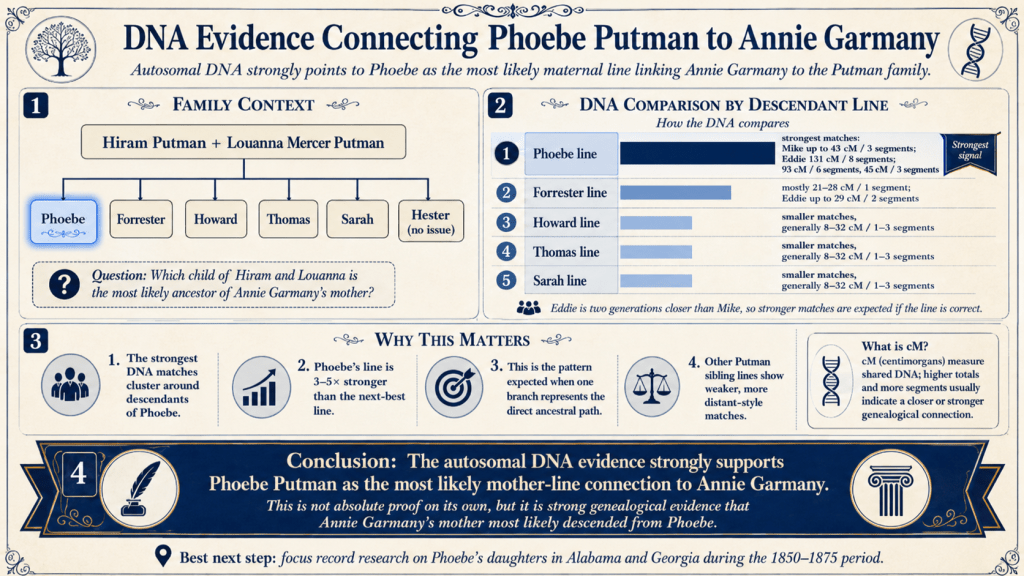
The most noticeable pattern appears among descendants of Phoebe. The author shares as much as 43 centimorgans across three segments with a match from that line. Eddie’s results are considerably stronger, including matches of 131 centimorgans across eight segments, 93 centimorgans across six segments, and 45 centimorgans across three segments. A centimorgan, usually abbreviated cM, is a unit used to measure the amount of DNA shared between two people. In general, a larger total and a greater number of meaningful segments suggest a closer or more strongly represented genealogical connection.
The matches descending from Hiram and Louanna’s other children are generally smaller. The strongest comparisons from Forrester’s line are mostly in the range of about 21 to 29 centimorgans, usually across only one or two segments. Matches through Howard, Thomas, and Sarah are also generally lower, most often between approximately 8 and 32 centimorgans across one to three segments. Those results are compatible with descent from the broader Putman family, but they do not show the same concentration seen among Phoebe’s descendants.
This difference is important. If Annie’s connection to the Putmans came only through a sibling of Phoebe, the DNA results might be expected to look more evenly distributed among the various descendant branches. Instead, the strongest and most repeated matches cluster around Phoebe’s line, especially in Eddie’s results. That pattern is consistent with Phoebe being more closely connected to Annie’s mother than the other Putman siblings.
The DNA does not identify Annie’s mother by name, nor can it independently prove the relationship. Shared DNA may sometimes reflect more than one ancestral connection, particularly among families that lived in the same communities and intermarried over several generations. Full chromosome comparison and triangulation would strengthen the case by showing whether several matches inherited the same DNA segments from the same ancestral line.
Even with those limitations, the present evidence points in a clear direction. The documentary record places Annie within Phoebe’s immediate family circle, while the DNA results show notably stronger connections to descendants of Phoebe than to descendants of her brothers and sisters. Taken together, the evidence supports the working conclusion that Annie Garmany’s mother was most likely a daughter of Phoebe Putman Ruff.
This does not close the case, but it narrows the search. Future research should focus on Phoebe’s daughters, their movements and relationships between about 1865 and 1875, and any court, church, guardianship, marriage, or family records that might explain how Annie came to be raised by Hester Putman Borden.
 digging our roots
Leave a comment