
Was Job Smith connected to the Smith Clan by blood, through close neighborly ties, or simply by coincidence? Could his origins or lineage differ from the commonly understood branches of the Smith family tree, raising questions about how he fits into the broader family history?
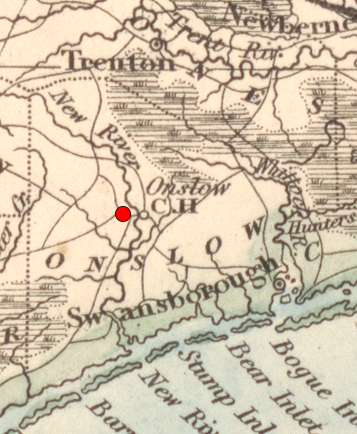
Job Smith was born on 12 October 1750, near Smith’s Creek in Onslow County, North Carolina (Houston County, Georgia; Court Minutes, 1828-1831, pg. 112). Smith’s Creek was located on the south side of the Northwest Branch of the New River, just west of present day Jacksonville, North Carolina.
Job Smith is believed to be the son of Nathaniel Smith and Elizabeth Smith (maiden name unknown).
He likely spent his early years on his father’s plantation in Onslow County. This connection is supported by the 1769 Onslow County Tax List, where Nathaniel Smith paid poll taxes for himself and his two sons, likely including Job Smith.

In 1770, Nathaniel Smith was listed on the poll tax rolls, claiming his sons Jacob Smith, Job Smith, and Darden Smith. At the time, the taxable age for free males in North Carolina was 16, indicating that all three sons had reached or surpassed this age by 1770. This record highlights Nathaniel’s role as head of the household and provides valuable insight into the ages and presence of his sons during this period.

In June 1775, in response to growing tensions and the need to defend against British aggression, the Continental Congress authorized the formation of the Continental Army, with each colony tasked with raising regiments to support the war effort.
In April 1776, the North Carolina Provincial Congress expanded its contributions by authorizing the creation of additional Continental Line regiments, including the Sixth North Carolina Regiment on April 19, 1776. John Baptista Ashe was commissioned as a Captain in the 6th Regiment. To meet recruitment needs, Congress also empowered local recruiting officers to travel across counties to enlist men into these new regiments, ensuring North Carolina could meet its commitments to the Continental Army.
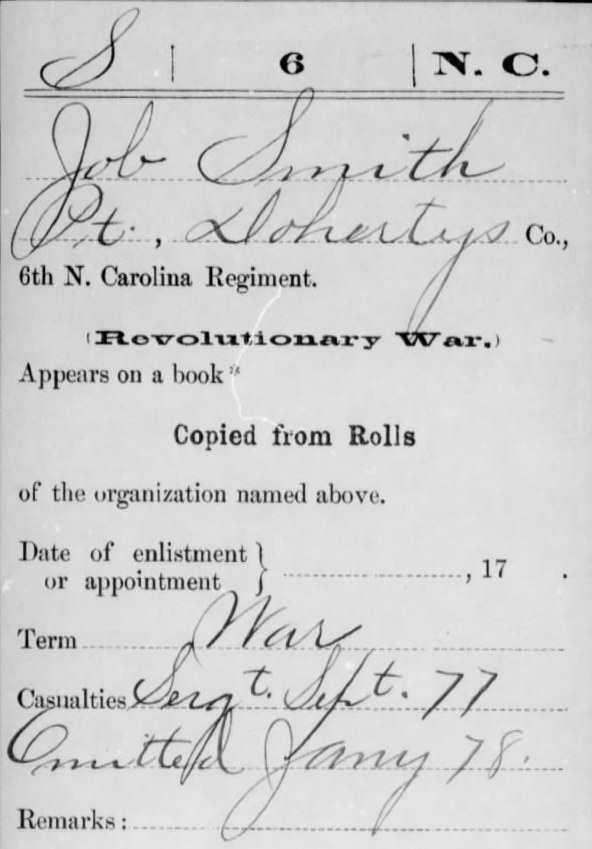
During the summer of 1776, as part of recruiting efforts in Onslow County, North Carolina, Job Smith, age 26 and living west of the New River, enlisted in the Continental Army. By November of that year, he was assigned to the Sixth North Carolina Regiment under the command of Captain George Doherty in the North Carolina Line.
In the spring of 1777, Job Smith marched with the Sixth Regiment to Halifax, North Carolina, where they joined the Main Continental Army as part of a brigade commanded by General Francis Nash. On July 8, 1777, the Sixth Regiment officially became part of the North Carolina Brigade, a key element of the Main Continental Army.
From Halifax, the regiment began a long journey northward. They marched for nearly two weeks to Georgetown, Maryland (now part of Washington, D.C.), and from there continued for another week to Brandywine Creek, Pennsylvania. On September 11, 1777, Job Smith and his regiment saw limited action during the Battle of Brandywine. Records suggest that Job sustained an injury or fell ill during this campaign, as indicated by his accompanying roll card.
About a month later, the North Carolina Brigade participated in the Battle of Germantown, near Philadelphia, as part of a larger effort by the Continental Army. Following this battle, the brigade joined other Continental Army units at Valley Forge, Pennsylvania, establishing their winter encampment on December 19, 1777. The harsh winter of 1777-1778 at Valley Forge was marked by extreme shortages of food, clothing, and shelter, testing the resolve of the army.
In January 1778, Job Smith was “omitted” from the muster rolls, likely due to the injuries or illness he suffered during the campaign in September 1777. It is presumed that he returned home to Onslow County, North Carolina, around this time. While Job may have briefly stayed at Valley Forge in late December 1777 or early January 1778, his departure before the end of winter could explain why his name does not appear on the official Valley Forge Muster Rolls.
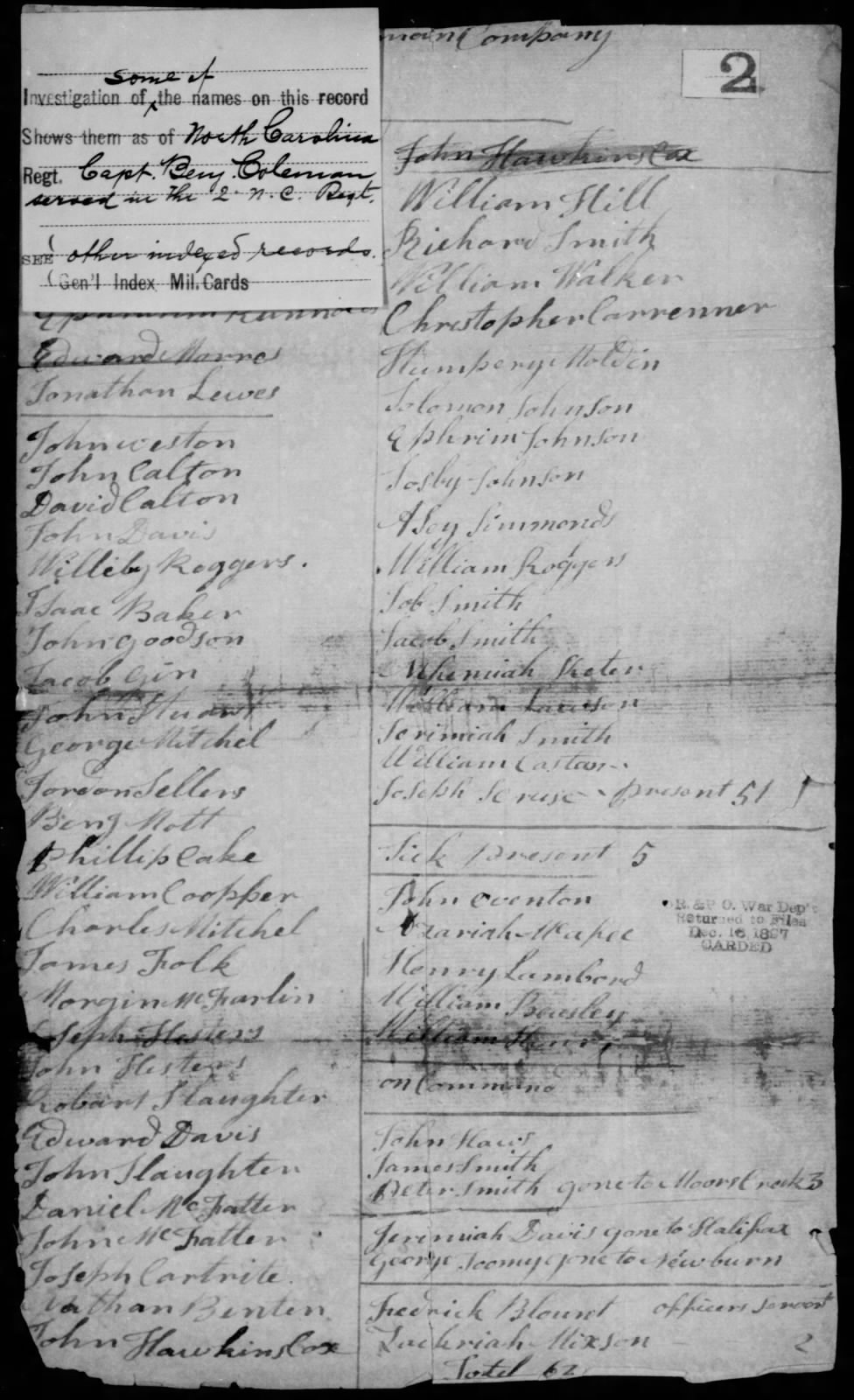
Despite his earlier injury or illness, Job Smith recovered and remained active in the Continental Army. By March 1779, he was reassigned to Captain Benjamin Andrew Coleman’s Company in the Second North Carolina Regiment.
Job Smith appears on the muster rolls of the Second Regiment alongside Jacob Smith and Jeremiah Smith. Jacob is believed to be Job’s brother, while Jeremiah is thought to be a relative, possibly an older brother as he lived on adjoining property to Nathaniel Smith on Smith’s Creek.
In November 1779, Job Smith, along with Coleman’s Company of 29 men, marched first to Wilmington, North Carolina, and then to the Saltketcher River (now known as the Salkehatchie) in South Carolina before arriving in Charleston, South Carolina. There, they joined the forces defending Charleston during the Siege of Charleston. The company remained on the outskirts of the city until the summer of 1780, when they marched back to Wilmington, North Carolina. Following the disbanding of Coleman’s Company, Job returned home to Onslow County.
It appears that Job Smith and his brother Jacob Smith stayed in Onslow County for several years after the end of the American Revolution. Meanwhile, their father, Nathaniel Smith, and his wife, Elizabeth, had relocated to Craven County, where they acquired a 150-acre tract of land south of the Trent River (Craven County DB 20:168). This area later became part of Jones County after its formation in 1779. Further research is ongoing to explore this transition and its implications for the Smith family.
Around 1783, Job Smith married Lucretia Wilder, the daughter of John Wilder, a well-known resident of Onslow County and a friend of the Smith family. On June 25, 1776, John Wilder conveyed 100 acres on Gum Branch, a tributary of the Northeast River, to his friend Jacob Smith. This transaction was witnessed by Henry Harier and Nathaniel Smith (Onslow DB K:9, as recorded in Abstracts of the Records of Onslow County, North Carolina, 1734-1850, Vol. 1 by Zae Hargett Gwynn).
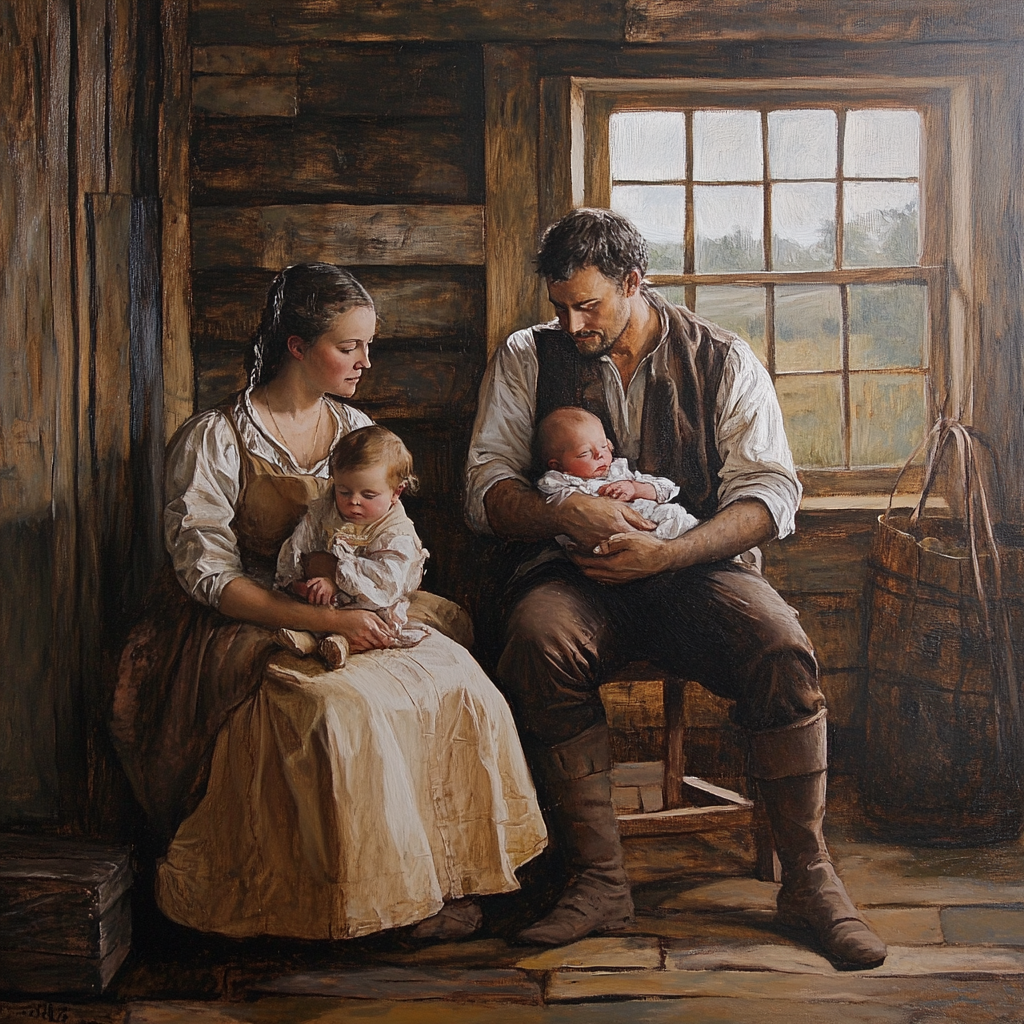
By 1784, Job and Lucretia welcomed their first child, a daughter whose name remains unknown to this day. Two years later, around 1786, they celebrated the birth of their second child, and their first son, believed to be Samuel Robinson Smith. These early years marked the beginning of Job and Lucretia’s expanding family in Onslow County, North Carolina, where they began to establish their legacy and raise their children amidst the close-knit communities of the region.
By 1786, it seems that Nathaniel Smith and his wife, Elizabeth Smith, had returned to the Onslow County area, based on local records. County documents indicate that Nathaniel Smith likely passed away in the spring of 1788, as his estate records appear in Onslow County during that time.
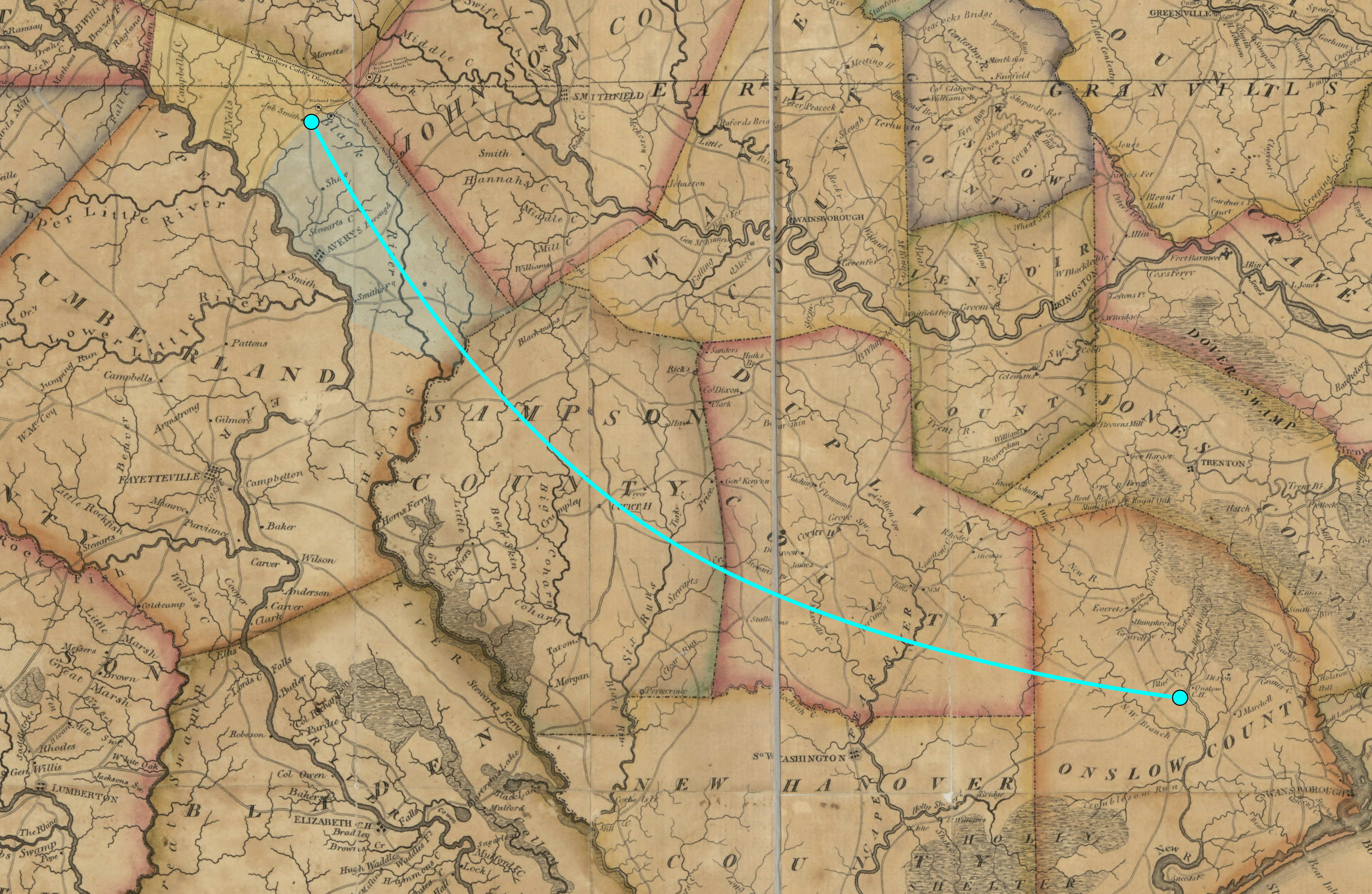
By 1788, Job Smith, Jacob Smith, and John Wilder moved to Cumberland County, North Carolina.
In 1787, John Wilder bought a 500 acre tract of land on Black River from Hardy Smith Sr. The deed states that John Wilder was “of Wake County,” indicating that this was likely a transitional residence for him before his permanent relocation to the Black River area. (Cumberland DB 11:6)

Over the following decade, Job Smith and Jacob Smith began acquiring property along the Sprowles Ferry Road, a well-traveled route that played a vital role in connecting Wake and Johnston Counties to the Cape Fear River, facilitating commerce and settlement in the region. Their strategic land acquisitions suggest an intent to capitalize on the economic opportunities afforded by this important corridor.
| Name | Year | Acreage | Instrument | Sold To | Year | Instrument |
| Jacob Smith | 1787 | 200A | DB 9:458 | Philemon Hodges | 1789 | DB 14:414 |
| Jacob Smith | 1789 | 150A | Grant 2253 | Philemon Hodges | 1789 | DB 14:414 |
| Jacob Smith | 1789 | 116A | Grant 2279 | Philemon Hodges | 1789 | DB 14:414 |
| Job Smith | 1790 | 100A | DB 14:312 | Abraham Hogins | 1804 | DB 20:316 |
| Job Smith | 1791 | 400A | DB 12:418 | Abraham Hogins | 1804 | DB 20:316 |
| Job Smith | 1796 | 50A | Grant 3001 | |||
| Job Smith | 1796 | 150A | Grant 3002 | Abraham Hogins | 1804 | DB 20:316 |
| Lucretia Smith | 1800 | 300A | Fathers LWT | Creed Collins | 1801 | DB 18:422 |
| Lucretia Smith | 1800 | 161.5A | Fathers LWT | Creed Collins | 1801 | DB 18:423 |
| Job Smith | 1800 | 150A | Grant 3783 | James Gilbert | 1801 | DB 18:442 |
| Job Smith | 1802 | 150A | Grant 4113 |
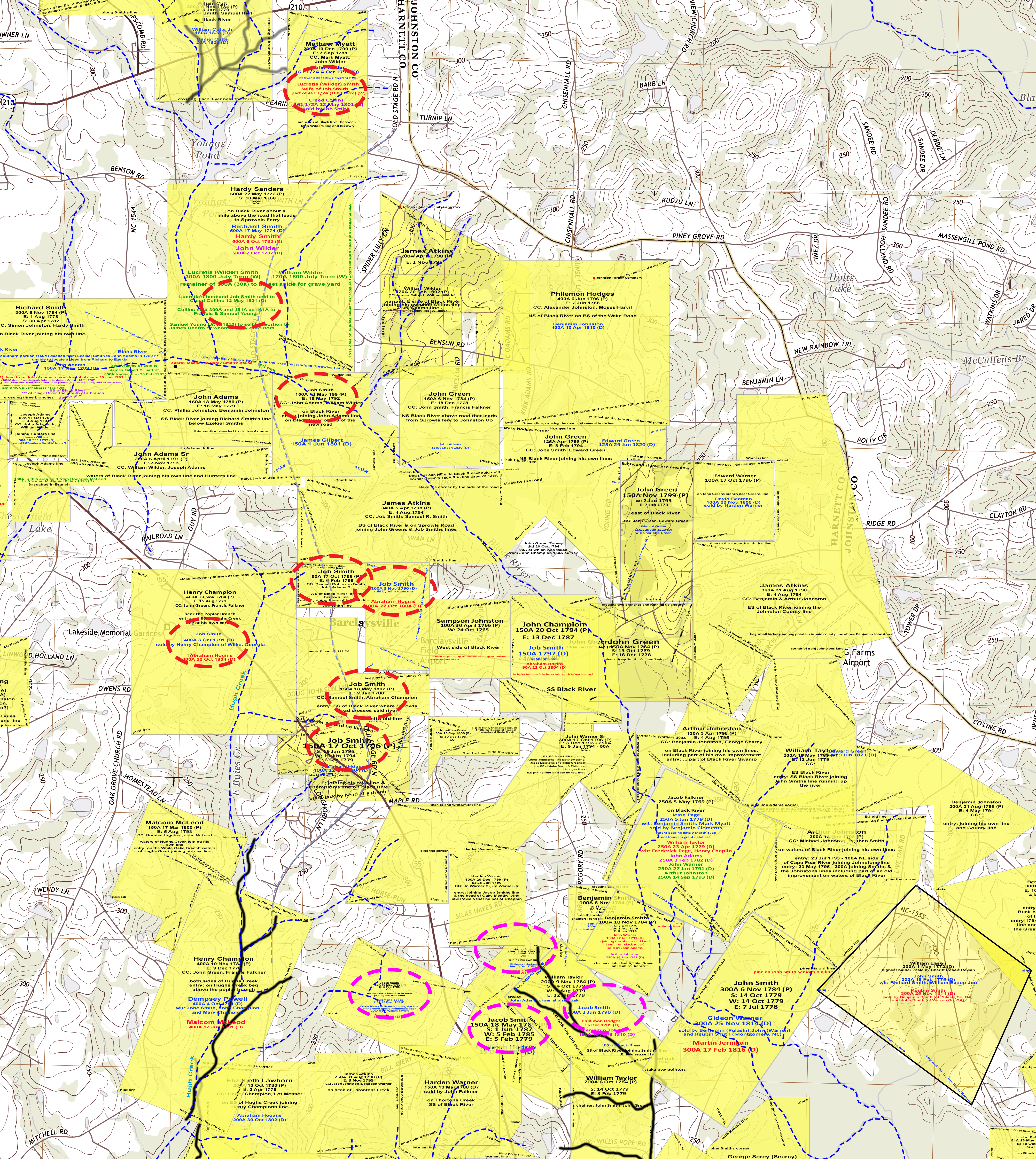
There are several intriguing connections and unanswered questions surrounding these land events, adding to the mystery of the Smith and Wilder families.
The deed from Hardy Smith Sr to John Wilder was witnessed by Jacob Smith and John Green. It seems likely that Jacob Smith was representing his family’s interests, while John Green may have acted on behalf of Hardy Smith Sr. The possibility of a familial connection between John Green and the Smith family adds another layer of complexity. For instance, John Green might have married a cousin of Hardy Smith Sr or perhaps a sister of John Smith. This raises the question: were these witnesses chosen solely for convenience, or do they reflect deeper family ties?
Adding to the mystery, was it mere coincidence that the Smith/Wilder group’s first documented transaction in Cumberland County involved a member of the Smith family linked to the J-M267 haplogroup? The author has identified several atDNA matches to descendants of Job Smith. If these connections can be accurately traced, it opens the possibility that his brother Jacob Smith could also share a Y-DNA match with the Jacob Smith who later migrated to Conecuh County, Alabama. Could these genetic ties be the key to unraveling this family puzzle?
Further complicating the narrative, in 1787, Jacob Smith executed his first deed from William Taylor, with John Green and John Smith as witnesses. At first glance, this may appear coincidental: John Smith was an adjoining landowner, and John Green may have had connections to the Smith family. However, when viewed alongside the other correlations, these details suggest there may be more to the story than meets the eye. The question remains: are these events coincidences, or do they point to a deeper network of family relationships waiting to be uncovered?

In the 1790 U.S. Census for Cumberland County, North Carolina, Job Smith’s household is recorded as including 1 male under the age of 16 and 3 females. The young male is most likely Samuel R. Smith, Job and Lucretia’s first son. The three females in the household are likely Lucretia Smith (Job’s wife), their oldest daughter, who was born around 1784, and Elizabeth Ann Smith, who is believed to have been born in April 1790, just prior to the census enumeration. This snapshot not only highlights the early structure of Job Smith’s family but also provides valuable clues about their ages and relationships during this time period.
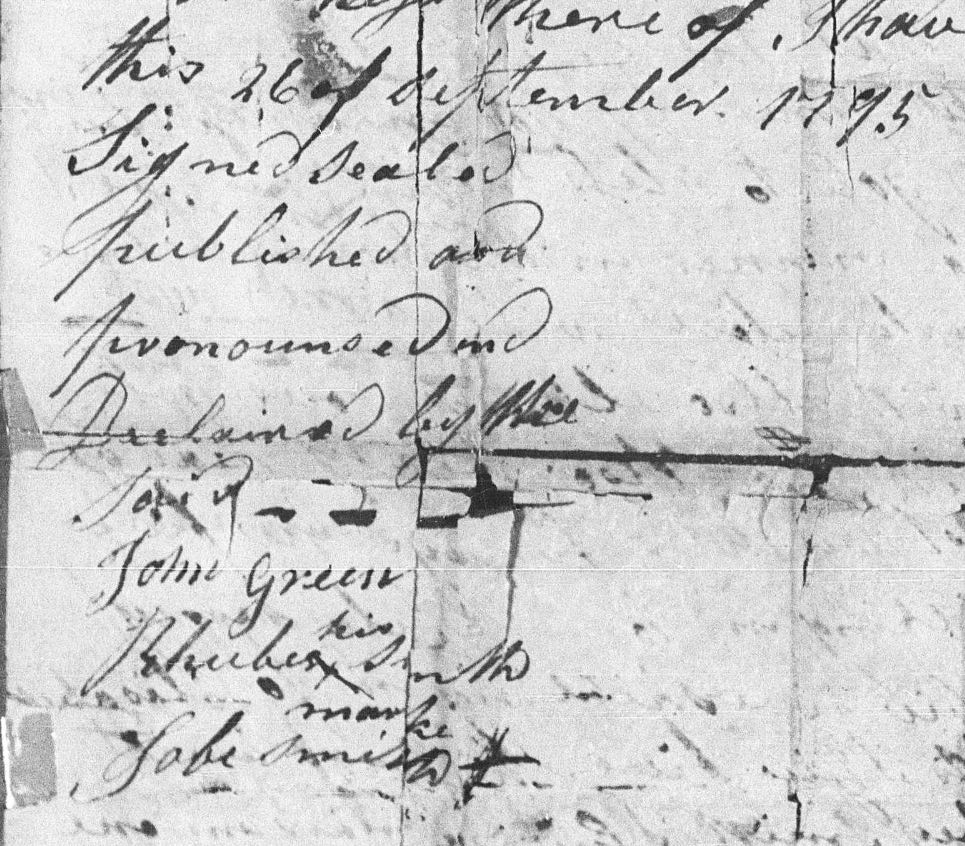
In September 1795, Job Smith served as a witness to the Last Will & Testament of John Smith Sr and signed the document. The following month, during the October 1795 court term, Job Smith appeared in open court to provide his oath and formally prove the validity of the will.
While Job Smith and John Smith Sr living near one another could suggest that Job’s involvement was simply a matter of convenience, the circumstances point to a potentially deeper connection. Job’s role as a witness, alongside John Green and Reuben Smith (John’s son), combined with his responsibility for proving the will in court, suggests a relationship beyond that of mere neighbors. In close-knit communities, these roles were often entrusted to family members or close associates who were both reliable and familiar with the testator’s intentions. This raises the question: was Job Smith chosen purely out of proximity, or does this indicate a familial tie to John Smith Sr?
In the 1800 U.S. Census for Cumberland County, North Carolina, Job Smith’s household is recorded with a total of 9 members. This includes 1 male aged 10 to 15, who is likely Samuel R. Smith, and 1 male aged 45 and over, presumed to be Job Smith himself. Among the females, there are 4 under the age of 10, likely Job and Lucretia’s younger daughters, 1 female aged 10 to 15, who could be Elizabeth Ann Smith, and 1 female aged 16 to 25, believed to be their oldest daughter born around 1784. The household also includes 1 female aged 26 to 44, presumed to be Lucretia Smith, Job’s wife.
In the 1810 U.S. Census for Captain Mac Cranie’s District, Cumberland County, North Carolina, Job Smith’s household is recorded with a total of 8 members, providing valuable insights into his family and their place of residence. The census lists 2 males under the age of 10, who are presumed to be Job Elbert Wilder Smith and Jeremiah B. Smith, indicating that both sons were likely born in Cumberland County during the early 1800s. The household also includes 1 male aged 45 and over, almost certainly Job Smith himself.
Among the females, there are 3 aged 10 to 15, likely representing Job and Lucretia’s older daughters who had been born during the 1790s while the family resided in Cumberland County. Additionally, there is 1 female aged 45 and over, presumed to be Lucretia Smith, Job’s wife and the matriarch of the household.
Job Smith was last recorded in Cumberland County, North Carolina, on the 1815 tax list. Around 1818, he relocated his family to Washington County, Georgia, settling near the Great Ohoopee River. Interestingly, the family of Edward Cross, who had been adjacent neighbors to Job Smith in Cumberland County, also moved to Washington County during this time. Edward Cross is believed to have married Elizabeth Ann Smith, who is thought to be Job Smith’s daughter, born in April 1790, making her approximately 28 years old in 1818. This challenges several online theories suggesting that the Elizabeth Ann Smith who married Edward Cross was the daughter of David Smith of Cumberland County. (Edward Cross’ War of 1812 Pension File validates they were married in Cumberland)
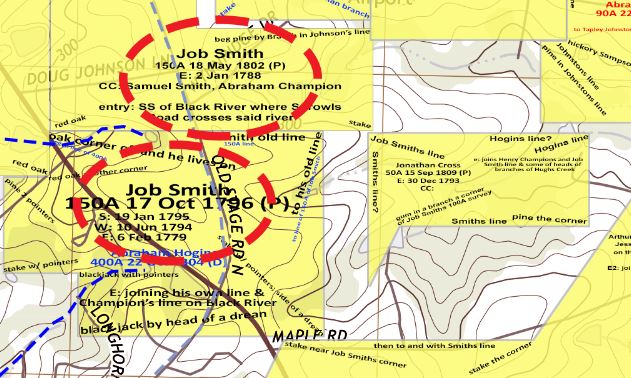
In 1809, Jonathan Cross, the father of Edward Cross, received a 50-acre land grant adjoining the property of Job Smith. At that time, Elizabeth Ann Smith would have been about 19 years old, and Edward Cross around 29, suggesting they were both at pivotal points in their lives. Later that year, on November 11, 1809, Edward Cross and Elizabeth Ann Smith were married, solidifying the connection between the Cross and Smith families.
The process for this land grant began much earlier. The warrant for the grant was entered on December 30, 1793, and the property was surveyed on December 15, 1805. It is plausible that Jonathan Cross began living on or near the land as early as 1793, shortly after the warrant was issued. This was a common practice of the time, as settling and improving the land was often essential for securing the claim. By the time the survey was conducted in 1805, Jonathan Cross was likely well-established on the property, as surveys often served to formalize boundaries for land that claimants were already occupying and utilizing.
The 1820 U.S. Census for Washington County, Georgia, along with the 1825 tax list for District 89, places Job Smith living in a community near the Great Ohoopee River. Among his neighbors were Samuel R. Smith (likely Job’s son), Barney Hart and Jonathan Hart (presumed sons of Samuel Hart), and Creey Cutts, Elisha Cutts, and Joseph Cutts. These families—the Harts and Cutts—were well-acquainted with Richard Smith and Hardy Smith in Cumberland County and were likely also familiar with Job Smith. These families, along with the Smiths, had migrated together in the 1780s from North Carolina to Wilkes County, Georgia, and later to Washington County, with some eventually moving on to Houston and Dooly Counties, Georgia. This network of interconnected families highlights the strong ties among these early settlers as they moved southward.
In the 1820 U.S. Census for Washington County, Georgia, Job Smith’s household consisted of 3 free white persons. The census lists 1 male aged 10 to 15, likely Jeremiah B. Smith, and 1 male aged 16 to 18, believed to be Job Elbert Wilder Smith. Additionally, the household included 1 male aged 45 and over, almost certainly Job Smith himself. Among the females, there is 1 aged 26 to 44, presumed to be Lucretia Smith, Job’s wife, or possibly another adult female relative. These details provide a snapshot of Job Smith’s family as it continued to grow and establish itself in Georgia.
In 1827, Job Smith participated in Georgia’s Land Lottery, a system designed to distribute newly acquired lands from the Creek Indian Nation to eligible citizens of the state. Winning a prize in the lottery was considered both a privilege and an opportunity for economic advancement.

Job Smith was one of the fortunate drawers in the 1827 Land Lottery. He was awarded Land Lot #8 in District 7 Lee County, an area located in the southwestern part of Lee County, west of Randolph, Georgia. This prize would have provided Job with valuable land in a developing region, offering opportunities for farming, settlement, or investment. The official drawing took place on May 10, 1827, and is documented in the Reprint of the Official Register of Land Lottery of Georgia 1827 (page 176).
By late 1829 or early 1830, Job Smith relocated once again, this time settling in District 13 of Houston County, Georgia (70 acres on lot 53). The move seems to have been influenced by the presence of friends and extended family in the area, suggesting a continued reliance on familiar social and familial networks for support and community.
The broader District 13 community included several notable individuals connected to Job Smith. Among them were Elisha Cutts and Joseph Cutts, as well as John Cross and Edward Cross, all of whom had familial or neighborly ties to Job from earlier settlements. Additionally, Job’s own sons, Jeremiah B. Smith and Jobe W. Smith (Job Elbert Wilder Smith), were living nearby. Other residents included Needham Smith Sr, Isaiah Smith Sr, Henry Smith, and Eason Smith, all descendants of the Smith Clan from Cumberland County, North Carolina.
These connections are supported by the 1830 U.S. Census for Houston County, Georgia, and the 1831 Houston County Tax List, which document the presence of this extended network of Smiths and their associated families. This move not only reflects Job Smith’s continued migration southward but also highlights the enduring ties between members of the Smith Clan and their shared legacy, stretching back to their origins in North Carolina.
In 1833, Job Smith appeared in court to provide testimony about his service during the Revolutionary War as part of his application for a pension. At the time, Congress had passed laws, such as the Pension Act of 1832, to provide financial support to veterans who had served in the war, especially those who were older and unable to support themselves through work.
Job’s court appearance would have involved recounting the details of his military service, such as the battles he participated in, the units he served with, and the length of his enlistment. Veterans often needed to provide credible testimony, sometimes supported by affidavits from witnesses or fellow soldiers, to validate their claims. This process ensured that only eligible veterans received pensions for their contributions to the fight for independence. Job’s testimony not only helped secure his rightful pension but also provides valuable insight into his role during the Revolutionary War for future generations researching his life and service.
Houston. Court Minutes 1822-1827, 1828-1831, pg. 112

State of Georgia, County of Pulaski

On this the twenty ninth day of October in the year of our Lord one thousand eight hundred and thirty three; Personnally appeared in open court before the Honorable Christopher B. Strong, Judge of the Superior Court in and for the county aforesaid now sitting Job Smith a resident of the said County of Houston and State of Georgia aged eighty three years who being first duly sworn according to law doth on his oath make the following declaration in order to obtain the benefit of the Provision now by the Act of Congress passed Jun 7th 1832 that he enlisted as a private soldier in the army of the United States in the year (1776) under Captain John Baptist Ash [John Baptista Ashe] with the company raised by the said Captain Ash in the County of Onslow in the State of North Carolina and served in the Sixth Regiment of the Regular Troops raised in the State of North Carolina under the following named officers Captain John Baptist Ash, George Dougherty [George Doherty], Frank Child, & Samuel Jones, first lieutenant George Daugherty aftewards promoted & made Captain in the place of the said Captain John Ash and George McCown Ensign, Joshua Hadley Colonel and Gideon Lamb and General Nash that he resided at the time he entered the service in the County of Onslow in the State of North Carolina; that he first enlisted for six months and before the expiration of said six month term of enlistment enlisted for and during war of the Revolution; that he was in various small engagements & in the battle of Germantown in the State of Pennsylvania that said Battle was as well as he recollects fought on the fourth day of October in 1777 or 1778 and that in the said Battle he served under the said Captain Daughtery Nash General and Samuel Colonel & Lighter Lieutenant Colonel; that he marched from Onslow County foresaid in the State of North Carolina to Halifax in the State of North Carolina. From thence to Georgetown in the State of Maryland from thence to Phildelphia and into Winter Quarters at Valey Forge. From thence returned home under the command of Lieutenant William & from thence to Wilmington in the state of North Carolina. From thence to the Salt Ketches to the wesboy & near Charleston in the State of South Carolina. From thence to Ashely Hill in the State of South & there remained untill peace was declared & from thence marched back to Wilminton in the State of North Carolina when the company in whiche he served was disbanded and he returned home without a regular discharge which is now lost the he does not now recollect any of the compainies with which he served in there continental or militia except Colemans Company. That he was born in the said County of Onslow in the State of North Carolina on the twleth day of October O.S. seventeen hundred & fifty; that he has no record of his age save a memorandum in a family bible that he lived in the said County of Onslow in the State of North Carolina untill five or six years after Peace was declared that then he removed from thence to Cumberland County in the same State of North Carolina until five or six years after Peace was declared; that then he removed from thence to Cumberland County in the same State of North Carolina from thence to Washington County in the State of Georgia & from to the said County of Houston in the State of Georgia where he now resides, that there is no person now living by whom he can prove his service that by reason of old age & the consequent loss of memory he cannot swear as to the precise time he entered he enlisted in the service of the United States but to the best of his recollection it was as above stated nor can swear positively as to the precise length of his service but according to the best of his recollection he served not less than six years as an orderly Sergeant & for such services he claims a pervision that he hereby relinqueshes every claim whatever to a pension or an annuity except the present and he declares that his name is not on the Pension Roll of any agency in any state sowrn to and subscribed the day and year aforesaid in open court.
Witnessed: C.B. Strong, Judge Superior Court Flint District, Signed Job Smith
Job Smith served as an orderly sergeant during his time in the Continental Army, a position of great responsibility within a military company. As an orderly sergeant, Job was tasked with maintaining discipline, relaying orders from officers to enlisted soldiers, and overseeing administrative duties such as keeping muster rolls and organizing guard assignments. He also played a key role in managing the logistical needs of his unit, ensuring that supplies, equipment, and camp arrangements were in order. This role required strong leadership, organizational skills, and trust from his commanding officers, reflecting Job’s dedication and reliability as a soldier during the Revolutionary War.
The above court document is the last known record of Job Smith. He does not appear in the 1835 Houston County Tax List nor are there any estate documents that can be found. It is presumed that Job Smith died ca 1834.
Job Smith and Lucretia Wilder Smith had the following children:
Daughter 1, b. ca 1784, Onslow County, North Carolina
Samuel Robinson Smith, b. ca 1786, Onslow County, North Carolina
Elizabeth Ann Smith, b. 18 April 1790, Cumberland County, North Carolina; d. after April 1783, Dooly County, Georgia
Daughter 3, b. ca late 1791, Cumberland County, North Carolina
Daughter 4, b. ca early 1794, Cumberland County, North Carolina
Daughter 5, b. ca lat 1796, Cumberland County, North Carolina
Daughter 6, b. ca early 1799, Cumberland County, North Carolina
Job Elbert Wilder Smith, b. 10 December 1801, Cumberland County, North Carolina; d. 2 December 1880, Echols County, Georgia
Jeremiah B. Smith, b. 5 April 1804, Cumberland County, North Carolina, d. 10 July 1879, Hamilton County, Florida
 digging our roots
Hello, I am wondering if you have found any more information about Job’s father Nathaniel?
Thank you for all your research, it has been quite useful!
LikeLike
Hi Zachary,
Thanks so much for the kind words. I’ve researched Nathaniel during his Onslow County years, with the earliest presumed appearance in July 1745; from there he remains active around the New River/Smith’s Creek neighborhood into the 1780s. I don’t yet have a documented origin for him prior to 1745.
I did explore a possible tie to the Occoneechee Neck Smiths (see my piece on George Smith: https://diggingourroots.com/2023/03/27/george-smith-of-occoneechee-neck/), because a Jeremiah Smith exits that corridor after a 1764 Halifax deed and a Jeremiah Smith appears in Onslow in 1766 with a sizable 390-acre plat. At present, the age and timing suggest those are likely two different men, so that “bridge” remains unproven. There were also early Thomas and William Smiths in Onslow that I haven’t fully vetted for relevance yet.
If your interest is primarily Job and his descendants, I do have a working hypothesis about Lucretia’s mother—more breadcrumb than conclusion.
/r
Mike
LikeLike