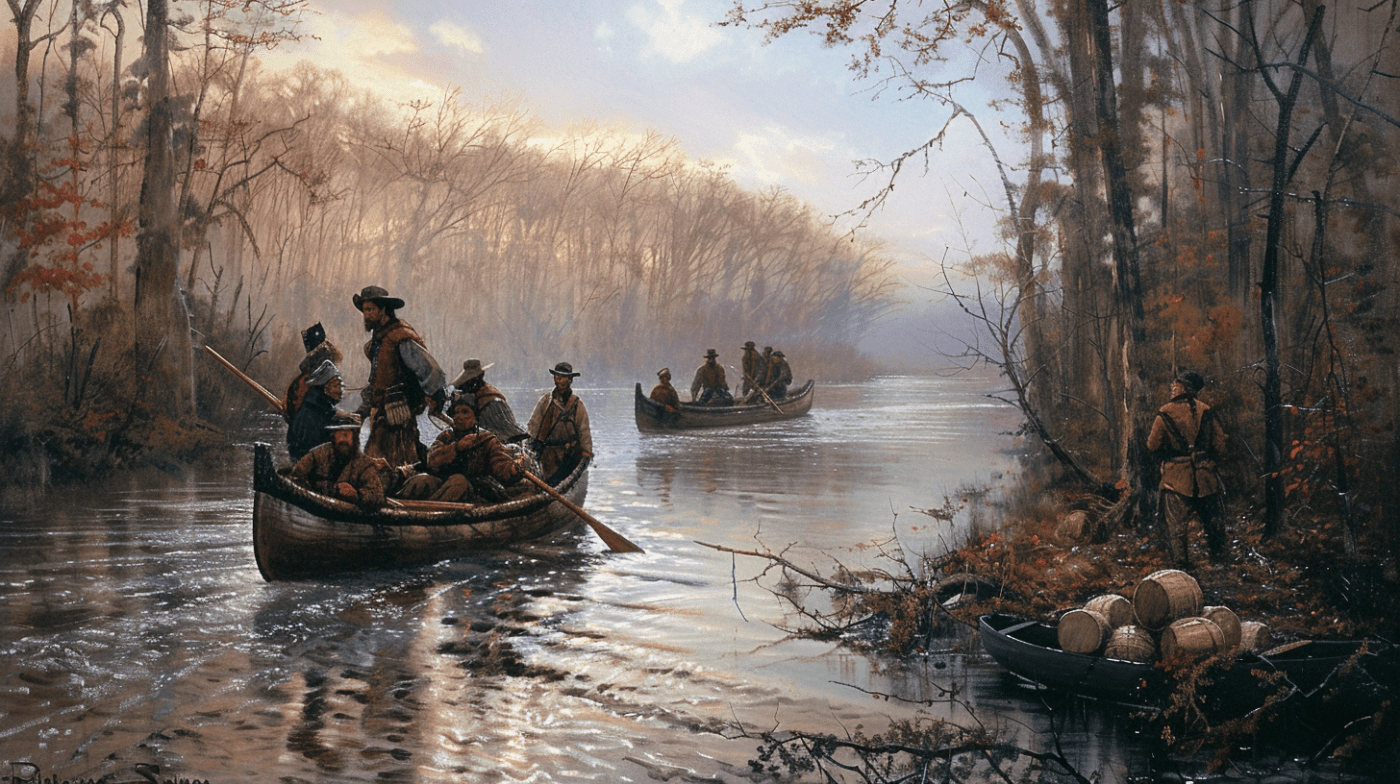
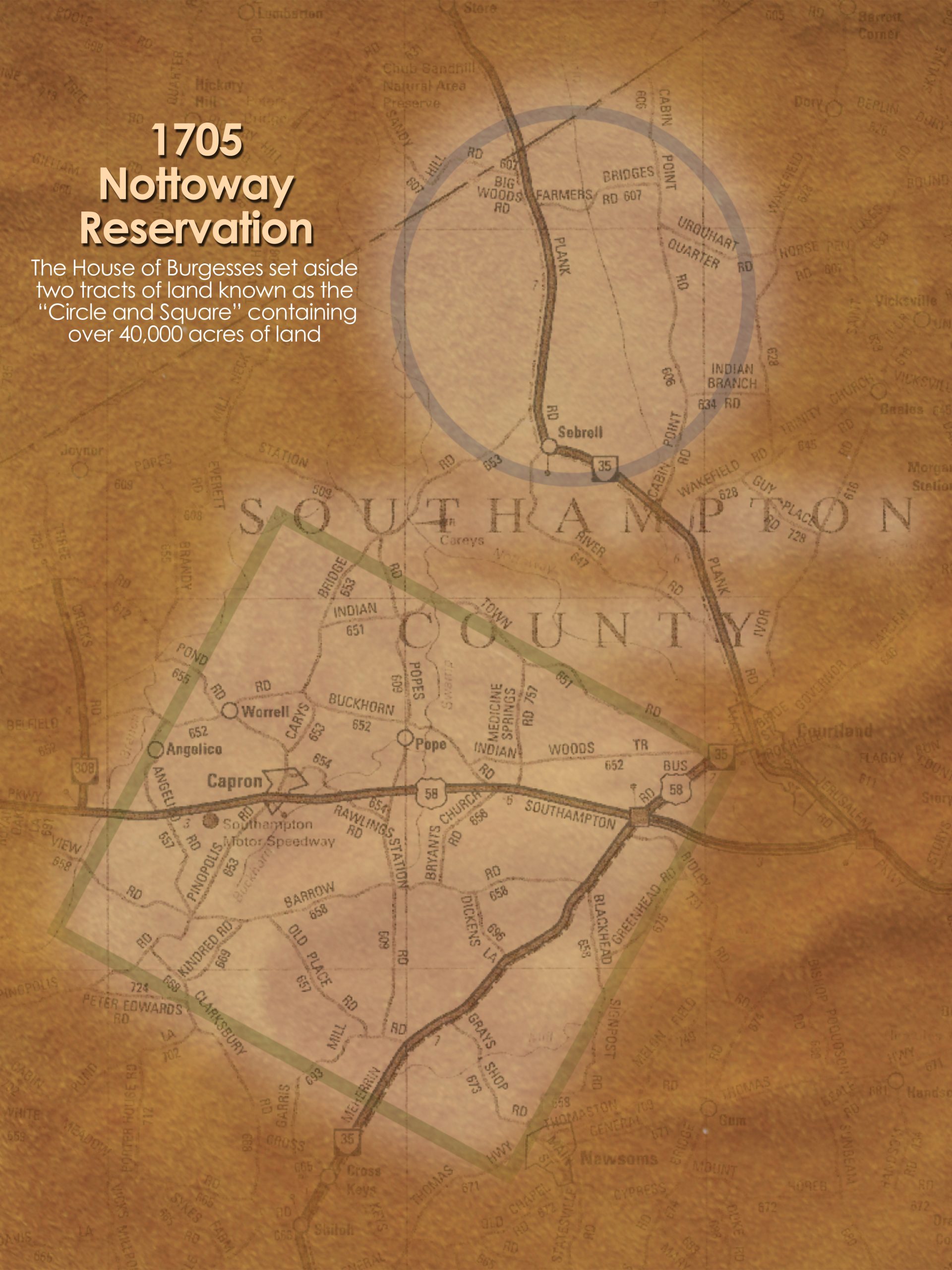
Around the time that George Smith was born, the Cheroenhaka Indian Tribe, or commonly called the Nottoway Indians, due to encroachment by the Colonials of Virginia moved from the Nottoway town of Tonnatorah in Sussex County, Virginia to the Assamoosick Swamp in what was then Isle of Wight County, Virginia. In 1705 the Virginia House of Burgesses granted two tracts of land to the Cheroenhaka Indian Tribe, commonly called the Circle and Square Tracts consisting of some 41,000 acres of reservation land. These lands were to have a three mile perimeter established around their towns, to limit Colonial-Indian conflicts over hunting and grazing areas, and establish a surveyed boundary against land encroachment.
The Square was a parcel of land (23,000 acres) on the south side of the Nottoway River and was about six miles square. The Circle (three miles round, 18,000 acres) was located to the north of the Square and positioned on the north side of the Nottoway River, and above the mouth of the Assamoosick Swamp.
[image source: https://encyclopediavirginia.org/circle-square-map/ ]
This Nottoway Indian Town became a somewhat central network hub of Indian trade between the interior and coastal areas of the region. Its role or position of importance in trade would slowly decease as the colonial frontier pushed farther into the interior.
At the beginning of the eighteenth century the Colony of Virginia opened the lands beyond the Blackwater River for English settlement. This is when young George Smith, estimated to be about 27 years of age, petitioned the Secretary in Williamsburg for a Treasury Rights Patent for land in Isle of Wight County, Virginia.
On 13 November 1713 George Smith was one of the first individuals to receive a patent for 100 acres in the vicinity of Three Creeks in Isle of Wight County, Virginia.
Virginia State Land Office, Patent Book 10, page 107
Anne etc To all etc Know Ye that for divers good causes and considerations but more especially for and in consideration of the sum of ten shillings of good & lawful money for our use paid to our Receivers General our own Revenue in this our said Colony and Dominion of Virginia. We have given, granted, and confirmed & by these presents for us our heirs and ** do give grant and confirm unto George Smith of the County of Isle of Wight one certain tract or parcel of land containing one hundred acres lying and being on the south side of Nottoway River in the said County of Isle of Wight and bounded as followeth to wit; beginning at a gum on the north west side of a branch of the three Creeks thence south seventy three degrees east seventy nine pole to a pine thence north north east one hundred four pole to a red oak then north thirty two degrees east one hundred & six pole to a red oak then north fifty five degrees west forty five pole to a gum then south sixty one degrees west eighty pole to a small gum by the branch side begun upon up the various courses of the run of the said branch to the beginning, withal. To have hold etc To be held etc Yielding & Paying etc Provided etc In Witness etc Witness our trusty and well beloved Alexander Spotwood our Lieutenant Governor at Williamsburgh under the seal of our said Colony the thirteenth day of November, in the twelfth year of our Reign Anno Domini one thousand seven hundred thirteen. Signed A. Spotwood
This 100 acres is believed to be about 7 miles to the west of the Nottoway Indian lands (Square and Circle) in the vicinity of Assamoosick Swamp and Nottoway River. This portion of Three Creeks was located in the Upper Parish of Isle of Wight County and south of the Nottoway River.
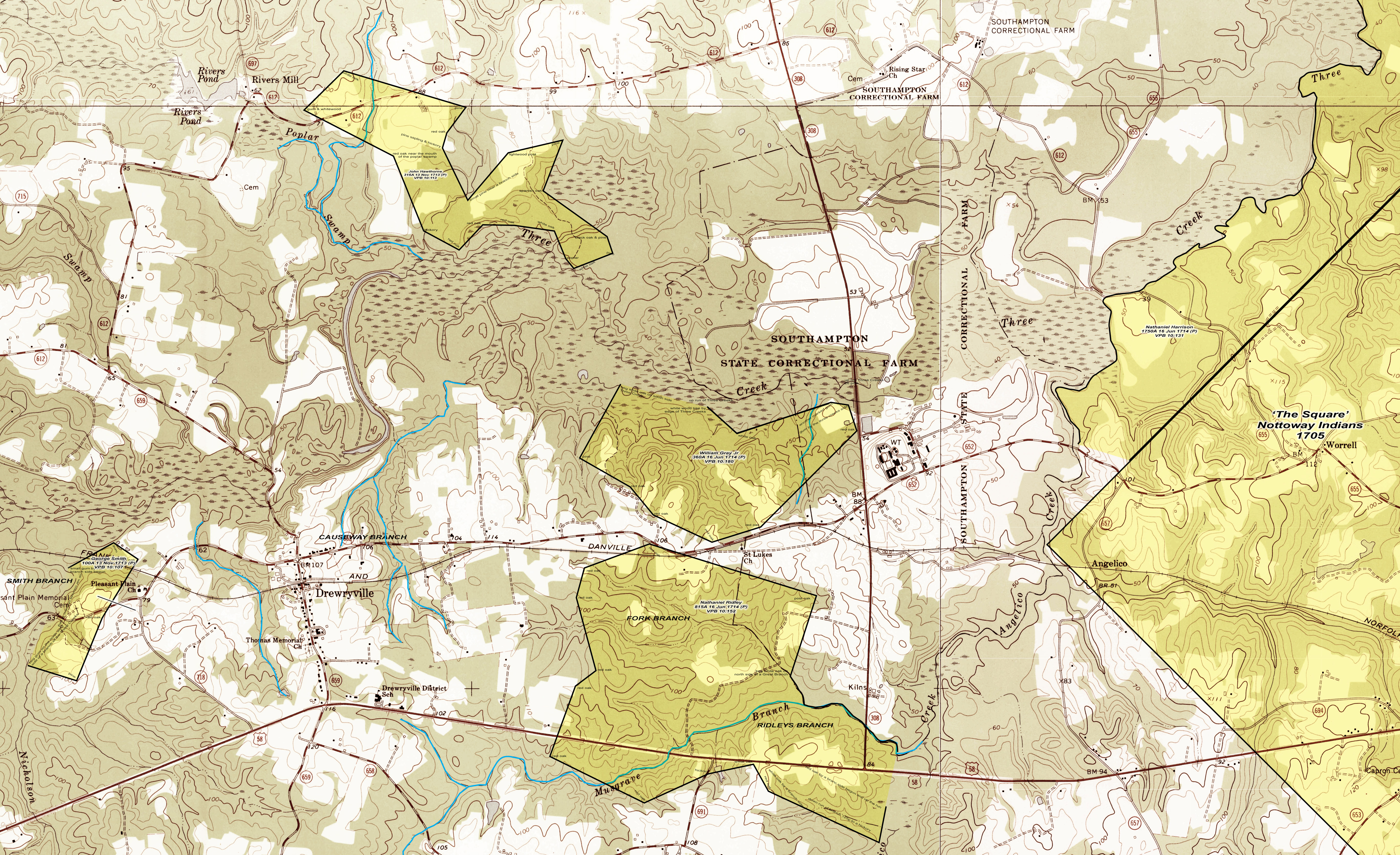
While it is likely arbitrary, a known Indian Trader, John Hawthorn who resided in Surry County also acquired a tract of land on the north side of Three Creeks.
The above patent also shows that George Smith was possibly living in Isle Of Wight County, Virginia when either the warrant or the patent were issued. This is a good research marker to keep notes on for future research.
The only George Smith known in the Isle of Wight records is a George Smith (ca 1640-1669) son of Arthur Smith I (d. 1645) of Isle Of Wight. This George Smith died without issue (Seventeenth Century Isle Of Wight; Boddie; pg. 251). Arthur Smith II also had a son named George Smith however he appears to have died without issue as well.
The other contemporary George Smiths were from Surry County. While more research is needed the first George Smith appears to be the Pamunkey Indian Interpreter George Smith. He appears to be a couple generations older then the George Smith of Three Creeks. There is also the George Smith son of Thomas Smith of Blackwater in Surry County. This George Smith is younger than his older brother Thomas Smith Jr and fits the generation span of the Three Creeks George Smith. Thomas Smith Jr was born ca 1676.
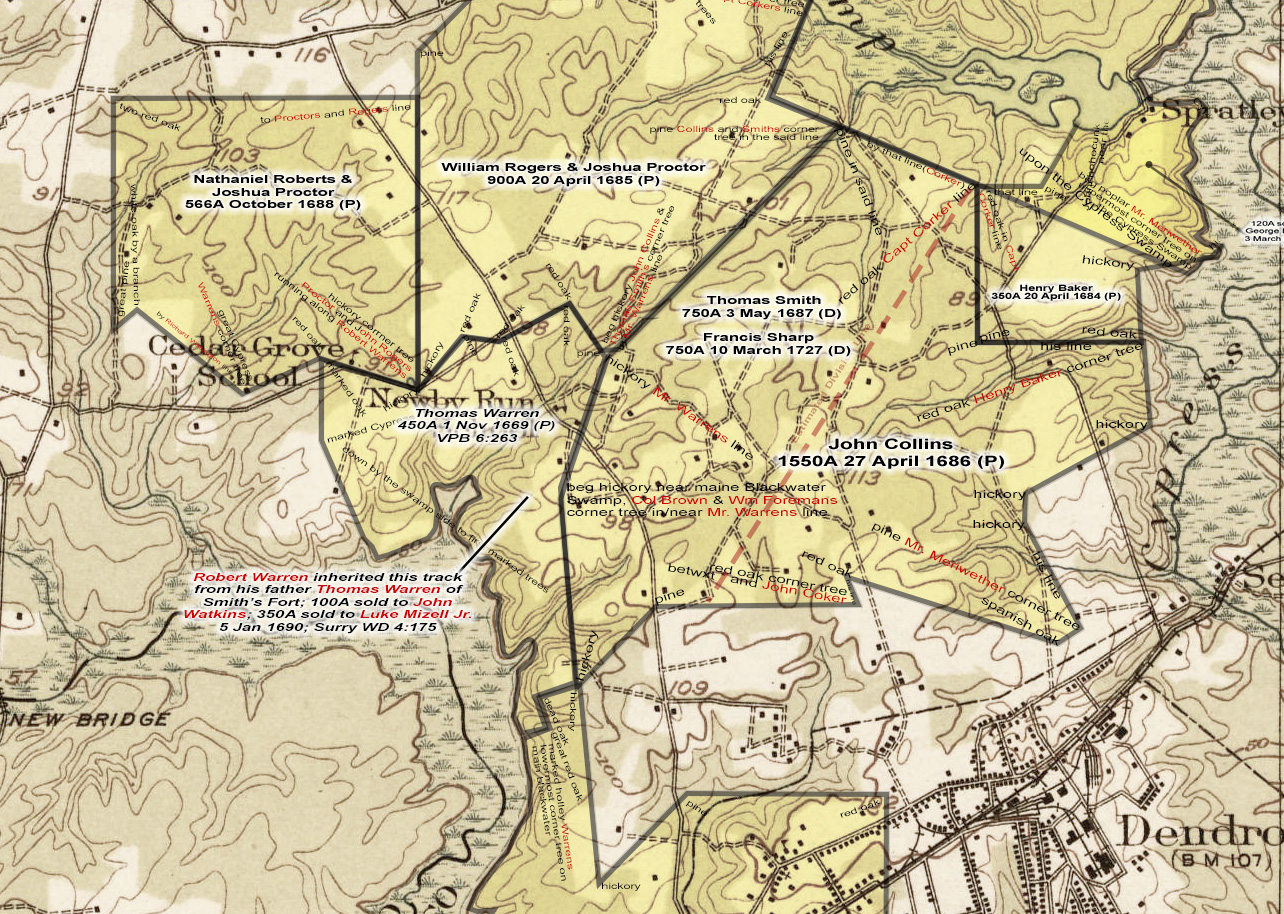
Thomas Smith Jr would also migrate to the Three Creeks area of Isle of Wight County. This is evident by a deed where Thomas Smith Jr sells the family plantation in Surry County, Virginia after his father’s death in 1723 and as referenced in Thomas Smith Jr’s own will.
Surry County, Virginia; Surry County Wills and Deeds, Book 7 (1715-1730) page 788
Thomas Smith of ye Upper Parish of Isle of Wight County on the south side of Nottoway River in Virginia, Planter to Francis Sharp of Surry County in Virginia, Carpenter; 10 shillings of lawful money of England; track of land containing by estimation seven hundred & fifty acres situate lying & being between ye Main Blackwater & ye Pigeon Swamp in ye Upper Parish of Surry County & bounded as followeth, north easterly on the land formerly belonging to Capt William Corker deceased, north west upon the land of William Rogers, south westerly upon Mr Warrens land & south easterly by such a line being run from ye aforementioned Capt Corker to Mr Warrens land aforesaid as will give ye said quantity to have & to hold ye said plantation being part of a track of fifteen hundred & fifty acres by patent granted for the same to John Collins formerly of ye Upper Parish of ye Isle of Wight County in Virginia bearing date ye 27th of April 1686; 10 March 1727. Signed by Thomas (his T mark) Smith (seal). Witnessed by James Ramsay, Owen (his mark) Mirack.

At a court held at Southwark for the County of Surry March ye 20th 1727.

This day appeared in court the within named Thomas Smith & did acknowledge the within mentioned contents to be his real act & deed which is ordered to be recorded & is recorded by ...
Thomas Smith Jr lived about 6 miles down Three Creek from George Smith’s patent.
Below is my interpretation map of where George Smith and Thomas Smith Jr lived. Click on the below image to see a larger view.

Within the next couple of years, George Smith sells his property in Isle of Wight County, Virginia and moves his family to Occoneechee Neck.
Isle of Wight County Virginia, Isle of Wight County Deed Book 2 pg 228

This indenture made the sixteenth day of April in ye fifth year of the Reign of our Sovereign Lord George King of Great Britain, France, and Ireland and in the year of our Lord God one thousand seven hundred and nineteen; Between George Smith & Elizabeth his wife of the Isle of Wight County of ye one part and Charles Briggs of ye County of Surry of ye other part; Witnesseth that ye said George Smith & Elizabeth his wife for and in consideration of five shillings sterling to them in hand paid by the said Charles Briggs ... [truncate]... tract of land thereunto belonging containing one hundred acres lying and being on the south side of Nottoway River in ye County of Isle of Wight and bounded as may appear more at large by a patent bearing date the thirteenth day of November one thousand seven hundred and thirteen. ... [truncate] ... In witness where of the said George Smith & Elizabeth his wife have hereto set their hands & seals the day and year above written. Signed George (his (G) mark) Smith (seal). Witnessed by John Warden, Robert Warren, and George Briggs.

Proved at a Court held for Isle of Wight County the 29 day of April 1719.

George Smith came into Court presented and acknowledged this his deed to Charles Briggs to wit & admitted to record.
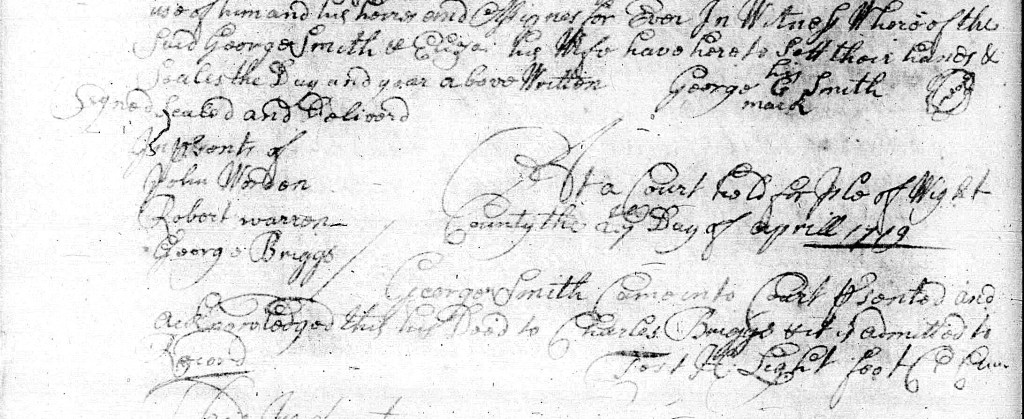
The above image shows a good visual of George Smith’s mark of a ‘G’.
Charles Briggs was the brother of Henry Briggs Jr who was an Indian Interpreter for the Nottoway, Meherrin and Nansemond Indians.
The Colony of Virginia, during this period, required deeds to be proven, either by the testimony of the seller himself or by witnesses. Virginia required the testimony of two witnesses to prove the transaction and have it registered at the respective county court.
In this transaction between George Smith and Charles Briggs, witnesses were identified as John Warden (appears may have been a clerk at the county court; more research required to confirm), Robert Warren who represented the interest of George Smith, and George Briggs who represented the interest for Charles Briggs. George Briggs is the brother of Charles Briggs.
Robert Warren (1667-1728) was an adjoining land owner on Blackwater River in Surry County to Thomas Smith Sr. He is believed to have later settled further south near Coppahaunk Swamp. The fact that Robert Warren owned property next to Thomas Smith Sr and likely knew the Smith’s lends creditability that it is plausible George Smith of Three Creeks is the son George Smith that is mentioned in Thomas Smith Sr’s will.
At the beginning of the second decade of the eighteenth century in Colonial North Carolina, land was made available by the Lord Proprietors for Purchase Patents along the Morratuck River, which today is known as the Roanoke River.
One of the areas along the Morratuck River that early Land Patents were issued, was an area that would become known as Occoneechee Neck.
The Edward Moseley map of 1733 shows us the earliest visual of where Occoneechee Neck was located on the Roanoke River. Labeled on the map as ‘Acconeechy Neck’.

The first patents issued in the Occoneechee Neck where to John Hawthorn, Matthew Sturdivant, Henry Jones Sr, and his two nephews Phillip Jones and William Jones on 26 February 1711/12 (NC Land Patent Book 1 pg. 170 & 171). The following month patents were issued to John Council, William Braswell, and William Boon (Boon: listed as William Brown NC Land Patent Book 1 pg. 177, Council & Braswell: NC Land Patent Book 1 pg. 173).
John Hawthorn, Matthew Sturdivant, and Henry Jones Sr where known to be in the Indian Trading business in the early 1700s.
In 1713, two more patents were issued to John Pace and Robert Lang (Pace: NC Land Patent Book 1 pg. 212; Lang: listed as Robert Long, NC Land Patent Book 8 pg. 290). They both were known to be in the Indian Trading business. Below is my interpretation of this area at the time of these early patents in Occoneechee Neck.
This community of Indian Traders would be styled as the ‘Chickasaw Traders’.
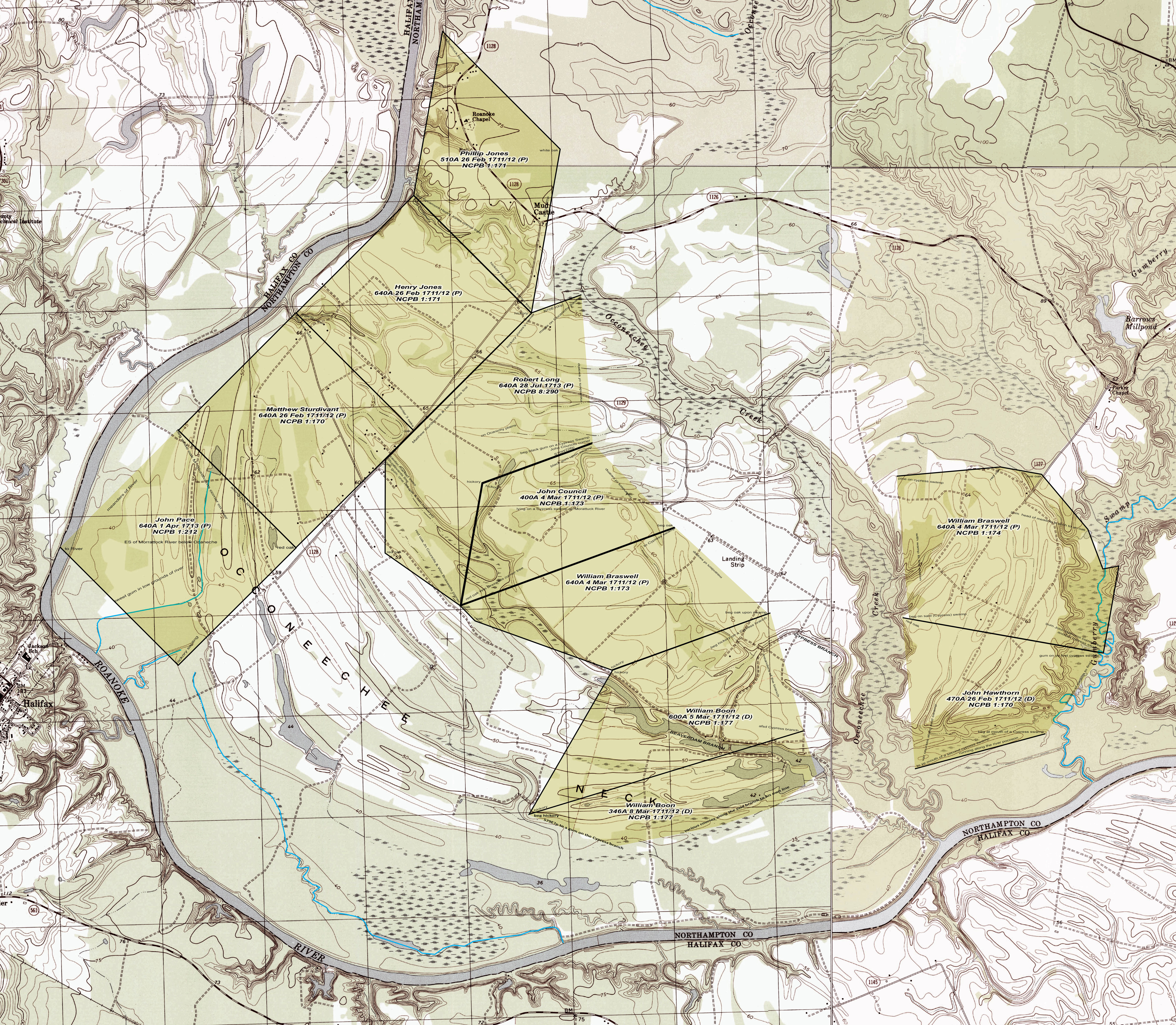
Seven months before selling his 100 acres in Isle of Wight County, Virginia, George Smith on 28 September 1718 purchased 140 acres, part of Robert Lang’s 640 acres on Occoneechee Neck.
Chowan Precinct North Carolina, Chowan County Deed Book B1 pg 634

To all Christian people to whom these presents shall come greeting; Know ye I Robert Lang of Chowan Precinct in the Province of North Carolina, Planter for & in consideration of the sum of five pounds to me in hand paid before ensealing & delivery hereof by George Smith of the Precinct & Province afsd, Planter ... [truncate] ... tract of land situate, lying & being in Chowan Precinct & containing by estimation one hundred & forty acres being more or less. Beginning at a red oak in Henry Jones' line so running by the Gut slash by a line of marked trees a S E course to John Councils line on Aquaneechy Swamp ... [truncate] ... my hand & seal this 26th day of September 1718. Signed Robert [his mark] Lang; Witness: Thomas Smith and Joseph [his mark] Sims
Of interest with this deed, is that it was witnessed by Thomas Smith, who in this context could be assumed as his brother Thomas Smith Jr. Or this could be Thomas Smith Sr. George Smith’s father, was still alive and living in Surry County, Virginia. However, because there is a Thomas Smith who appears to have witnessed multiple deeds within that year including a deed on the same day from Robert Lang to John Cotton it is assumed that this Thomas Smith was a Chowan County Clerk.
While it may be coincidental or not, an interesting item is that John Hawthorn and George Smith would own property near each other in two different locations. Once on the Three Creeks in Isle of Wight, Virginia and the other in Chowan Precinct in North Carolina. Interestingly, Henry Jones is known to be of aquaintance of both John Hawthorn and George Smith. Henry Jones and his nephew Phillip Jones signs as a witness to a John Hawthorn deed in 1718 (IOW DW 2:244) and George Smith is a witness to Henry Jones’ last will and testament in 1733.

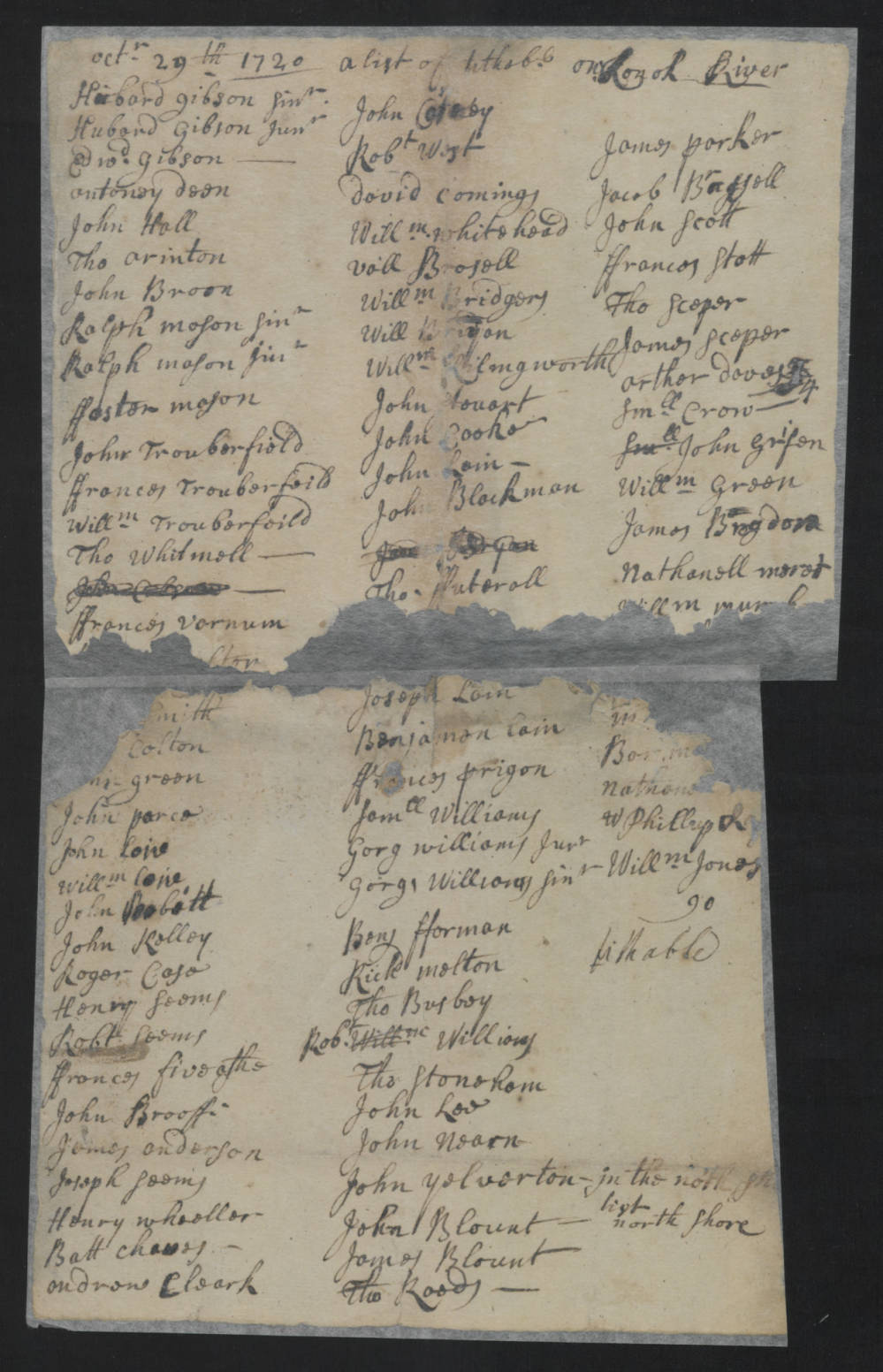
George Smith moved to North Carolina, likely after selling his property in Isle of Wight, Virginia. This is supported by examining the Chowan Precinct Tithable List dated 29 October 1720 (Tithables: Chowan County, 1719-1753; State Archives of North Carolina). The tithable or poll tax was devised as an assessment on income producing people. The procedures for collecting the tax was that between June 15 and August 5 the constables were to visit each household in a precinct in order to make up a tithable roll. Examining the 1720 roll there is a portion of the list where it alludes that the poll collector entered the Occoneechee Neck.
A snippet of the poll shown along with a plat & deed map supports who was likely living in this area in late 1720. The list shows the following individuals: George Smith (presumed), John Cotton (presumed), John Green (presumed), John Pace, John Lane, William Lane, John Bobbitt, John Kelly, Roger Case, Henry Sims, Robert Sims, Francis Fiveash, John Brooks, James Anderson, Joseph Sims, Henry Wheeler, Bartholomew Chavis, Edward Clark.

Here is an expanded view of my interpretation of the area of Occoneechee

Over the next couple of decades, George Smith was involved in a few land transactions.
Chowan County North Carolina, Chowan County Deed Book C1 pg188
George Smith of the County of Albermarle in Chowan Precinct, by the consent of Elizabeth my wife; to William Pope; tract of land or plantation in Chowan Precinct on the south side of Moratuck River on the loswer side of the Great Swamp & joyning to William Jones’s survey Thomas G*** survey & Joseph Simms’s survey being all on the lower & the south side of the aforesaid Great Swamp; by patent granted to me the aforsaid George Smith bearing date the 3rd day of December 1720 and containing five hundred & eighty acres of land (580A); 13 July 1721; signed by George Smith and Elizabeth Smith; wit: William Ledbetter, John Pope
Chowan County North Carolina, Chowan County Deed Book C1 pg187
George Smith & Elizabeth my wife … appoint our trusty and well beloved friend Barnaby Mackinney to be our true lawful & absolute attorney; POA for selling of the 580A tract listed above. Signed by George Smith and Elizabeth Smith
North Carolina Patent Book 8 pg. 177, File No. 767
Granted to George Smith 510 acres in Chowan Precinct lying on ye south side of Morattock River beginning at a gum on ye north side of Conaconarah Swamp (Conoconnara Swamp)….; Issued: 1 March 1719/20. (George Smith sold part of this property to Barnaby Mackinne on 7 May 1726, 20£)(evidence below suggest the remaining 300 acres of this tract was sold to Philip Raiford, son of Philip Raiford and Sarah Kitchen)
Bertie County North Carolina, Bertie County Deed Book B pg143
George Smith, Planter to Barnaby Mackinne Jun
Deed; 20£ from Barnaby Mackinne Jun; lying in Bertie Precinct and on the south side of Morattuck River; 210A it being part of a Patent for 510A granted to George Smith bearing date 1 March 1719 bounded beginning Phillip Rayfords [sic] line according to the bounds of his deed of conveyance for the other three hundred acres belonging to the afsd Patent so running on Phillip Rayfords …; 7 May 1726
Witness: John Mackinne, Jurant & William Law
Interesting note: Arthur Davis from Isle of Wight and Robert Warren Jr from Surry would migrate to the immediate north of George Smith’s tract on Conoconnara Swamp. Arthur Davis was an adjoining neighbor of Thomas Smith Sr when he lived in Isle of Wight. Robert Warren Jr’s father lived next to/near Thomas Smith Sr when he lived on Blackwater Swamp.
Halifax County North Carolina, Halifax County Deed Book 1 pg 98
George Smith of the precinct of Bertie in the County of Albemarle Province and Joseph John Alston of Edgecombe precinct; for 100 currency of said province; 220A lying in Edgecombe precinct commonly called & known by the name of Beaver Pond; beg at a white oak on the mouth of a branch so up the branch to the dividing line between Philip Mulky ___ alonged line & the head line so along said line & the Beaverdam Swamp so down the said swamp to the first station. 2 May 1735.
Signed: George Smith; Witness John Baldwin, ***** Harvey (or Hardy)
This deed has an unexpected twist associated with it. Joseph John Alston’s father John Alston first appears in Virginia in 1693, age 16, as a tithable to his uncle Nicholas Pasfield who was living in Surry County next to the land owned by Thomas Smith Sr.

Thomas Smith Sr would likely have known Nicholas Pasfield in 1688, however depending on how much visiting or business in the area by Thomas Smith Sr in the years after he moved to Surry-Blackwater, John Alston may have known the Smiths. It is probably arbitrary that John Alston’s son and Thomas Smith Sr’s son would have an interaction 42 years later.
Halifax County North Carolina, Halifax County Deed Book 1 pg 125
George Smith of Bertie Precinct within the Province of North Carolina, Planter to John Baldwin of Edgecombe Precinct & Province afsd; 10£ current money, 440 acres a certain tract of land it be granted by patent bearing date Feb 1 Ammo Dom 1725 containing 440 acres situate lying & being in Edgecombe Precinct on the north side of Kelushee [sic] Creek, beginning at a white oak on the Beaver pond then along a line of marked trees to a black oak a corner tree then to a black oak a corner tree then along a line of marked trees to a gum on the Beaver pond thence up the swamp to the first station. 15 November 1735. Signed George (his mark) Smith (Seal); Witness: J. Hardy, Philip Mulky
John Baldwin is believed to be George Smith’s son-in-law.
Halifax County North Carolina, Halifax County Deed Book 1 pg 153
George Smith to Philip Mulkey both of Bertie Precinct; 20£ current money; 100A lying in Edgecombe in the fork between the Beaver Pond & *ittewood(sp) beg at a white oak a corner three in the fork so up a line of marked trees or dividing line between Thos Elloby & George Smith in two white oaks a corner tree of Elloby then along a line of marked trees to a live oak a corner tree on butterwood Swamp so down the said swamp & the first station.
Signed: George Smith; Witness: Henry Horne, John C Calehard(sp?), Henry Jones
Halifax County North Carolina, Halifax County Deed Book 1 pg 248
George Smith of Bertie Precinct in the Province of North Carolina to Robert Mims; 10£ lawful English money, 100 acres lying in Edgecombe Precinct on Great Quanky Swamp as followith: beginning upon the creek at a maple at John Cottons corner tree so down the creek to a corner maple of John Bobbitts deed, then said Bobbitts line of marked trees to a red oak then W line of marked trees to a white oak then N on a line of marked trees that divides Cotton & I to the first station. It being part of the land that was granted by patent to John Cotton for 100 acres bearing date the first day of March 1735. 19 February 1738. Signed George (his mark) Smith (Seal) and Eliza (her mark) Smith (Seal); Witness: Peter Piercy, Francis Jones
On 21 January 1745/46, George Smith will write his Last Will & Testament.
In the Name of God Amen I George Smith of North Carolina Northampton County being very sick and weak but in perfect sense and memory thanks be to God for the same knowing the mortality of my body and that all men are appointed to die and I do make and ordain this writing to contain my Last Will and Testament. First and principally I recommend my soul into the merciful hands of God my creator hoping there the meritorious death and possession of my Savior and Redeemer Jesus Christ to receive pardon for my sins; my body I commit to the earth to be buried in a descent and Christian manner all the discretion of my Executors hereafter named and as for my worldly estate wherewith God hath blessed me in this life I dispose of the same in manner and form following:

Item I give and bequeath to my daughter Martha Jones one shilling sterling:
Item I give and bequeath to my son William Smith one shilling sterling:
Item I give and bequeath to my daughter Elizabeth Baldwin one shilling sterling:
Item I give and bequeath to my son Jeremiah Smith my plantation I now live on and the land there unto belonging to him and his heirs or assigns: likewise the hoes & axes and carpenter tools and saddle and my wearing clothes: and one feather bed and two blankets one dish six spoons one pot, which he has in possession now: likewise I give him one Negro man named Potter to him & his heirs or assigns: also one sorrel horse:
Item I give and bequeath to my daughter Mary Barrett one Negro boy named Cato and one feather bed and furniture to her and heirs or assigns: which she now has in possession:
Item I give and bequeath to my daughter Susannah Smith one Negro girl named Hannah and one feather bed and furniture that is called hers to her and her heirs or assigns.
Item I give and bequeath to my daughter Sarah Smith one Negro girl named Aggy and one feather bed and furniture that is called hirn to her and her heirs and assigns.
Item I give and bequeath to my daughter Rachel Smith one Negro boy named Dick and one feather bed and furniture that was called her fathers to her and her heirs or assigns.
Item I give and bequeath to my daughter Caroline Penelope Smith the first child a wench that is called Nan brings to her and her heirs or assigns.
Item I give and bequeath to my daughter Elizabeth Smith one Negro wench named Nan and her increases excepting that above mentioned and the new bed to be filled from the geese to her and her heirs or assigns.
Item I leave my gray and white horses to be sold for to pay my debts.
Item I give and bequeath to my daughter Caroline Penelope Smith all the rest of my estate whether goods, chattels or ready money and the stock and the old lumber to be sold and the money for her life to her and her heirs or assigns.
Lastly I constitute ordain and appoint Jeremiah Smith and Thomas Barrett to be my Executors of this my Last Will and Testament. Revoking & making void all other or former wills by me heretofore made in witness of I have here unto set my hand and seal this 21st day of January 1745/46.
Signed George (his mark) Smith (Seal)
Signed sealed and delivered in the presence of James (his mark) Smith, James Jones - Jurat

{back}

Northampton County
February Court 1746
The within Will of George Smith was in open court proved by the oath of James Jones and of the subscribing evidences thereto at the same time Jeremiah Smith and Thomas Barret Executors thereof were qualified. Ordered that the Secretary be notified thereof.
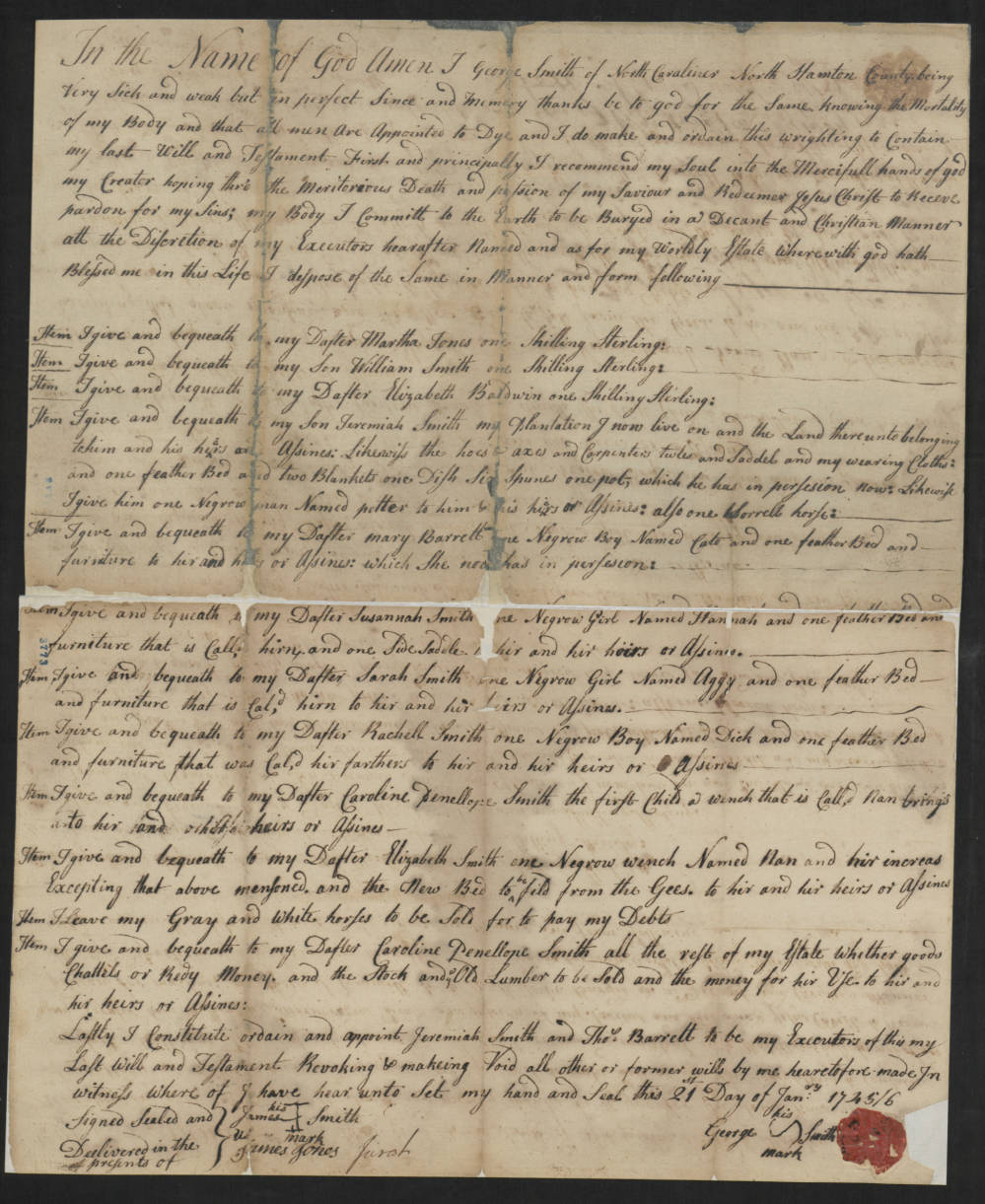
There are a couple of things that we can use the will to decipher.
Based on the deed between George Smith and Robert Mims it shows that George Smith’s wife Elizabeth Smith is still alive as of March 1735. She was probably still alive in 1738 as there is no information about her death or any dowry information documented when the deed was recorded in court.
Elizabeth Smith appears not to be mentioned in the will above. So common assumption is that Elizabeth Smith died between February 1738 and 1745.
However, this may not be the case. Appearing in a deed between Robert Jones Jr and his son Allen Jones on 24 Apr 1765 (Northampton DB 3:397) it mentions, “… then a straight course to Littles ___ line where the line dividing the land of the widow Smith from the land purchased by the said Robert Jones of Jeremiah Smith corner in the same ___ by Littles line …”.
This line likely refers to the property line between George Smith’s 140 acres and William Smith’s 50A. My current hypothesis is the widow Smith is not a reference to the wife of William Smith as he can be found living in 1767.
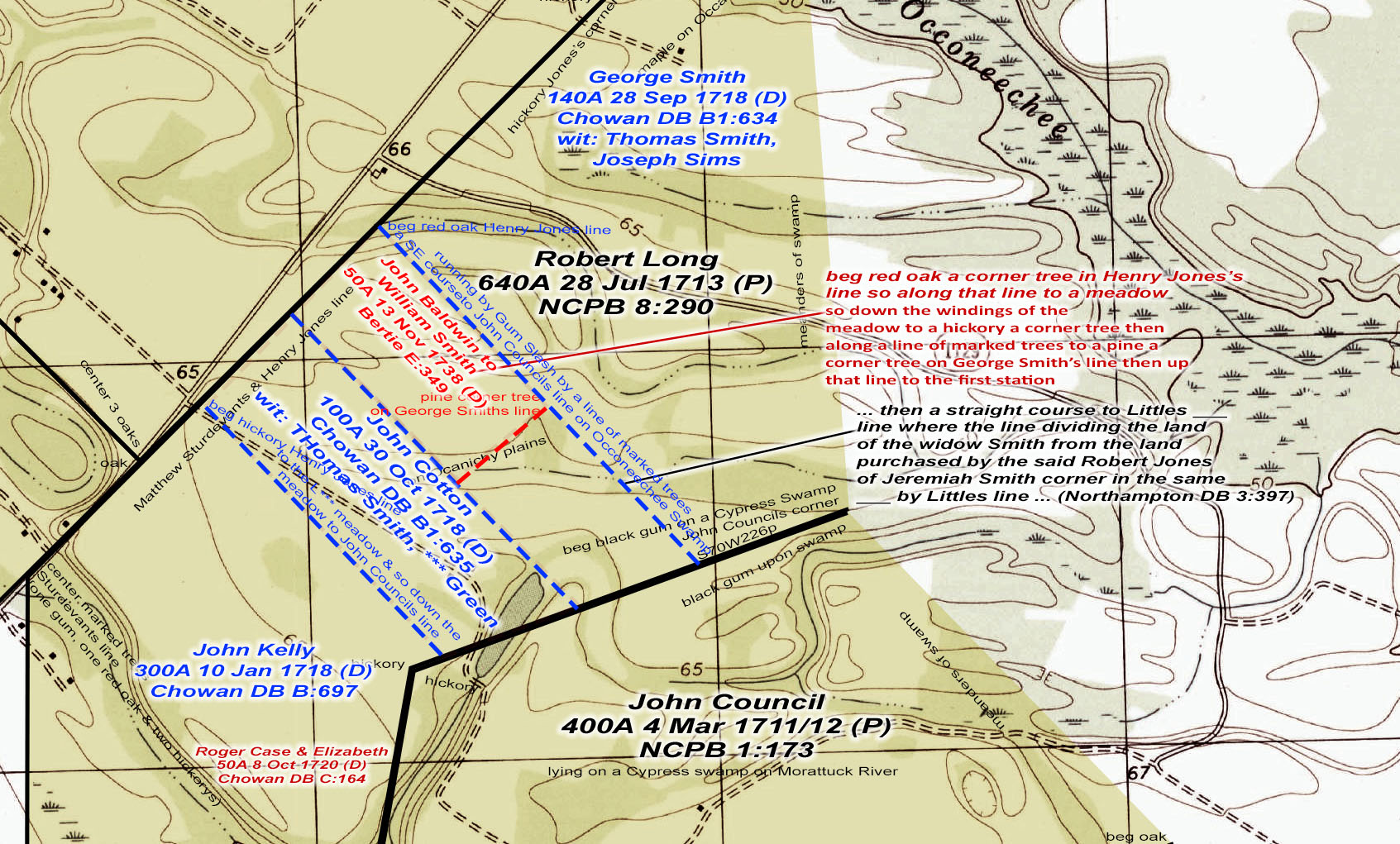
There is a slight chance the widow Smith might be referring to George Smith’s wife Elizabeth Smith, even though she appears not listed in his will. The will first identifies daughter Elizabeth Baldwin and then after all the children are named it identifies a second “daughter” named Elizabeth Smith. While it could be possible to have two daughters named Elizabeth or one of the daughters using their middle name, a third option could be the will writer or transcriber mistakenly identified Elizabeth Smith as a daughter instead of a wife.
George Smith’s children, as it appears in his last will and testament, were likely listed in order of their births.
Below is my research dataset that I use when evaluating information.
George Smith was born ca 1686. This is based in part on his land purchase in Isle of Wight in 1713 and evaluation that his son William Smith was born ca 1709. Information about William will be discussed in a future article. George Smith is also not listed in the 1704 Virginia Quit Rents for Surry or Isle of Wight.
George Smith and Elizabeth, maiden name unknown, were married ca 1706/07. This assumes daughter Martha Smith is a couple years older than William Smith, and was born in wedlock.
Susannah, Sarah, Rachel, and Caroline were likely between the ages of 19-25 at the time of their fathers death in 1746. And it could be concluded they were unmarried.
Martha Smith appears to have married Henry Jones
Elizabeth Smith appears to have married John Baldwin.
Mary Smith appears to have married Thomas Barrett.
Jeremiah Smith married Mary, maiden name unknown. Jeremiah Smith is last recorded living in Edgecombe County, North Carolina in on the north side of Quankey Creek ref 1756.
 digging our roots
Nice maps Mike… I do not envy anyone doing research with the surname SMITH.
When I run across a JONES I just cringe… this from an ANDERSON researcher. smiling
LikeLike