During the 1600s, in the Colony of Virginia, the laws allowed any person who settled in Virginia (personal right) or paid for the transportation expenses of another person who settled in Virginia (transportation right), to be entitled to receive fifty acres of land for each immigrant. This provision was known as a headright system.
On 20 April 1682, a William Baldwin received a patent for 275 acres in the Lower Parish of Surry. This patent was located on the head of the first branch of the Blackwater River. During the 17th and 18th century this branch (modern times called ‘Stallings Creek’) was referred to in patents and deeds as the ‘first branch’, ‘first swamp’, or the ‘easternmost branch/swamp’.
Over a year later, William Baldwin would sell 70 acres of this track of land to a Thomas Smith.
Surry County Virginia, Surry County Deed Book No. 3 pg 345

This indenture made ye 5th day of October in ye 35th year of ye Reign of our Sovereign Lord Charles ye 2nd of England, Scotland, France & Ireland King defender of ye Faith & in ye year of our Lord God 1683. Between William Baldwin of ye upper parish of ye Isle of Wight County & Elizabeth his wife on ye one part, Thomas Smith of ye aforesaid parish & county on ye other part. Witness that ye said William Baldwin & Elizabeth his wife for a valuable consideration to them in had paid before ye sealing and delivery of these presents. Have given granted bargained sold alienated enfeoffed & confirmed, by these presents dot and fully clarity & absolutely give grant alien enfeoff & confirm unto ye said Thomas Smith his heir & assigns forever a certain parcel of land contained within a patent wherein is granted unto me 275 acres of land bearing date 20th of April 1682 as by ye said patent more or less may appear containing seventy acres of land be it more or less situate lying & being in ye lower parish of Surry County about ye heads of ye branches of the first branch of the maine blackwater; bounded (viz) to begin from a line of one Arthur Davis' along ye west side of a branch called the g**m branch unto a line of on Capt. Lawrance Baker, deceased, so along that line unto ye first station. [truncate] Signed: William (MB) Balden, Elizabeth (E) Balden. Witnessed by: Joseph Foard, William Evans.

At a court held for Surry County January 1st 1683, This day appeard in court ye above said William Baldwin and did acknowledge the above said to be his recollect & deed. Test. William Edwards.

An interesting twist realized from this deed, in a future article, I’ll explore how Thomas Smith’s granddaughter will marry a Baldwin which, while currently not proved, appears plausible to be the grandson of the above William Baldwin.
William Baldwin also sold 80 acres of this parcel to Joseph Foard on 5 October 1683.
Surry County Virginia, Surry County Deed Book No. 3 pg 344

[truncate] ... Between William Baldwin of ye Upper Parish of ye Isle of Wight County and Elizabeth his wife on ye one part & Joseph Foard of ye Lower Parish of Surry County on ye other part ... [truncate] ... containing eighty acres of land be it more or less situate lying & being in ye lower parish of Surry County abound ye head of ye branches of ye first branch of ye main blackwater bounded (viz) on ye eastern most side with a branch called or known by the name of ye first branch so down that branch unto one Arthur Davis' line to ye said William Baldwins corner tree thence along Mr George Cripps' line to a corner tree in one Mr George Hardings line unto a barron marked white oak from thence a cross unto the former branch ... [truncate] Signed William (MB) Balden (seal) and Elizabeth (E) Balden (seal). Witnessed by Thomas Smith and William Evans. (5 October 1683)
It appears that Thomas Smith didn’t immediately settle on this property. In reviewing the Surry County tithable list (record of white males 16 years and older) from 1683, 1684, 1686, and 1687 it shows that there was no Thomas Smith living in the county during those years. The tithable list from 1688 and 1689, as recorded appears incomplete or missing records for a couple of parishes, so it can’t be concluded if Thomas Smith lived in Surry County during those years.
Thomas Smith was likely living just across the county line in Isle of Wight County as evident from a 1688 deed from George & Susanna Branch to John Goodrich.
Isle of Wight County, Isle Of Wight Deed Book No. 01 pg 6

This indenture made the eight day of October in the fourth year of the reign of our Souviegn Lord James the Second ** England, Scotland, France, Ireland, and Virginia King defender of the faith & and in the year of our Lord God one thousand six hundred eighty and eight. Between George Branch of the Upper Parish of Surry County and Susanna his wife, of the one part and John Goodrich Junior of the Upper Parish of the Isle of Wight County on the other part. [truncate] ... onto the said John Goodrich, his heirs and assigns forever all that plantation and tract of land which on Thomas Smith, doth now live, lying and being in the upper Parish of the Isle of Wight County, situate on the east side of the first swamp on the blackwater, running easterly out into the woods followingth and for breadth bounded between two branches on the south side with a branch called by the name of Davises branch joining on the land that was lately George Cripps and formerly Francis Englands and on the north side with a branch that did formerly divide a parcel of land that the said Francis England did sell unto one James Piland all which land was by my grandfather Francis England given with my mother unto my father in frank marriage containing by estimation one hundred acres be it more or less ... [truncate] ... all that plantation and tract of land whereon I the said George Branch and Susanna my wife did formerly live, situate, lying and being on ye first swamp on the blackwater bounded on Capt Pierce marked trees and running for length west into the woods and for breadth sixty two pole and a half to the above mentioned land that was formerly Francis Englands land containing one hundred twenty five acres, it being land formerly sold and conveyed by the said Francis England unto one James Piland as by a conveyance dated the last day of September 1648 more at large it doth and may appear and by the said James Piland assigned over to my father George Branch as by his assignment on the back of the conveyances bearing date ye 22th of January 1661 as by the conveyance and assignment thereon doth appears together with all house [trunscate] Signed George Branch (seal), Susanna Branch (seal). Witnessed by James (mark) Lupos, William Evans, and Thomas Smith.

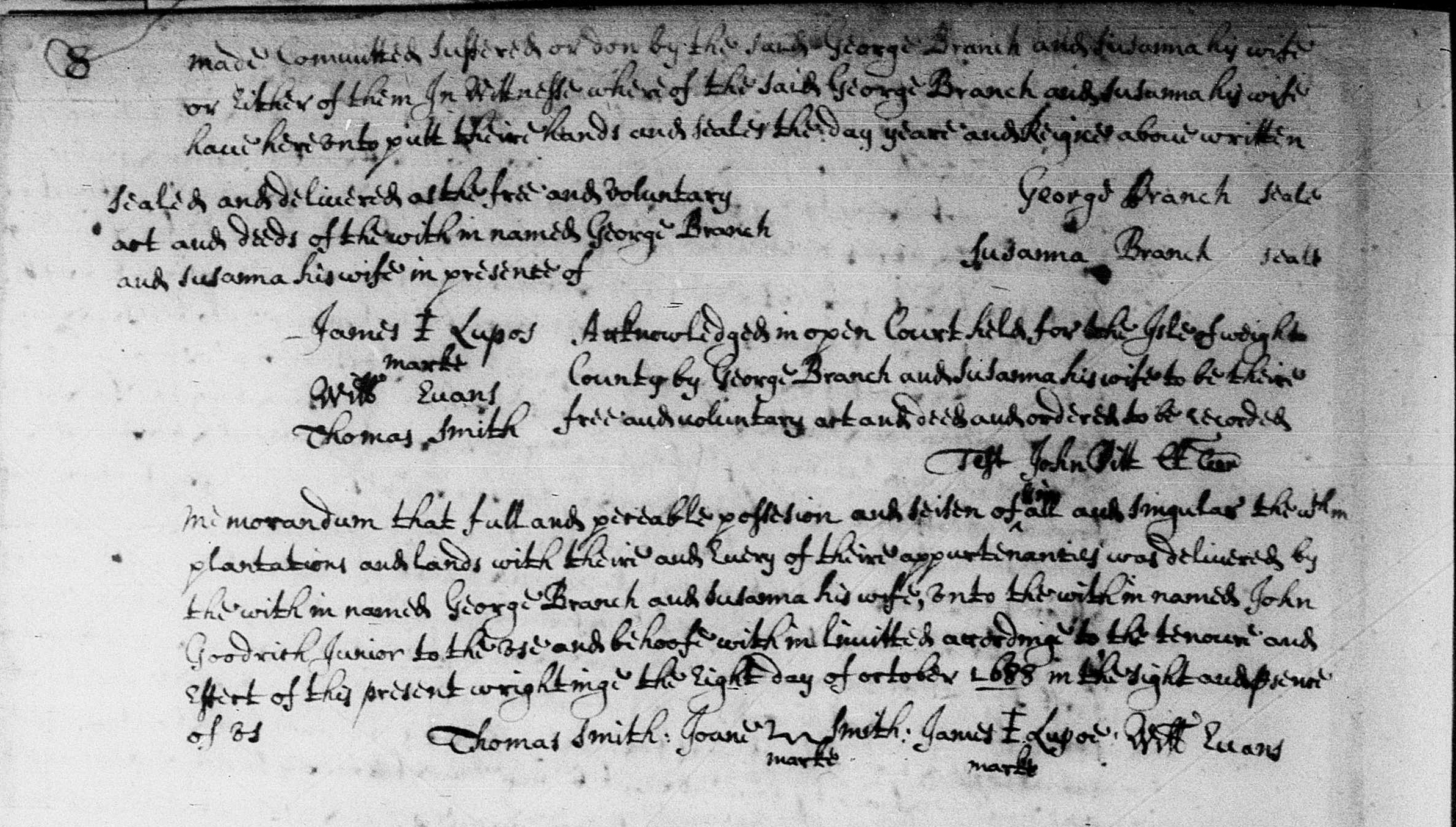
Memorandum that full and peaceable possession and seizen of all and singular the within plantations and lands with the ___ and entry of the appurtenancies was delivered by the within named George Branch and Susanna his wife, unto the within named John Goodrich Junior to the ___ and behalf within limited according to the ___ and effort of this present writing, the eight day of October 1688 in the sight and presence of Thomas Smith, Joane (mark) Smith, James (mark) Lupo, William Evans.
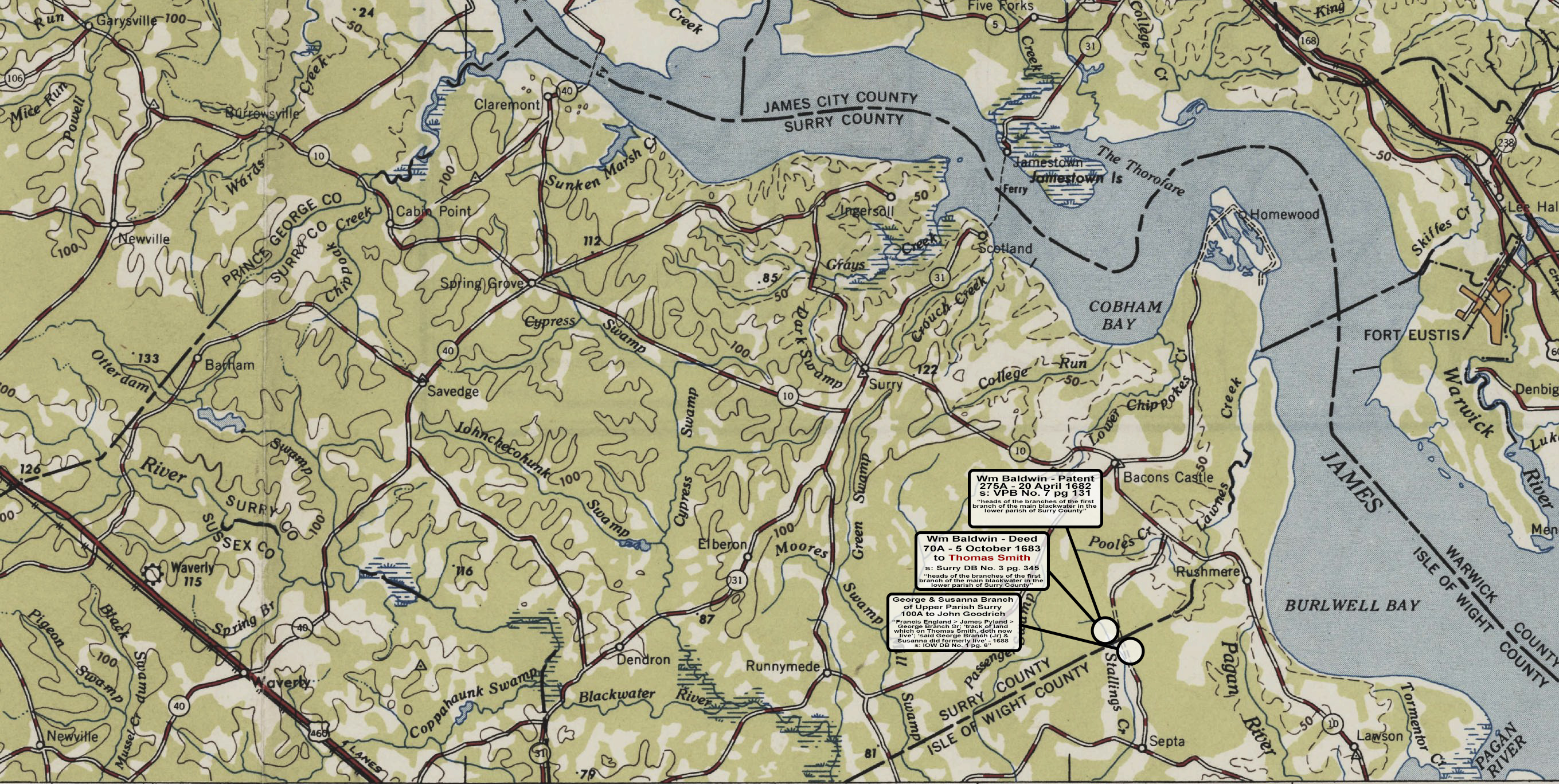
Below, is my detailed interpretation of a map showing where Thomas Smith was living from about ca 1683 to 1690. Click on the below image for a larger version.

Side note for John Goodrich researches; several Goodrich researchers perceive that John Goodrich and John Gutheridge are one of the same or that John Gutheridge is the father and his surname morphed to his son John Goodrich.
One item to not overlook, regarding the above deed, is that Thomas Smith and a Joane Smith confirmed the sale. While it is not specifically indicated, this could be an introduction to the identity of the wife of Thomas Smith. Below is the signoff and memorandum of the deed.
A year following Thomas Smith’s purchase of the 70 acres in Surry County, he receive a patent for 200 acres.
Virginia Land Office Patents No. 7, 1679-1689 (vol 1 & 2) page 367
Location: Surry County

To all &c Whereas &c Now know ye that I the said Francis Lord Howard Governor &c do with the advice and consent of the council of state accordingly give and grant unto Thomas Smith two hundred acres of land situate between the Cypress Swamp of Johnchokuck Swamp in the upper parish of Surry County beginning at a red oak by a branch a corner tree of Richard Jordan Jun his land, thence by ye said Jordans line north west one hundred twenty eight poles to a small red oak north ninety four poles to a red oak by a great Branch, then north thirty degrees east two hundred and eighty one poles to a pine, then south east one hundred and eight poles to a small white oak by the Branch first above mentioned and so down the said Branch to ye first station. The said land being and by and for the transportation of four persons into this colony whose names are in the records mentioned under this patent. To have and to hold &c to be held &c yielding and paying &c Provided &c Dated this twentieth day of April one thousand six hundred eight four.

Morris Bowen
William Milton
Ann Tatum
Mary Tatum
Understanding the rules of engagement in obtaining a patent, Thomas Smith would have lived in the colony for a year or two prior to being granted the patent in 1684. In obtaining a patent, the prospective applicant would have first selected a vacant tract that he or she wished to receive and then made a petition. The petition was to contain some general description of the tract – perhaps a map – in order that a surveyor could later locate it. This description, along with evidence of the applicant’s “rights,” (proof that he or she paid transportation costs) was then taken to the office of the granting authority. This authority (either the crown or proprietary office, depending on where the land was located) then issued the applicant a warrant which authorized the county surveyor to make a survey and draw a plat of the tract. If, on the basis of the plat, the office determined that the tract was free of previous claims, a certificate of ownership was issued. The originals of these patents or grants were given to the applicants, while clerks in the land office made copies in registers.
In analyzing the patent it is determined that Thomas Smith was granted this patent for the transportation of the above four immigrants into Virginia. What is also understood is that Thomas Smith did not receive fifty acres, for himself (personal grant), as an immigrant into Virginia, suggesting that he was already living in the colony prior to this transaction. During the later half of the 17th century it cost, on average, up to £6 per person for transportation cost to come to the Colony of Virginia. Another way to look at it is that it would cost a skilled tradesman about 66 days of work to pay the transportation cost for one immigrant. Thomas Smith in theory provided £24 (or 266 days of skilled labor) to pay the transportation cost for these four immigrants. Also it could be suggested that this transaction didn’t include any indenture servant agreements as the Tatum sisters likely didn’t fall into that category.
What also can be deciphered, is that Thomas Smith was born before April 1661 (probably born ca 1654, see later). This assumes that Thomas Smith was at least 21 years of age, when he began the process to be granted a patent for land in 1682 or 1683, and when he purchased the 70 acres in April 1683. He likely would have had to be of age, which was required, in most situations to own land during the 17th century in Virginia.
Patents during the 17th century, Virginia, required seating and planting of the tract within three years. Seating was defined as building a house, keeping stock on the land for one year, and providing a servant to tend that stock. Clearing, planting and tending an acre of ground was defined as planting.
Thomas Smith didn’t immediately seat the 200 acres in Surry County. It appears he would come to desert this patent as evident of the following patent.
Virginia Land Office Patents No. 7, 1679-1689 (vol 1 & 2) page 691
Location: Surry County

To all &c Whereas &c Now know ye that I said Francis Lord Howard Governor &c do with the advice and consent of ye council of state accordingly give and grant unto Richard Jordan two hundred acres of land situate between ye Cypress Swamp and Johochocuck Swamp in ye uppper parish of Surry County. Beginning at a red oak by a branch a corner tree of Richard Jordan Jun his land thence by said Jordans line north west one hundred twenty eight pole to a small red oak, north ninety four poles to a red oak by a great branch then north thirty two degrees east one hundred and eight pole to a small white oake by ye branch first above mentioned and so down the said branch to the first station. The said land was formerly granted to Thomas Smith by patent dated 20th April 1684 and by him deserted for want of due seating according to law and is now granted to said Richard Jordan by and of gentle course dated &c 3rd of May 1688 and is further due by and for ye transportation of four persons. To have and to hold &c to be held &c yielding and paying with payment &c Dated this twentieth day of October Anno Domini 1688.
As shown in the deed earlier from George Branch to John Goodrich, Thomas Smith appears to have been living on land owned by George Branch.
George Branch (Jr) was the grandson of Francis England, whose daughter Ann England Branch, married George Branch Sr.
By 1688 George Branch (Jr) and Susanna, his wife, had moved to Surry County as noted in the deed to John Goodrich and confirmed by the 1688 Surry County tithable list. George Branch and his wife Susanna Corker Branch, daughter of Capt William Corker moved to land that she inherited from her father. Capt William Corker received a patent for 1,850 acres in Surry County along the Cypress Swamp in 1677. Susanna Corker Branch and her two sisters each inherited a third of the patent.
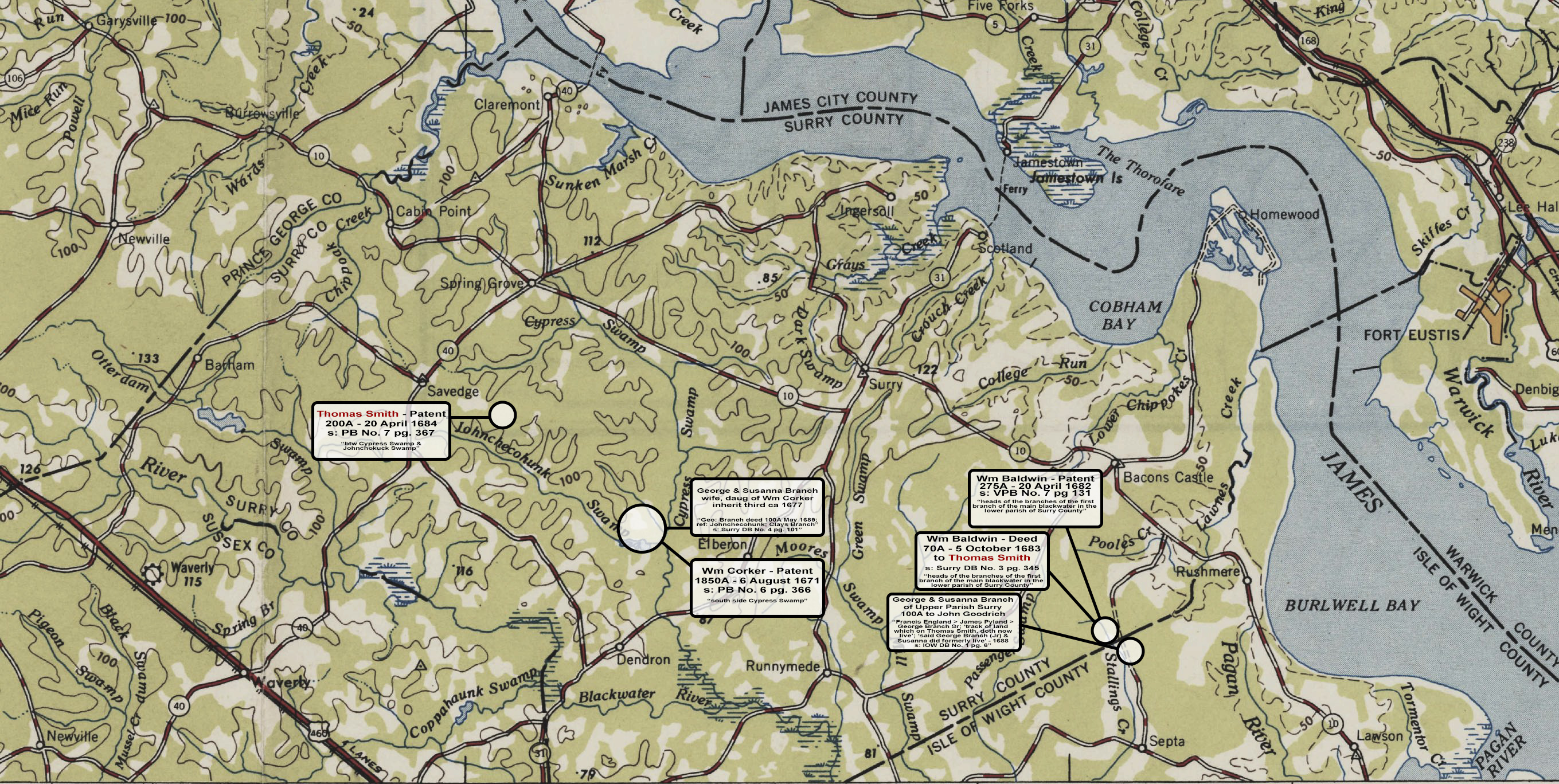
Thomas Smith appears to follow the Branch’s to Surry County by purchasing an adjoining property; 750 acres of a land from John Collins. This deed insinuates that Thomas Smith was living in Isle of Wight County and reasonably supports he was living on land at the ‘first swamp’.
Surry County Virginia, Surry County Deeds, Wills, Etc No. 3 1684-1687, page 83

Know all men by these presents, I John Collins of the Upper Parish of the Isle of Wight County in Virginia, Planter, for a valuable consideration to me paid by Thomas Smith of the parish & county aforesaid, have bargained & sold & do hereby from me, my heirs & Ex'tors & Adm:rs forever bargain, sell, deliver, enfeoff and confirm unto the said Smith, to his heirs, assigns forever seven hundred and fifty acres of land being part of a patent for fifteen hundred & fifty acres to me granted ye 27th of April 1686 & situate between the maine blackwater & the pidgeon swamp in the Upper Parish of Surry County the said seven hundred & fifty acres of land being bounded northeasterly on the land formerly belonging to Capt. William Corker, deceased; northwest upon the land of William Rogers, southwesterly upon Mr. Warrens land & southeasterly by such a line being run from aforementioned Capt. Corkers to Mr. Warrens land aforesaid as will give the said quantity. To have, to hold the said seven hundred & fifty acres of land with his due share of all mines & minerals therein contained with free privilege of hunting, hawking, fishing & fowling together with all woods ways waters & all other ____ commodities, hereditaments whatsoever to the said land belonging or in anywise appertaining to him the said Thomas Smith his heirs or assigns forever in as full and any manner to all intents and purposes as anywise might or could have enjoyed the land by virtue of the afore cited patent or as the ____ learned in the law can devise, and I do hereby further oblig myself, my heirs, executors, administrators & in the____ of twenty thousand pounds of good tobacco & caske payable to the said Smith his heirs, executors, administrators and assigns upon demand to warrant and defend this my sale of all & singular the premises with these appurtenances to him the said Thomas Smith his heirs & assigns forever against all manner of persons claiming by from or under me and that the said land & ____ thereof as clear and free from all and all in manner of former bargains, sales, dowers, forfeitures, mortgages, judgments,  executions and all other manner of encumbrances whatsoever, and that I have at the signing & sealing hereof a good firm and indefeasible estate in fee to all & singular the promises in wit and of all which I have hereunto put my hand & seal the 3 day of May 1687. Signed John (his mark) Collins (seal). Witnessed by Thomas Tooke, Littleburg Epes, Arther Allen.
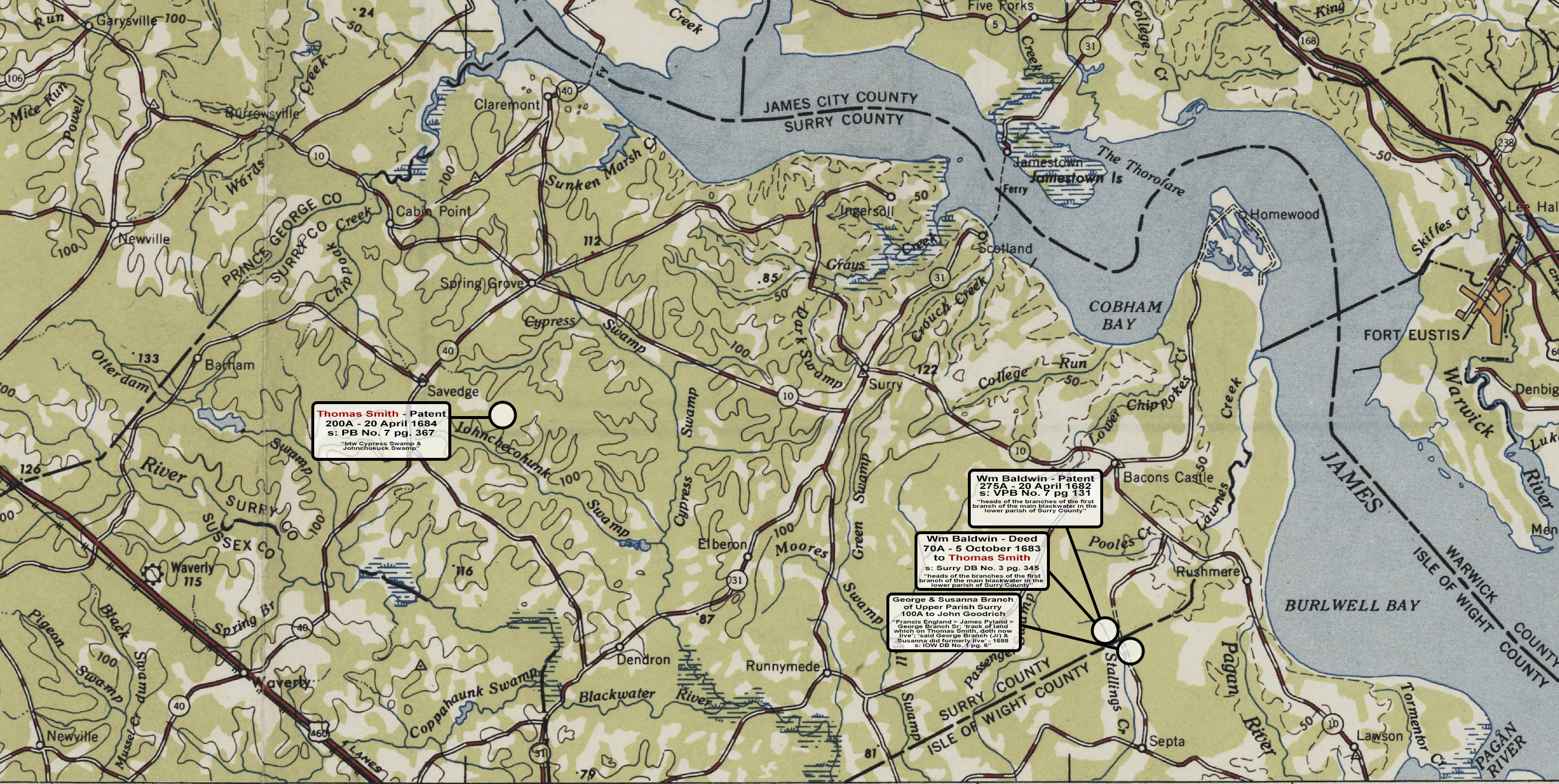
This property was located in Surry County near where the Johnchecohunk Swamp runs into the Cypress Swamp and the Cypress Swamp runs into the Blackwater River.
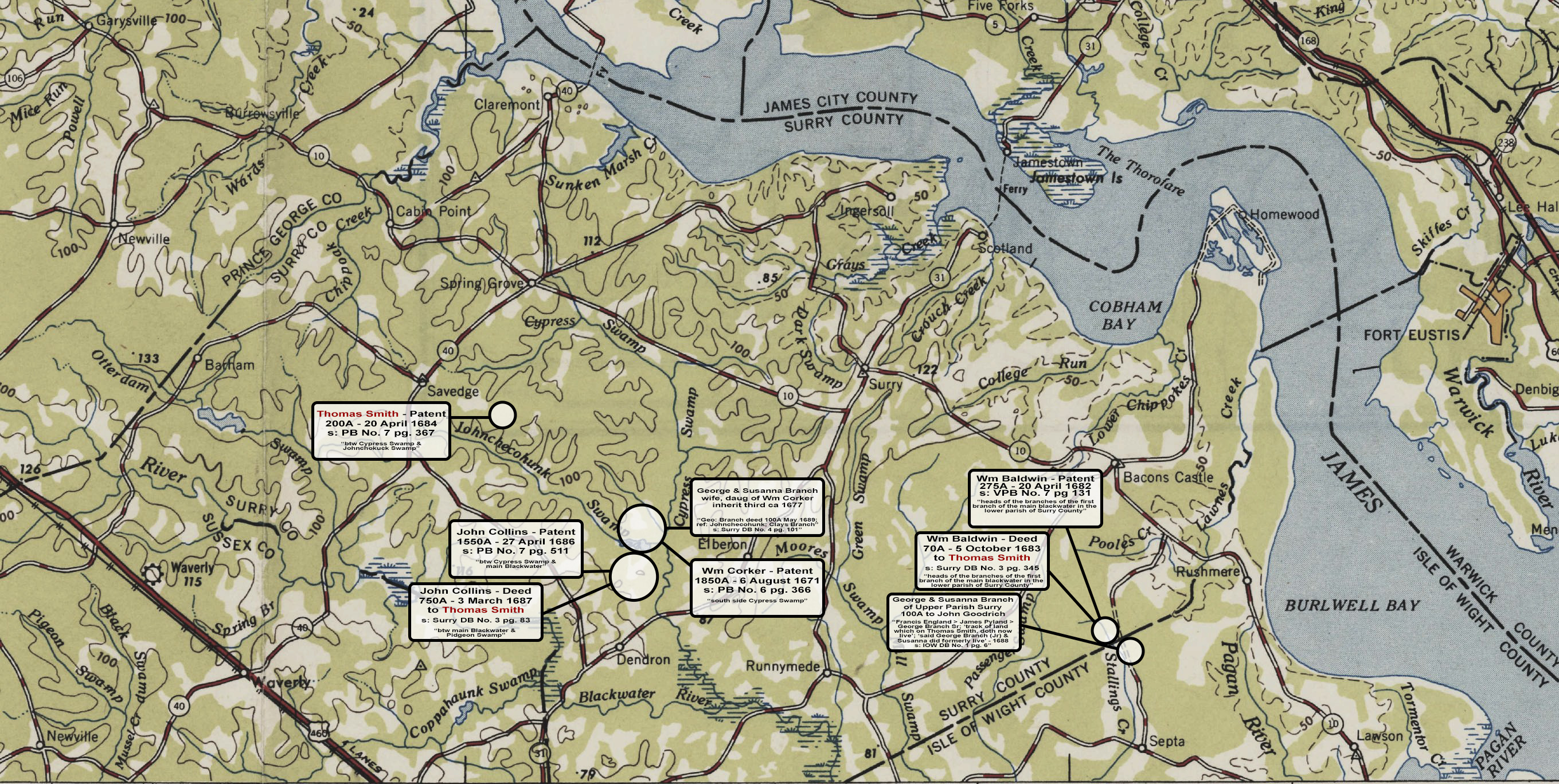
Below, is my detailed interpretation of a map showing where Thomas Smith was living from about ca 1690 until his death. Click on the below image for a larger version.
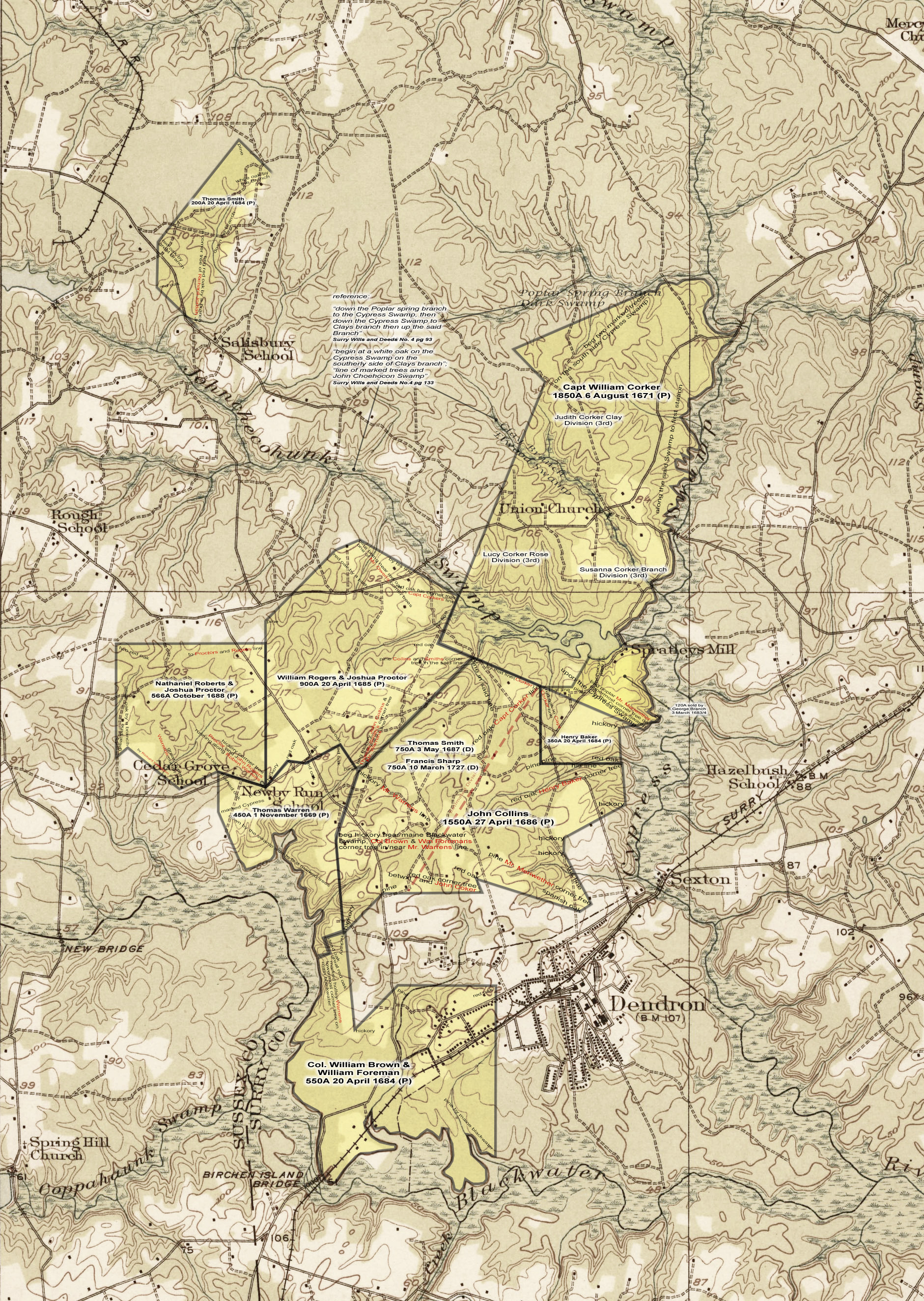
The 1690 Surry County tithable list is the first year that shows Thomas Smith living in Surry County. The list shows the names of heads of households and all males not being slaves of the age of sixteen and older; and all slaves in the household, either male or female, twelve years of age and older. The 1690 list shows, “Tho: Smith – 1” which indicates Thomas Smith as the head of household and he does not have any males or slaves living in the household. (source: Surry County Wills and Deeds, No. 4 1687-1694 page 150)
The 1692 Surry County tithable list is the first year that shows Thomas Smith and his tithable Thomas Smith Junior

Since this is the first year that Thomas Smith Jr appears on a tithable list, it normally assumes he is now 16 years of age. This would project Thomas Smith Jr being born before June of 1676. And to project a birth year for Thomas Smith Sr, assuming he was at least 22 in 1676, he would have been born ca 1654.
Also upon further review of the above tithable list it can be observed that five entry’s below Thomas Smith Jr is a Richard Smith. This Richard Smith of Surry County lived nearby on Pidgeon Swamp and based on DNA deduction, is of no relation to this Thomas Smith. Descendants of Richard Smith have been resolved to the R-M269 haplogroup, while if my research is accurate Thomas Smith descendants would resolve to the J-M267 haplogroup.
Richard Smith’s known children are Elizabeth Smith Sessums Boon, Richard Smith Jr, Thomas Smith and Nicholas Smith. There are several contemporary Thomas Smith’s in Surry County and Isle of Wight during this period and to make matters worse is they exhibit similar migration patterns over the next 100 years. Another interesting bit of information is that Richard Smith Jr’s son Richard Smith (III) married Amy Avent (Avant). Amy Avent’s first cousin once removed is Ransome Avant, who is known to my fellow Smith researchers, lived next to Needham Smith Sr in Washington County, Georgia during the early 1800s.
Thomas Smith Sr wrote his will 29 September 1722.
Surry County Virginia, Surry County Wills and Deeds No. 7 (1715-1730) pg. 441

In the name of God Amen the twenty ninth day of September 1722. I Thomas Smith Sen of the county of Surry, Planter, being very sick and weak in body but of perfect mind and memory thank be given unto God therefore calling unto mind the mortality of my body and knowing that it is appointed for all men once to die do make and ordain this my last will and testament. That is to say first of all I give and recommend my soul into the hands of god that gave it and my body i recommend to the earth to be buried in decent Christian burial at the discretion of my Executors not doubting but at the general resurrection I shall receive the same again by the might power of God and as touching such worldly estate where with it hat pleased almighty God to bless me in the life. I give demand and dispose of the same in the following manner and form. I give to my well beloved son Thomas Smith and son George Smith my estate to be equally be divided betwixt them both after my debts be paid ought of it and I do hereby utterly, disallow, revoke, and disannu all and every other former testaments, wills, legacy's and requests by me in anyway before named willed and bequeathed ratifying and conforming this and no other to be my last will and testament. I make and ordain my son Thomas Smith my sole Executor. In witness where of I have hereunto set my hand & seal the day an year above written. Signed Thomas Smith (seal). Witnessed: Harmon (H) Horn, William Bynam.
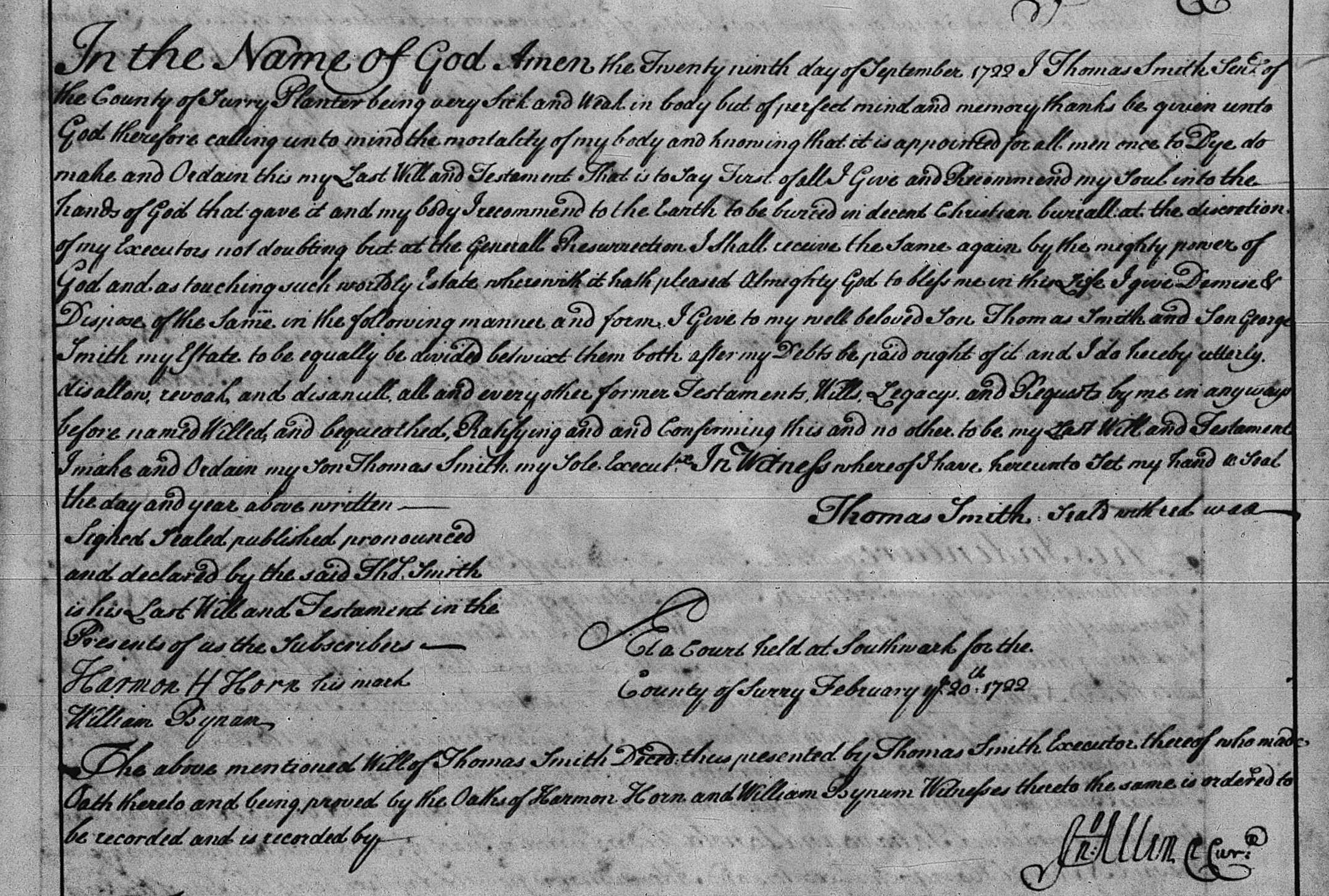
Thomas Smith Sr died ca February 1722 as his will appears probated on 20 February 1722/3.
Thomas Smith Jr and George Smith will keep their father’s tract of land in Surry County until 1727, when Thomas Smith Jr sells the 750 acres to Francis Sharp.
Surry County, Virginia; Surry County Wills and Deeds, Book 7 (1715-1730) page 788

Thomas Smith of ye Upper Parish of Isle of Wight County on the south side of Nottoway River in Virginia, Planter to Francis Sharp of Surry County in Virginia, Carpenter; 10 shillings of lawful money of England; track of land containing by estimation seven hundred & fifty acres situate lying & being between ye Main Blackwater & ye Pigeon Swamp in ye Upper Parish of Surry County & bounded as followeth, north easterly on the land formerly belonging to Capt William Corker deceased, north west upon the land of William Rogers, south westerly upon Mr Warrens land & south easterly by such a line being run from ye aforementioned Capt Corker to Mr Warrens land aforesaid as will give ye said quantity to have & to hold ye said plantation being part of a track of fifteen hundred & fifty acres by patent granted for the same to John Collins formerly of ye Upper Parish of ye Isle of Wight County in Virginia bearing date ye 27th of April 1686; 10 March 1727. Signed by Thomas (his T mark) Smith (seal). Witnessed by James Ramsay, Owen (his mark) Mirack.

At a court held at Southwark for the County of Surry March ye 20th 1727.

This day appeared in court the within named Thomas Smith & did acknowledge the within mentioned contents to be his real act & deed which is ordered to be recorded & is recorded by ...
A very important clue in the above deed is that it states that Thomas Smith is of the Upper Parish of Isle Wight on the south side of Nottoway River. This gives researchers a bread trail to follow this Smith ancestry.
Interesting side note about the above deed. Thomas Smith Sr is estimated to be the authors’ 7th or 8th great grandfather (paternal line). Thomas Smith Jr sells the above tract of land to Francis Sharp who is surmised to be the authors 8th great grandfather (maternal line). [Francis Sharp > Elizabeth Sharp Garris > William Benjamin Garris > Bedford Garris > Winnifred Garris Blackman, William Blackman, Martha Jane Blackman, William Benjamin Hazelwood, Alma Imogene Hazelwood]
Francis Sharp also identifies this Thomas Smith land by name in his will.
Surry County Virginia, Surry County Deeds, wills, etc., No 9 pg 115

In the name of God Amen I Francis Sharp of the parish of Lawnes Creek in the County of Surry ... [truncate] ... Item: I give to my son John Sharp the house or tenement now in the occupation of Roadwell a shoemaker it lying in the city of Williamsburg and the plantation whereon I now live upon that is now called by the name of Young Thomas Smiths, then along a line of marked trees near an east course to a branch called Possums and into the great Branch which said house, land and plantation I give unto my said son John Sharp and to his heirs and assigns forever excepting what timber my son Jacob and William Sharp shall want off of the said land ... [truncate] ...
 digging our roots
WOW, J-M267? That’s extremely rare among Europeans and White Americans. J-M267 is a Middle Eastern haplogroup. Were any of your ancestors Jewish or Arab?
LikeLike
Hi Sophia
No Jewish or Arabic that I am able to trace in the Smith line (or any of my lines) through genealogy or atDNA (150-200 years). It’s likely Thomas Smith came from England and I have another Y-DNA cousin that lives in England and his ancesters are from England. So the J-M267 line likely came to England in the early days. One concept is that it came from the Romans during their occupation of England. Maybe from a low level solider or slave. Who knows.
/r
Mike
LikeLike