
At this stage of my research, I have identified a common DNA link between Isaiah Smith Sr and Needham Smith Sr.
For repetition, I have a DNA match to a user who’s traced lineage via documented sources starts with Patricia Rhodes > Minnie Claire Cox > Charlie Needham Cox > Needham Cox > Elizabeth Ann Smith > Needham Smith Sr > ???
We are likely 5th to 8th cousins which makes our common ancestor either our 4x, 5x, 6x, or 7x great grandparent. If Needham Smith’s parents were the common ancestor then that would be Patricia’s 4x great grandparents and my 5x great grandparents.
As a side research note, Patricia also shares DNA matches with my great uncle Clayton Smith and his son Richard Smith.
Many family genealogist claim that Needham Smith’s father is a William Smith from Albermarle County, Virginia. This likely stems from, ‘Genealogy: A Journal Of American Ancestry, Volume 6’, edited by William Montgomery Clemens, copyright 1916.
THE SMITHS OF GEORGIA
(Contributed to Genealogy)
John Smith emigrated from Bristol, England, in 1700. He had two sons, John Smith, who married Ann Marshall and Augustine Smith, who married Elizabeth Marshall, who were daughters of John Marshall and Elizabeth Markham.
John Smith the first sone of Augustine Smith and Elizabeth Marshall had two sons, Henry and William. The first emigrated to Kentucky and William went to Georgia, and settled in Washington County.
William Smith of Georgia had one son Needham Smith and two daughters, Mary and Martha. Mary Smith married William Bland. Martha Smith married Ransome Davis Avant and their daughter Malinda married John Cox; their daughter Isabella married John E. Smith.
Ransome Davis Avant married Martha Smith about 1794. Both the Smith family and the Avant family were from Albemarle County, Virginia. William Smith and Joseph Avant, the father of Ransome, were soldiers in the 9th Virginia Regiment under Col. George Mathews, and who also induced the emigration to Georgia after the war.
This genealogy has led to many family genealogist and other authors to include it in their work. For example in:
- ‘Roster Of Revolutionary Soldiers In Georgia And Other States’, compiled by Mrs. Howard H. McCall, copyright 1968, pg 113.
WILLIAM SMITH, b. 1746 in Va. (son of John Smith and Martha Alexander; grand-son of Augustine Smith and Elizabeth Marshall). He mar. in Va., 1774, Mary Richards, b. 1756; d. 1820, in Ga. He d. in Ga., 1834. He was a REV. SOLDIER of Va., served in the 9th Va. Reg., commanded by Col. George Matthews. About 1785, he came with his family to Ga., with Colony headed by Col. Matthews. He received a bounty grant of land in Washington Co., Ga. for his services. One son (known):
1. Needham Smith (1775-1845); mar., 1795, Tabitha Tillman (1780-1847).
- ‘The Georgia Frontier Volume II: Revolutionary War Families to the Mid-1800s’, by Jeannette Holland Austin, copyright 2005, pg 368.
Smith of Virginia;
Washington CountyWilliam Smith was born in Albermarle County, Virginia, died 1824 Oconee District, Washington County. He was married in 1774 to Mary Richards of Albemarle County, Virginia. Revolutionary War Soldier.
William Smith was a son of John Smith and his wife, Martha Alexander, and grandson of Augustine Smith and his wife, Elizabeth Marshall, and a great-grandson of John Smith who was born in Bristol, England and who came to Virginia in 1700.
William Smith settled near Buffalo Creek on the Oconee River, having drawn 287 1/2 acres of land on 10 April 1785, for being a Revolutionary War Soldier.
Warren County Deed, Book B, Page 74, on 5 January, William Smith of Washington County to James McCormick, William Smith having obtained the 200 acre grant on 7 January 1786 on Brier Creek. Witness: Hardy Smith and Samuel Smith.
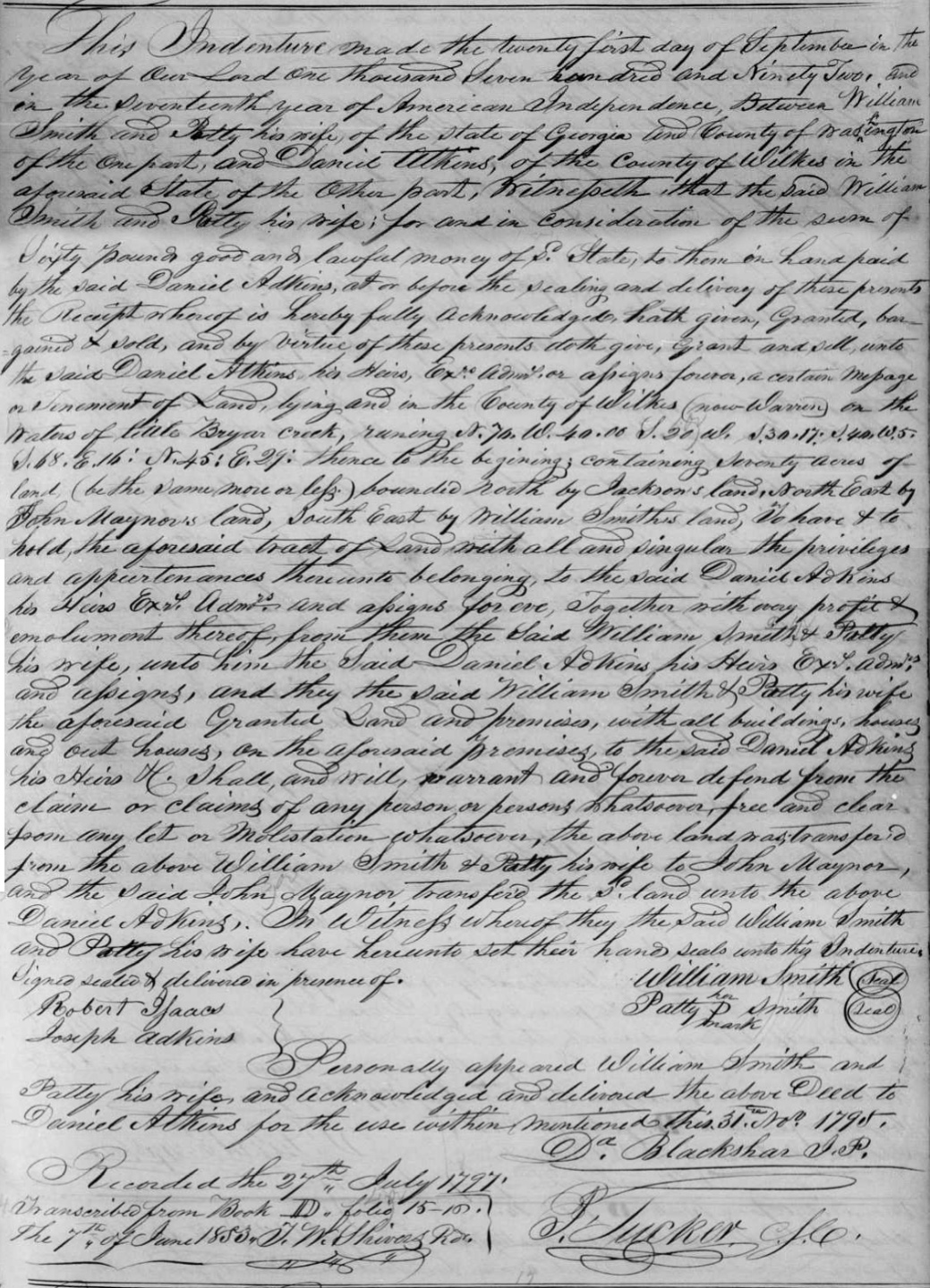
Warren County. Ga. Deed Book A, Page 296-7, on 21 September 1792, William Smith and his wife, Patty, of Washington County to Daniel Atkins of Wilkes County, 70 acres on Little Brier Creek.
Washington County, Ga. Surveyors Records – …. William Smith, granted 70 acres, 6 April 1789.
Issue:
I. Needham Smith, born 1775, died in Washington County, Georgia in 1845. He married Tabitha Tillman, born 1780, died 1847.
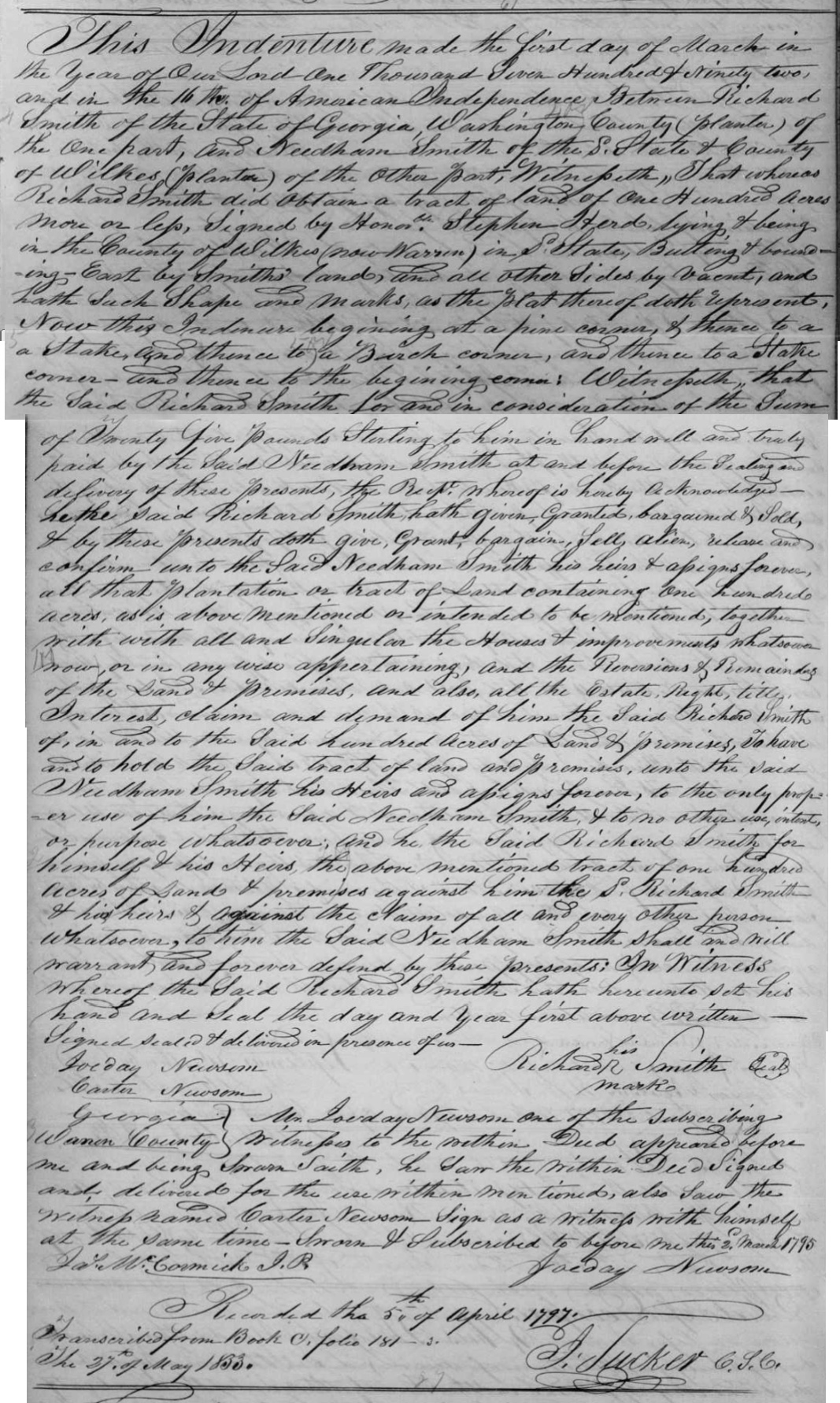
Warren County. Deed, Book A. Page 249-50, dated 1 March 1792, Richard Smith of Washington County to Needham Smith of Wilkes County, now Warren County, 100 acres of land.
II. Mary Smith married William Bland.
III. Martha Smith married Ransom Avant.
- Numerous NSDAR & NSSAR applications.
- Numerous family tree’s.
—————————————————————————————————————————————–
The goal for the following content is to try and dissect each statement to validate or deliberate the value of it’s content.
Clemens
John Smith emigrated from Bristol, England, in 1700. He had two sons, John Smith, who married Ann Marshall and Augustine Smith, who married Elizabeth Marshall, who were daughters of John Marshall and Elizabeth Markham.
John Smith the first son of Augustine Smith and Elizabeth Marshall had two sons, Henry and William.
It appears that Clemens may have partially derived this information from an earlier source. In ‘The Marshall Family‘, by W.M. Paxton, copyright 1885, a reprint of the ‘Will of John Marshall’, it is found:
- Item: I give and bequeath unto my beloved daughter, Ann Smith, one negro boy named Daniel, now in possession of Augustine Smith.
- Item: I give and bequeath unto my beloved daughter, Lizzie Smith, one negro boy named Will, now in possession of John Smith.
It seems Clemens may have gotten it backwards. John Smith married Elizabeth Marshall and Augustine married Ann Marshall. However, ‘The Marshall Family’, does further iterate that John and Augustine are suppose to have been brothers, the sons of John Smith Sr., a native of Bristol, England who came to Virginia about 1700 and settled on Mattox Creek, Westmoreland County, near Thomas Marshall.
This source does not provide the names of any children of Augustine and Ann Smith, but in Will Book Vol 1 of Fauquier County, Virginia in a division of land it list the following people likely their children: Joseph Smith, Thomas Smith, Matthew Smith, John Smith, James Smith, William Smith, Augustine Smith, Elizabeth Smith and Susanna Smith.
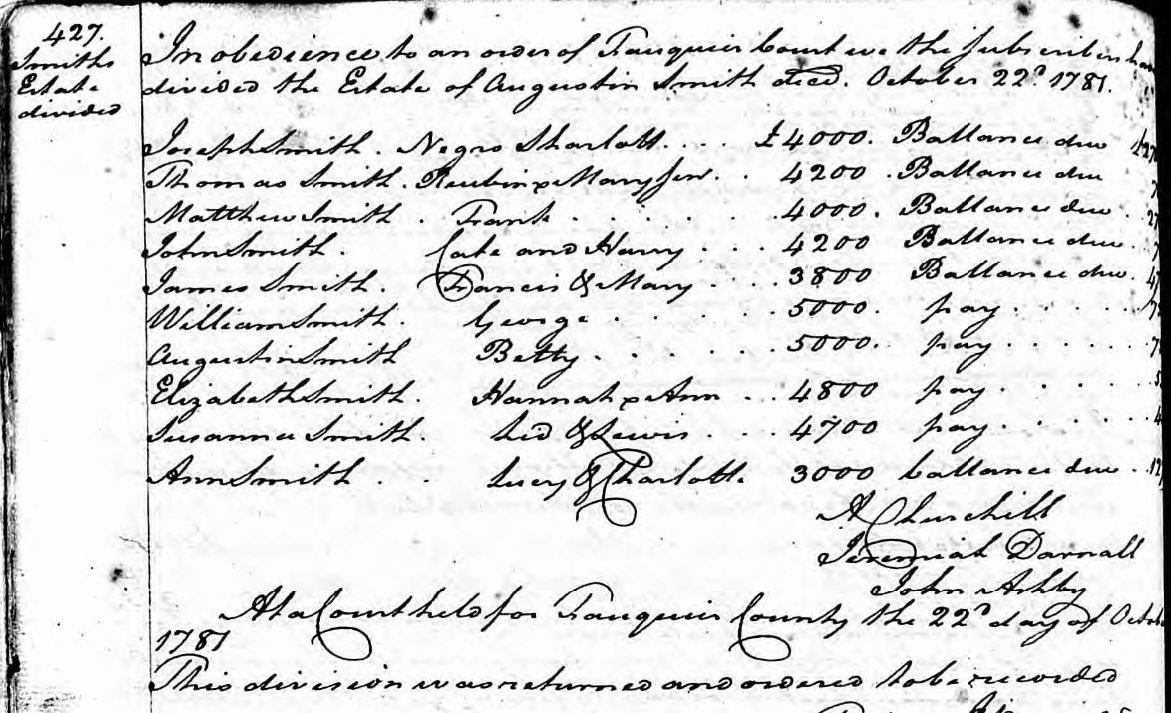
Augustine and Ann were married about 1745. If John was the first son of Augustine as claimed by Clemens then he would project to have been born around 1746. Ann was born about 1725.
Clemens further states that John had two sons Henry and William. William would project to be born around 1770 – 1774 (this assumes that John’s wife was born about 1749).
At this point in the discussion it appears that the math doesn’t add up. If Needham Smith Sr was born 1775 (likely incorrect, but more on that later) then William son of John son of Augustine surely could not be his father or have migrated to Georgia in the 1780s.
This would also have to discredit McCall and Austin’s claim as well.
McCall
WILLIAM SMITH, b. 1746 in Va. (son of John Smith and Martha Alexander; grand-son of Augustine Smith and Elizabeth Marshall).
Austin
William Smith was a son of John Smith and his wife, Martha Alexander, and grandson of Augustine Smith and his wife, Elizabeth Marshall, and a great-grandson of John Smith who was born in Bristol, England and who came to Virginia in 1700.
Conclusion: I think this information while partially true is some aspects for the Smith’s in Fauquier County, Virginia does not pertain to or connect to the father / parent of Needham Smith Sr.
Neither does William Smith the son of Augustine. This William appears to have been born around 1755 in Fauquier County, Virginia, married Ann Ashby about 1782 and died in 1823 in Fauquier County. He appears to have been a Lieutenant in the Revolutionary War.
—————————————————————————————————————————————–
Clemens
William Smith and Joseph Avant, the father of Ransome, were soldiers in the 9th Virginia Regiment under Col. George Mathews, and who also induced the emigration to Georgia after the war.
Clemens claims William and Joseph Avant where soldiers in the 9th Virginia Regiment under Col. George Mathews. History tells us that Colonel George Mathews was in command of the 9th Virginia Regiment from 10 February 1777 to 14 September 1778.
Reviewing the numerous muster reports of the different company’s under Col. Mathews during this time (primarily up until Col Mathews and the 9th were captured in October 1777), does not list a William Smith or a Joseph Avant (Avent) serving in the 9th Virginia Regiment.
Below is one of the many muster sheets that were reviewed. This one is from Captain Samuel Woodson’s Company, August 1777.

Original data: Revolutionary War Rolls, 1775-1783; (National Archives Microfilm Publication M246, 138 rolls); War Department Collection of Revolutionary War Records, Record Group 93; National Archives, Washington. D.C.
Since Needham Smith Sr’s lineage does not connect to the Smith’s of Fauquier County, and doubt exist the Smith’s of Black River in Cumberland County, North Carolina or the Avent’s (Peter and son Joseph) of Avent’s Ferry, Chatham & Cumberland Counties, North Carolina were enticed by George Mathews to move to Georgia. Many of those people Mathew’s enticed decided to relocate their families to the Goose Pond as part of the Virginia migration to the Wilkes frontier. (Note: there was a William Smith granted land on Millstone Creek which is in the proximity of Goose Pond. Was this William mistakenly assumed to be Needham’s father and how past researchers link/assumed Needham was connected to the Smith’s of Fauquier County? This is covered as bullet W3 futher down this page.)
The Black River Smith’s migrated to Wilkes County, Georgia which later became part of Warren County and the Avent / Avant’s likely migrated to Washington County (the part that became Greene County prior to 1787 – Joseph Avent) and Wilkes County (likely the part that became Warren – Thomas Avent). The map snippet below goes to show the distances where these three families settled from each other. An effort to support that what Clemens suggested was unlikely true.
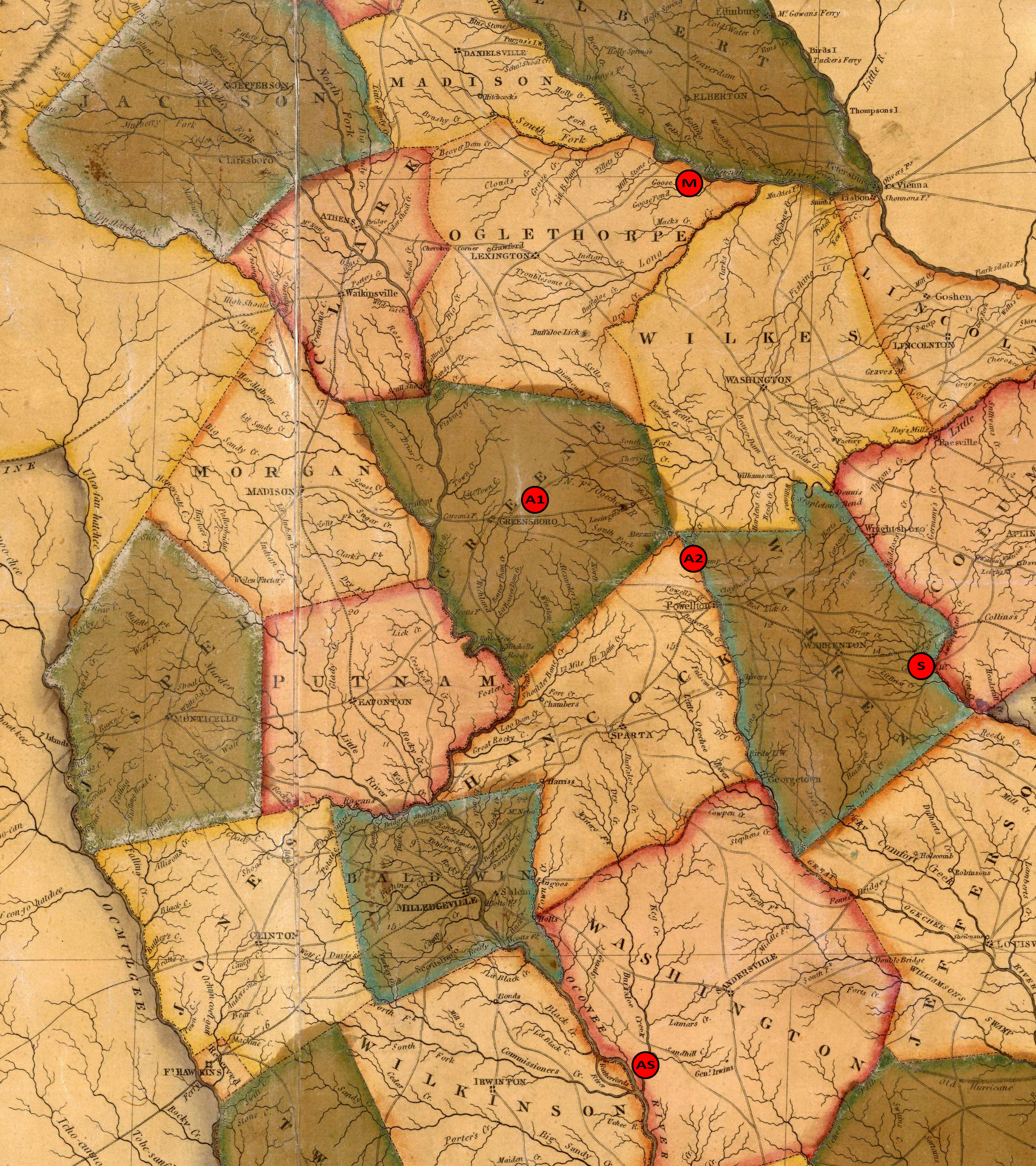
The M on this map represents the approximate location of Goose Pond. The S represents where the Black River Smith’s migrated. A1 represents a generalized area where Joseph Avant received Bounty Land in the Bounty Reserve and A2 represents a generalized area on the Ogechee River where Thomas Avent settled. AS represents the area where the Avant’s and Smith’s established land in the early 1790s and lived among each other in Washington County.
Conclusion: I think this information from Clemens is false. The Smith’s and Avent’s, intended to be identified in context, were actually living in North Carolina during the American Revolution and up to 1783/4 when they migrated to Georgia. This is supported by deeds found in Cumberland County, North Carolina.
This also goes to discredit Clemens, McCall and the numerous applications within NSSAR and NSDAR.
Clemens
Both the Smith family and the Avant family were from Albemarle County, Virginia. William Smith and Joseph Avant, the father of Ransome, were soldiers in the 9th Virginia Regiment under Col. George Mathews, and who also induced the emigration to Georgia after the war.
McCall
He was a REV. SOLDIER of Va., served in the 9th Va. Reg., commanded by Col. George Matthews. About 1785, he came with his family to Ga., with Colony headed by Col. Matthews.
NSSAR/NSDAR
The said William Smith is the ancestor who assisted in establishing American independence while acting in the capacity of a soldier in the Revolutionary War. William served in the Ninth Virginia Regiment, commanded by Colonel George Matthews. This regiment was captured by the British and held prisoners on a prison ship. After several months it was exchanged and took a regular place in the army. About 1779 Colonel Matthews was ordered to take his regiment to Georgia to aid General Green in driving the British out of Georgia and the Carolinas. This regiment participated in many of the battles of Georgia, the Carolinas, and Virginia. It was also in the siege of Yorktown when Cornwallis surrendered. In 1785 Colonel Matthews led a body of emigrants from Albemarle County, Virginia to Georgia of which was William Smith. He settled with his family in Washington County, Georgia on Buffalo Creek near the Oconee River. .
However Clemens latched on to Albemarle County, I’ve always wondered if there was a mistaken interpretation of the data and it was actually meant to indicate Albemarle County, North Carolina. Which the Smith’s (Chowan) and Avant’s (Northampton) can be traced too.
—————————————————————————————————————————————–
Clemens
William Smith of Georgia had one son Needham Smith and two daughters, Mary and Martha. Mary Smith married William Bland. Martha Smith married Ransome Davis Avant and their daughter Malinda married John Cox; their daughter Isabella married John E. Smith.
Ransome Davis Avant married Martha Smith about 1794.
I concede that there exist a Needham Smith and likely a Martha Smith. There is no information that I have researched that indicates any relationship between Needham, Martha, and Mary.
I have not come across any records indicating the existence of a Mary Smith, however I have seen a land record (200 acre headright Washington Co. 22 May 1807) for William Bland that puts him in the right place at the right time. So this union could be possible.
As for Ransome and Martha Smith, while there are no records to prove this union, I’m inclined to believe in its truth as I have a DNA match to a user who’s traced lineage via documented sources starts with Terrance Morgan Baxter III > Terrance Morgan Baxter II/Jr > Eugenie Avant > James Hunter Avant > David Freeman Avant > Ransome Thomas Avant > Martha Smith > ???
The only element in Clemens above statement that is questionable is identifying a William Smith as Needham’s father.
There are a few things that need to be discussed to enlighten the reader on the ways how land was dispersed in Georgia during the late 18th century. To start, assuming the reader already has a little exposure or knowledge about the Georgia Headright and Bounty Land Grant System, a great article to read is, ‘Georgia Bounty Land Grants’, by Alex M. Hitz. It can be read here for free.
From that article some items extracted that are pertinent to this discussion:
- Bounty grants initially granted to officers and enlisted men of
- the four regiments of the Georgia Line attached to the Continental Army
- the three Minute Battalions of the Georgia Line Regiments. Minutemen were all non-residents of Georgia at the time of their enlistments, recruited from other states.
- State Militia – patriotic members of the former King’s Militia
- Men who had fled from the state when their homes were over run by the British and had enlisted and fought in the Militia Regiments of South Carolina and North Carolina, know as Refugees.
- and entitled Citizens (post 20 August 1781), who remained in the state for ten months, at home and in peace with their neighbors
- Land set aside for these bounty lands called the “Bounty Reserve” was located in the south end of old Franklin County and the north end of old Washington County. The same territory is today part of Oconee, Oglethorpe and Greene counties, lying between the Oconee and Appalachee rivers. (See map below. Orange area is an approximation of the Bounty Reserve area)
- Only the governor’s numbered certificate indicated whether the grant was made to a civilian, or to a soldier, or to the purchaser and transferee of another man’s rights.
- Some unauthorized person, probably about 1920, created confusion by writing the word bounty on many pages in the survey books and grant books, where the acreage suggested to him that the early clears should have done so, even though the dates indicated that the grant could not lawfully have been a bounty.
- No bounty grants would be allowed or passed after February 22, 1786 unless application had been made prior to that date.
- The county surveyor or one of his deputies would survey the land chosen by the applicant, make three plats thereof, record one copy in a book in his office, and forward two copies together with the executed warrant, to the surveyor-general; one to be recorded and filed in the latter’s office and the other to be attached to the grant.
- Supplemental info: it was normally the responsibility of the prospective land owner to be the lead showing the land’s supposed boundary to the surveyor. It was also the prospective land owner’s responsibility to hire two chain carriers to assist the surveyor. Generally, there was a legal requirement that chain carriers take an oath as to the honesty of their work; therefore the chain carrier should have been of legal age. It was common practice for a member of the family or adjacent land owners to serve as a chain carrier.
With the Goose Pond fantasy aside, McCall added that a William Smith, “received a bounty grant of land in Washington Co., Ga. for his services.” And Austin added that this William, “settled near Buffalo Creek on the Oconee River, having drawn 287 1/2 acres of land on 10 April 1785, for being a Revolutionary War Soldier.”
Searching the Georgia, Headright and Bounty Land Records, 1783 – 1909, the Warrant that is likely suggested by McCall and Austin, is a warrant to the surveyor for Washington County, Georgia to admeasure a track of land which shall contain two hundred and eighty seven and a half acres in the county of Washington. This warrant was signed 17 May 1784.
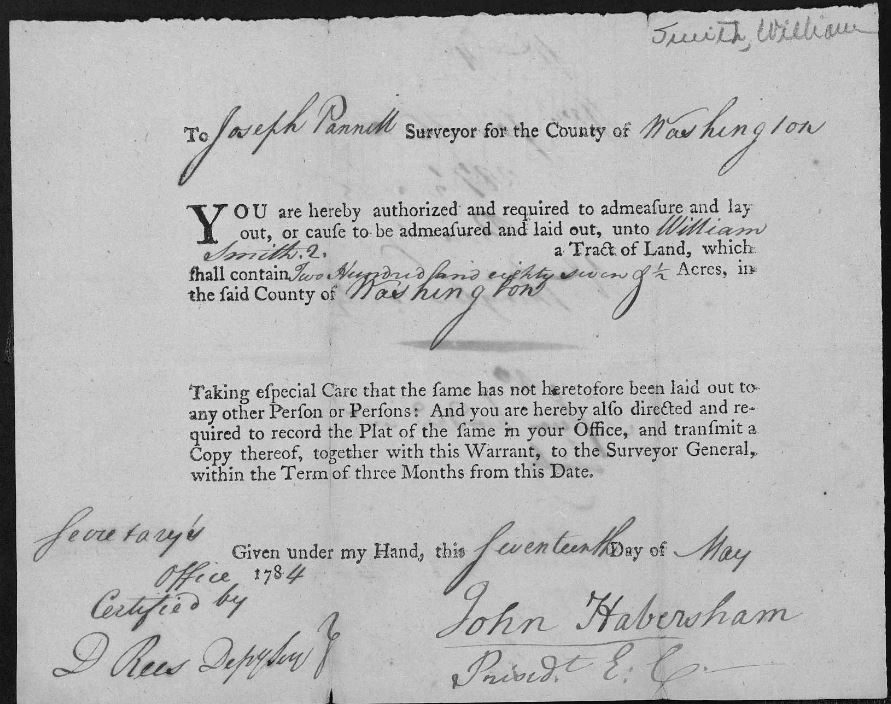
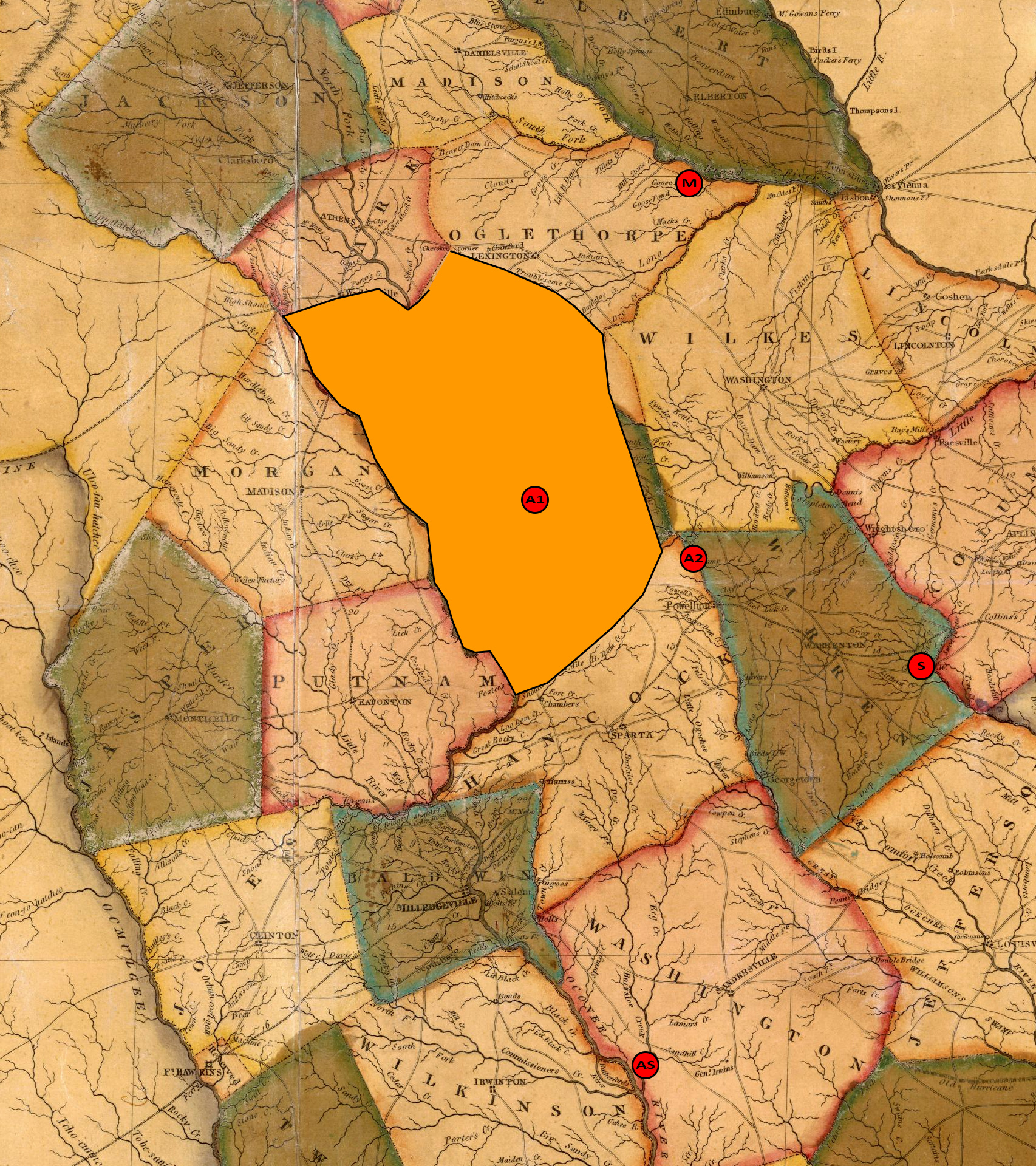
Understanding that bounty grants between 17 February 1783 and 22 February 1785 were lawfully to be granted in the Bounty Reserve (orange area above, which is an approximation of the area), this warrant would assume to be for land in the Bounty Reserve, which by indication of the map above is quite a distance from where it is believed the Smith’s and Avant’s lived (AS) post 1793 in Washington County (vicinity of Oconee River and Buffalo Creek).
Conclusion: Knowing that this Bounty Grant would have been for men living in Georgia and the land located in the Bounty Reserve it appears that this statement is incorrect as well.
While not vetted, a more reasonable explanation or cause for doubt is found in the, “Pioneers Of Wiregrass Georgia Vol 1”, by Huxford. A William Smith was born in Georgia, March 16, 1765, a son of Madison Smith who was born 1720 in Hampshire, England, and emigrated with his father, Madison Smith, Sr., to Georgia in 1733. He grew up in Liberty County and moved to Appling County. Huxford suggest that Mr. Smith was a Revolutionary soldier and served in the Georgia Line (p. 392, Knight’s Roster of the Revolution). For his services he was granted 2871/2 acres in Washington County, April 10, 1785 (p. 291, Knight’s Roster of the Revolution).
As for Austin’s claim, it appears more centered on the land grant T2 below. Below is a list of land grants from Wilkes and Washington County for a William Smith. For the fact that most bounty grants in 1884 lawfully should have been issued in the vicinity of the Bounty Reserve (that falls in Oconee, Olgethorpe, and Greene Counties), this seems unlikely to be a grant for southwestern Georgia near the town of Oconee (which didn’t see grants of land until the 1890s).
Wilkes
- W1 – Wilkes – 205 acres; his family headrights; 23 May 1787; Hardins Creek
- W2 – Wilkes – 200 acres; old warrant of Ambrose Crawford; 1793; Williams Creek
- W3 – Wilkes – 300 acres; lieu of part of an old warrant of six hundred acres Shadrick Roziers; 15 September 1788; Millstone Creek/Broad River
- W4 – Wilkes – 74 acres; family headright; October 1787; Little Brier Creek
- W5 – Wilkes – 200 acres; lieu old warrant Knowles Pace; March 1784; Cherokee Creek/Little River
- W6 – Wilkes – 39 acres; lieu part of an Hugh McDonald old warrant; August 1789; Cedar Creek
- W7 – Wilkes – 200 acres; in lieu of an old warrant near his old survey on Fishing Creek; 4 March 1784; Note: this William also established a 100 acre tract on Fishing Creek on 10 October 1774.
- W8 – Wilkes – 200 acres; 1785; Cedar Creek
- W9 – Wilkes – 200 acres; 1784; Brier Creek
Washington
- T1 – Washington – 400 acres; two old warrants one in his own name other John Smith; August 1785; Beaverdam Creek
- T2 – Washington – 287.5 acres; 1785; 6 April 1785; Buffalo Creek (note: warrant states 187.5 acres and seems likely corrected on the plat and ledgers. Warrant does not indicate that this is for bounty or an old warrant). The record after this states the same but is for Oconee River.
- T3 – Washington – 200 acres; part of old warrant in the name of James Robinson; 5 May 1794; Sandhill Creek
- T4 – Washington – 349 acres; headright; April 1793; Gum Creek
- T5 – Washington – 200 acres; 5 April 1785; Richland Creek
- T6 – Washington – 330 – on headrights; 5 August 1790; Gum Creek

The first William Smith that I can track to this region, Washington County in the vicinity of Oconee River and Buffalo Creek, is T3.
The Black River Smith’s of Cumberland County, North Carolina came to Georgia and settled on Brier Creek (W9) in Wilkes County, later Warren County, in the later part of 1784. Richard, William and Needham were the first Smith’s in this region of Brier Creek. Richard established on Brier Creek, Needham appears to be on Big Brier and William on Little Brier. This all being within a 5 to 8 mile stretch of each other.
My working theory, is that William from Little Brier Creek in Warren County is the same William Smith (W9) to receive a headright on Sandhill Creek. Richard is already know to have 400 acres in Washington as of the 1791 Warren County Tax List. Is this what eventually brought some of the Smith’s from Brier Creek, Warren County to Buffalo Creek/Oconee River, Washington County.
Richard and William of Brier Creek were in Washington County as of 1792.
In conclusion, except for the Smith and Avant connections, most of what has been written about Needham Smith Sr lineage has be a farce. My working theory is that Needham’s father is Richard Smith and they moved from Cumberland County, North Carolina to Wilkes County, Georgia in 1785 and in 1791/2 they moved again to Washington County, Georgia around what is today the town of Oconee, Georgia.
 digging our roots
I really enjoyed reading your articles on the Smith Families. Myself and others have researched our Smith Family Tree and Richard Smith born 1767 in Cumberland, or Edgecombe, North Carolina and died in Greene County, Georgia. He married Patience Atkinson b 1770 NC, d the daughter of Nathan Atkinson b1750 d 1813 and Martha Whitehead b? d 1828 in Greene County, Georgia. All attempts to identify the parents of Richard Smith have been fruitless. It appears that the Richard Smith you write about I believe to be our Richard Smith because he came from North Carolina to Wilkes County and the land transactions appear to be the same. If you find any further information please email me regarding Richard Smith. We cannot locate his parents. There were a few Richard Smith’s that were in the Wilkes County and Greene County during this time period. Thank you for sharing your work.
LikeLike
Sandra
Thank you for the comment. Derived on what I have learned about Richard Smith, he would have been born before 1753 and more likely around 1747.
If your Richard was born 1767, this fits more in line with the age grouping of Needham and William Smith who moved to Wilkes with Richard. One avenue for you to consider is that Richard 1767 is the son of Richard 1747.
In 1789 Vincent Allenharp of Wilkes deeded 300 acres of land to a ‘Richard Smith Sen’. This is strong evidence that Richard 1747 likely had a son named Richard. This lot of land is assumed to be part of the taxable land that Richard 1747 was taxed as it is joined with the land warrants he received several years earlier.
After Richard 1747 moved to Washington County, there is a Richard Smith that is still in Warren County. He can be found in tax records and news paper articles. I’ve yet to research this Richard to determine if he died in Warren or moved anywhere else (i.e. Greene). May be worth seeing of the dots connect.
I’d be interested if you find anything. And if you would like to discuss this further, I’m more than happy to chat. I’ve spent a long time trying to work this period of time …
/r
Mike
LikeLike
I’ve been tracing my Smith roots back and I am going to let you all in on a huge secret I uncovered while doing this. There was ALOT of incest going on back then. That’s why the repetition in names. They were marrying their 1st cousins and brother/sister combos. All of the smith’s that came over from London/Ireland/Scotland are all intertwined no matter what anyone says. Pay attention to how they name their kids too there is a pattern. I managed to get back to roughly 1700 and the names started changing or disappearing. Almost like the guys changed last names as well. Pay attention to what religion was big in all the Smith families back then. There is the batch of Smith siblings and their families that came from Ireland/Scotland and there is a separate batch that came from London. I also found a couple that came alone. I’m pretty sure one faked his death in London and came to New York. I gave up trying to decipher the codes with the names. I just wanted to see where my origins are from and I know where and I know why they are hiding it. Notice how many David’s just up and “die”? Almost all of them. Good luck
LikeLike