Born around 1772, Mark Cole was the son of William Cole, though little else is known about his early family life, including the identity of his mother. Circumstantial evidence hints that William may have been residing in Halifax County, Virginia, or Rowan County, North Carolina, when Mark entered the world. By 1779, when Mark was about seven years old, the Cole family had moved to the Lick Creek area of Rowan County. It was there, amidst the close-knit community of Lick Creek, that Mark grew up, his childhood marked by the challenges and opportunities of life on the North Carolina frontier.
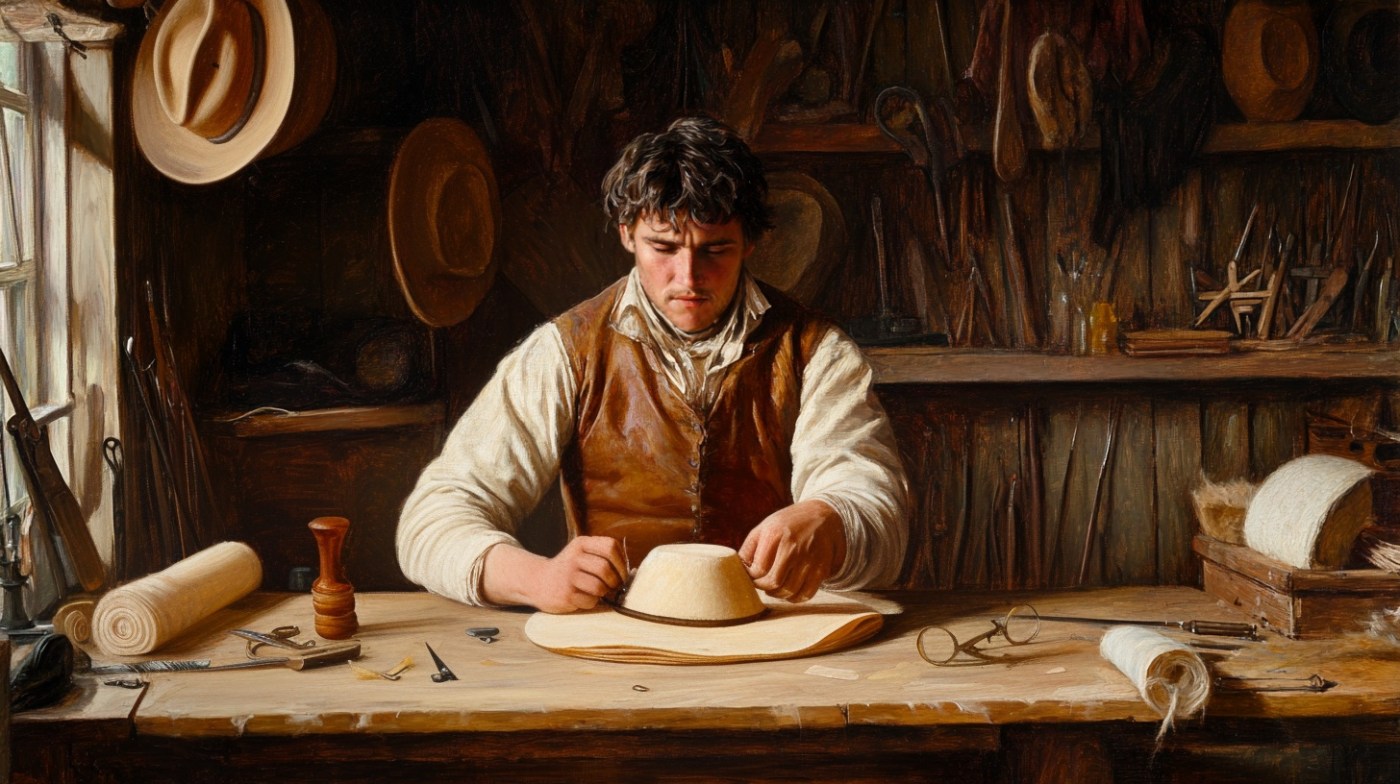
As Mark Cole grew into adulthood in the Lick Creek area of Rowan County, he took up an apprenticeship as a hatter, mastering a skilled trade that would later define his role in the community. A hatter was a craftsman responsible for creating hats, a vital accessory in the late 18th century that combined both function and fashion. Hats protected individuals from the elements and served as an important marker of social status, making the trade of hat-making both necessary and respected.
We know Mark pursued this trade thanks to a 1799 deed where Jacob Sheen sold land to “Mark Cole, Hatter.” (Rowan DB 16:622) This record not only confirms Mark’s occupation but also highlights his growing independence and place within Rowan County’s economy. As a hatter, Mark would have worked with materials like beaver or rabbit fur, crafting durable and stylish hats through meticulous processes such as felting, shaping, and finishing. In a time when communities were expanding and self-sufficiency was prized, skilled tradesmen like Mark were integral to local life, providing both practical goods and connections that wove individuals into the fabric of frontier society.
In a union that brought two Lick Creek families even closer together, Mark Cole married Sarah Cameron, the daughter of John Cameron, on 24 June 1794. The Camerons lived farther upstream on Lick Creek, about five or six miles from the Coles, toward the creek’s headwaters, while the Cole family was established at the creek’s mouth, where it emptied into the Yadkin River.
This was not the first time the Cole and Cameron families had come together—Sarah’s brother, Absalom Cameron, had married Mark’s sister, Mary Cole, in 1786, eight years prior to Mark and Sarah’s marriage. These connections highlight the close-knit nature of life along Lick Creek, where family bonds often extended beyond individual households. For Mark and Sarah, this marriage marked the beginning of their own chapter, grounded in a shared history and strengthened by the support of their intertwined families, all within the bustling yet intimate frontier community of Rowan County.
After their marriage in June 1794, Mark and Sarah Cole likely began their life together on a tract of land along Lick Creek. This land was purchased from Drury Goldsby (sometimes spelled Goolsby or Goolsbe), a figure of some importance in Mark’s life. Drury and his son, Wade Goldsby, were well-acquainted with Mark, as evidenced by Mark’s role as bondsman in Wade’s marriage to Jane Crook in 1787. Acting as a bondsman was not a trivial responsibility—it demonstrated trust and a close relationship, suggesting that Mark held both Drury and Wade in high regard.
It was on this Lick Creek property that Mark and Sarah likely welcomed their first child, Hester Cole, in the late spring of 1795. This would have been a busy time for the young family, balancing the demands of raising a child with the work required to maintain their new home. The lush surroundings of Lick Creek, combined with the support of nearby relatives and friends, likely provided a promising start for the Coles.
By around 1796, Mark and Sarah appear to have moved a little further east, settling near the headwaters of Cabbin Creek, near the Rowan and Randolph County line. This new location marked the beginning of a new chapter for the family and was where they had their next children: Harriet Cole, born in early 1797; John Cole, likely born early 1799; and Ally Cole, born around the fall of 1800.
At the turn of the 19th century, Mark Cole began to shift his focus from his holdings in Rowan County, North Carolina. He sold most of the property he had acquired on Lick Creek and Cabbin Creek, retaining only a 200-acre tract at the headwaters of Cabbin Creek near the Randolph County line. This remaining parcel, a valuable piece of land from Mark’s earlier patent, represented a foothold in Rowan County even as he and his family prepared for a significant change.

In circa 1802, Mark and Sarah packed up their belongings and set out with their four children for Columbia County, Georgia. Their likely route took them along the Carolina section of the Great Wagon Road, a major thoroughfare of the time. This route extended through North Carolina and South Carolina, ultimately leading to Augusta, Georgia, near their destination. The journey would have been arduous, with the Coles traveling by wagon, navigating the challenges of unpaved roads and unpredictable weather. Once in Columbia County, Georgia, the family settled along Little River, a tributary of the Savannah River. This area, not far from the Great Wagon Road’s terminus near Augusta, provided fertile farmland and access to a growing community of settlers.
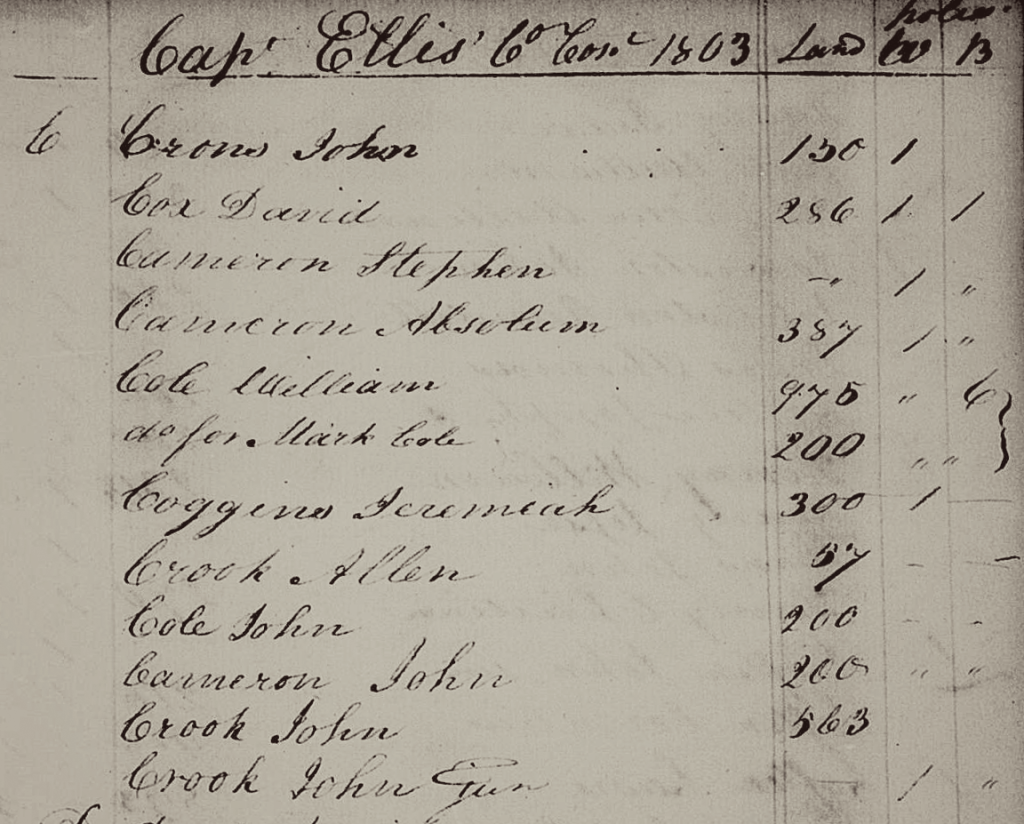
Even after Mark Cole’s move to Georgia, his ties to Rowan County remained evident. The 1803 Rowan County Tax List for Captain Ellis’ District shows that Mark’s father, William Cole, continued to pay taxes on 975 acres of land and six enslaved individuals, as well as covering the taxes for Mark’s retained 200-acre property at the headwaters of Cabbin Creek. This arrangement suggests that, despite relocating, Mark maintained connections to his family in Rowan County, likely relying on their support while he established a new home. The tax list also includes other familiar names: Mark’s brother John Cole, his brother-in-law David Cox, and Sarah’s father and brother, John Cameron and Absalom Cameron, emphasizing the deep-rooted relationships the family left behind.
Interestingly, the same 1803 tax list reveals a notable absence—Drury Goldsby, Mark’s former acquaintance and the seller of his Lick Creek property. Drury’s disappearance from the Rowan County records suggests that he, too, had moved, possibly around the same time as Mark.
By 1805, the connection between the Coles and Goldsby’s is evident in Columbia County’s Tax List for Captain Isaac Willingham’s District No. 4 (Columbia. Tax Records 1805–1806 (pg. 55 of 331)). This document records Mark Cole and Drury Goolsbee (a variation of Goldsby) living in close proximity, alongside a John Cole, who had already established himself in the area several years earlier.
The Cole Family’s Cross-State Bonds
John Cole had purchased a 357-acre tract along Little River on October 6, 1800, from Edward Telfair, a notable figure who served as Georgia’s governor from 1786 to 1787 and again from 1789 to 1793. Telfair himself had acquired the land from John Heard on August 2, 1777, with Heard’s original patent dating back to December 6, 1774. John Cole’s earlier presence on Little River likely played a significant role in influencing the exact location where Mark and Sarah Cole chose to settle.
This John Cole, a first cousin once removed of Mark Cole, represents an earlier branch of the family that had pioneered the Great Wagon Road migration nearly two-thirds of a century before. John is presumed to be the son of Mark Cole Sr, who, along with his brothers John and James, was among the earliest pioneers of this vital migration route.
Mark Cole Sr was residing in Bedford County, Virginia, around the same time his nephew William Cole, Mark’s father, migrated to Virginia. In the late 1750s, Mark Cole Sr left Virginia and moved to Craven County, South Carolina, specifically in Saint Mark’s Parish. This migration marked the establishment of a branch of the Cole family, which maintained contact with their relatives who migrated to Rowan County, North Carolina. The continued interactions between these two branches are evident through various records, showcasing their enduring familial ties despite geographic separation.
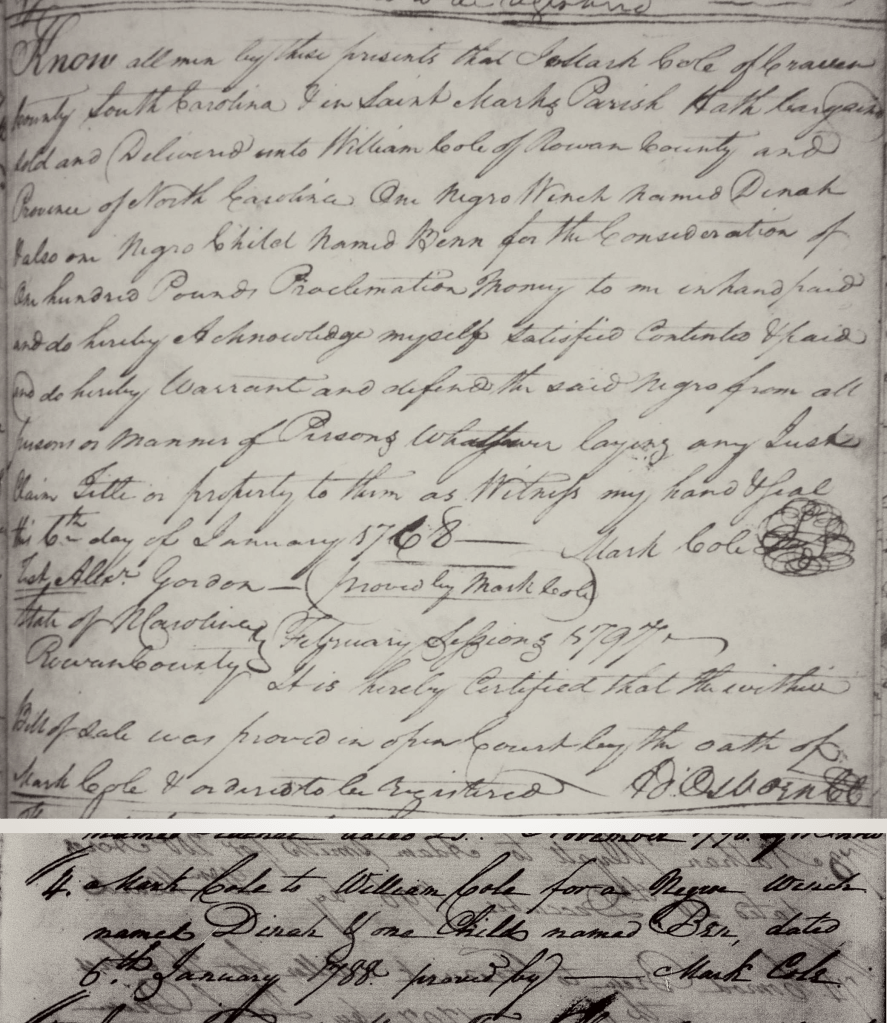
One such record is a deed (Rowan DB 14:658) recorded in Rowan County in 1797, which suggests that Mark Cole Sr sold two enslaved individuals to William Cole on January 6, 1768. The deed explicitly states, “Mark Cole of Craven County, South Carolina, and in Saint Mark’s Parish hath bargained, sold and delivered unto William Cole of Rowan County and province of North Carolina.” This transaction underscores the relationship between the two branches, as well as their economic and legal interactions across state lines. Notably, Mark Cole Sr is believed to have died around 1769 in Craven County. By this time, South Carolina had transitioned from a county system to a district system, with Craven County becoming extinct and now called Camden District. If the deed were initiated after 1769, it would likely have referred to the Camden District or the smaller Clarendon or Claremont Counties established in 1785.
Further complicating the timeline is a record found in the Rowan County Court Minutes (1793–1800), pg. 269, which lists the transaction as occurring in 1788. This entry appears in an “Inventory of Slave Conveyances,” providing a formal record of the sale. However, given the language and details in the original deed, the 1768 date is more likely to be accurate. This discrepancy highlights the challenges genealogists face when reconciling differing dates and interpretations in historical records. Regardless, this deed, along with the court record, provides valuable evidence of the continued interaction between the Rowan and Craven branches of the Cole family, offering insights into their shared history and connections.
The clustering of Mark Cole, Drury Goldsby, and John Cole in Columbia County highlights how kinship and trusted relationships shaped migration patterns during this period. The decision to settle on or near Little River, where John Cole had already established himself, reflects a deliberate effort to maintain family ties and benefit from the security of familiarity in a new and evolving community. Drury’s potential early migration and his connection to both Mark and John further illustrate the collaborative nature of these moves. This interconnectedness among family members and associates created tightly knit networks that eased the challenges of relocating to a new frontier.
Further insight into these relationships comes from the 1787 Last Will and Testament of John Cole’s mother, Alice Evans Cole, who named her children: sons John Cole, James Cole, Mark Cole (Jr), and Baptist Cole, along with daughters Harriet Cobb, Ann Goldsby, Mary Ellerby, Rhoda Shaw, and Susannah Cole (Liberty County, Georgia, Probate Estate Case Files 1775–1892, (pg. 997 of 1103)). Of particular note are daughters Ann Goldsby and Rhoda Shaw. While further research is needed, the correlation between Ann Goldsby’s husband and Drury Goldsby suggests a possible family link. Rhoda Shaw, meanwhile, plays a key role in connecting John Cole to Little River through a deed dated September 4, 1800. In this transaction, John Cole and his wife Prussia sold a 200-acre tract of land on Little River to Peter Coleman, with the deed witnessed by Mark Cole (Jr) and Rhoda Shaw (Columbia County Deed Book I:497).
Shortly after their arrival in Columbia County, Georgia, Mark and Sarah Cole welcomed their final child, Stephen Cole, around 1803. With a growing family, the Coles likely settled in the vicinity of Little River, where they lived and raised their children. This area, with its fertile land and established community, provided an ideal environment for the Coles to build their lives in their new home.
Sometime between 15 February 1811 and January 1812, Mark Cole presumably passed away intestate in Columbia County. Unfortunately, no will or probate records have been located to confirm his death, leaving this period of the Cole family’s history somewhat ambiguous.
On 15 February 1811, Mark sold his Rowan County 200-acre track on Cabbin Creek to his cousin Reuben Cole of Jones County, Georgia. By November of the same year, Reuben would in turn sell the property to Jesse Badgett of Rowan County, whose family were Cabbin Creek landowners (Rowan DB 25:219). The quick succession of these transactions and the absence of a recorded deed in Rowan or Columbia from Mark to Reuben suggest that Mark may have been in poor health and anticipating his death. It’s possible that Reuben, with no apparent ties to Rowan County himself, puchased the land as a favor to Mark, ensuring it could be quickly sold to a local buyer like Jesse Badgett as well as a means to settle debts or ensure some financial security for his family.
Evidence of Mark’s presumed passing also comes from records showing Sarah Cole’s first appearance as a tax defaulter in 1812 in District No. 4. Additionally, a deed dated January 9, 1812, provides further context. In this transaction, John Cole conveyed 95 acres on Lick Branch, a tributary of Little River, to Sarah Cole. The deed was witnessed by John G. Willingham [sic] and Sarah’s brother, John Cameron, underscoring the ongoing support of Sarah’s extended family.
This deed, with John Cameron as a witness, provides a meaningful connection back to the Camerons on Lick Creek in Rowan County, reinforcing the familial ties that linked Sarah Cole to her North Carolina roots. It also underscores the involvement of her brother, John Cameron, in providing support as she adjusted to her new role following Mark’s presumed passing. This connection is particularly valuable in genealogy, as it highlights the web of relationships that extended across state lines and generations.
The land records from this time can be complex and confusing, especially given the presence of multiple individuals named Mark Cole in Columbia County. Alongside Mark Cole from Rowan County, records suggest that John Cole’s brother, also named Mark, was living in Columbia County during this period. To complicate matters further, there is evidence that John’s brother Mark had a son, possibly named Mark Cole Jr, who may have also been active in land transactions (derived 1805 Georgia Land Lottery). This overlap in names has led some researchers to mistakenly attribute the children of Mark and Sarah Cole to the branch of Coles descending from John and Mark Cole, sons of Mark Cole Sr. Careful examination of land deeds, tax lists, and witness records is essential to disentangle these identities and accurately trace the lineage of Mark and Sarah’s family. Such challenges remind us of the importance of context and corroboration in genealogical research, especially when dealing with common names and overlapping family branches.
 digging our roots
Leave a comment