Stephen Cole presumably arrived in Pennsylvania sometime between 1716 and 1718. While the exact details of his journey remain elusive, traces of his family begin to appear in the Chester County, Pennsylvania and New Castle County, Delaware areas during this time. It is possible that Stephen, alongside his presumed siblings Mark, James, John, William, and Elizabeth, made the transatlantic voyage as a family. Alternatively, they could have followed an older sibling or other kin who paved the way years earlier, possibly inspired by the promise of land, opportunity, or a shared religious calling.
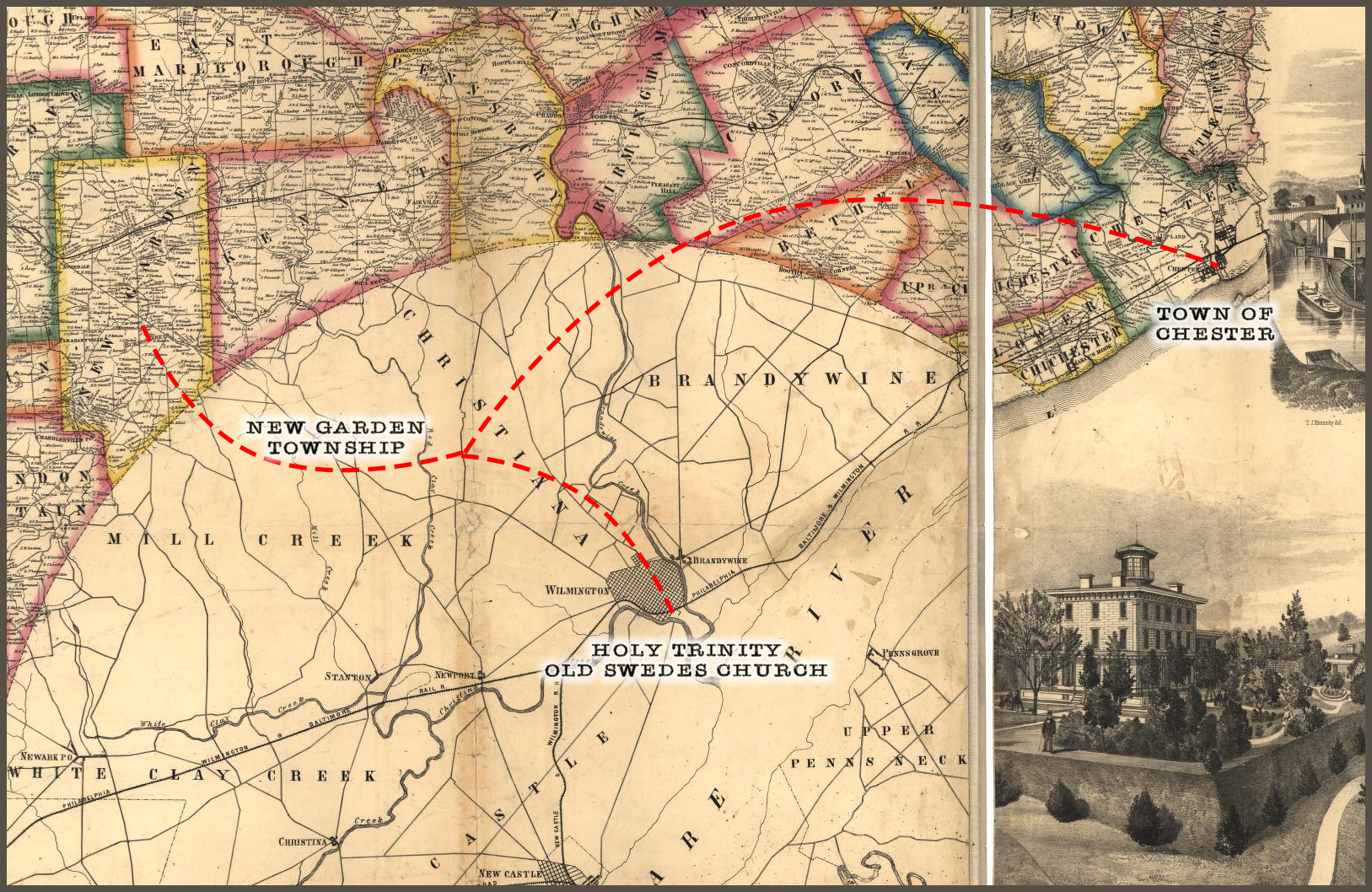
The movements of Stephen’s presumed siblings offer tantalizing clues. James Cole appears as a landholder in the 1719 tax records for New Garden Township, Chester County, Pennsylvania (Chester Co. Tax Transcripts 1715-1850, 1719, pg. 9), and later that year, on 9 January 1719 (julian date), he married Mary Susannah Renfro (Quaker, New Garden Monthly Meeting Minutes 1718-1746, pg. 9). William Cole married Prudence Shaw on 17 June 1730 in New Garden, also recorded at the Quaker New Garden Monthly Meeting (Women’s Minutes 1718-1763, pg. 64). Meanwhile, Elizabeth Cole married Thomas Wilcox on 3 Jun 1727 at Holy Trinity (Old Swede’s) Church in New Castle County, Delaware (The Records of Holy Trinity (Old Swedes Church, Willmington, Del., from 1697 to 1773, pg. 304).
The proximity of these locations suggest a tight-knit family network spanning Chester County and northern Delaware. Their presence in these areas hints at a possible migration route: landing in Philadelphia or New Castle and settling in the fertile farmland and emerging communities along the Pennsylvania-Delaware border.
Adding complexity to the story is the role of religion in the Coles’ lives. James and William were tied to the Quaker meetings of New Garden Township, likely circumstantial, while Elizabeth’s marriage at Holy Trinity Church connects the family to the Swedish Lutheran community in Delaware. Stephen, on the other hand, appears to have embraced Anglicanism. A pragmatic approach to religion assuming the Coles were English from Ulster or another region in Ireland where people were predominantly Anglican or Presbyterian. These clues offer intriguing possibilities about the Coles’ shifting affiliations and the blending of religious identities within the family.
By 1725, Stephen Cole had established himself as a landholder in Chester County, Pennsylvania. He appears in the 1725 tax records for Chester Township, which mark his first documented presence in the colony (Chester Co. Tax Transcripts 1715-1850, 1725, pg. 3).

Stephen’s presumed mother, Elizabeth Cole, likely joined the family in America and possibly lived with Stephen near the end of her life as she was buried at St. Paul’s Episcopal Church on 24 September 1732 (Pennsylvania and New Jersey U.S. Church and Town Records, 1669-2013, PA-Delware-Chester-Episcopal-St. Paul’s Episcopal Church, pg. 92). The church was located diagonally across the market square from where Stephen lived and worked in the Borough of Chester.
Although much about Stephen Cole’s early years in America remains a mystery, his documented presence in Chester County and his connections to his siblings hint at a family story rooted in migration, adaptation, and a deepening investment in the communities of Pennsylvania.
Stephen Cole established his roots in the Borough of Chester by purchasing several lots in the center of town.
Chester County, Pennslyvania Deed Book E, pg. 123

[truncate] This Indenture made the nineteenth day of January in the thirteenth year of the reign of our sovereign Lord George King over Great Britain anno Dom 1726/27. Between John Minshall of the Township of Chester in the County of Chester and province of Pennsylvania, Cordwainer and Hannah his wife of the one part and Stephen Cole of Chester aforesaid in the county and province aforesaid, Butcher of the other part. [truncate] for and in consideration of five shillings to them paid by the said Stephen Cole the receipt whereof they do hereby acknowledge have bargained and sold and by these presents do bargain and sell unto the said Stephen Cole all that messuage or tenement where the said John Minshall now dwells, situate in Chester aforesaid with six lots or parcels of land thereunto belonging which lie contiguous in one and is bounded to the southward with James Street, eastward with the lots late of Sarah Smith and the lots late of Roger Jackson and Griffith Howell's lot, northward with middle street and to the westward with the lots of John Baldwin and the lots late of William Pickle then southward and westward with the lots of John Worrall. [trunscate] Sealed and delivered in the presence of Joseph Parker, William Walden, Robert Park. Signed John Minshall (seal), Hannah Minshall (seal)
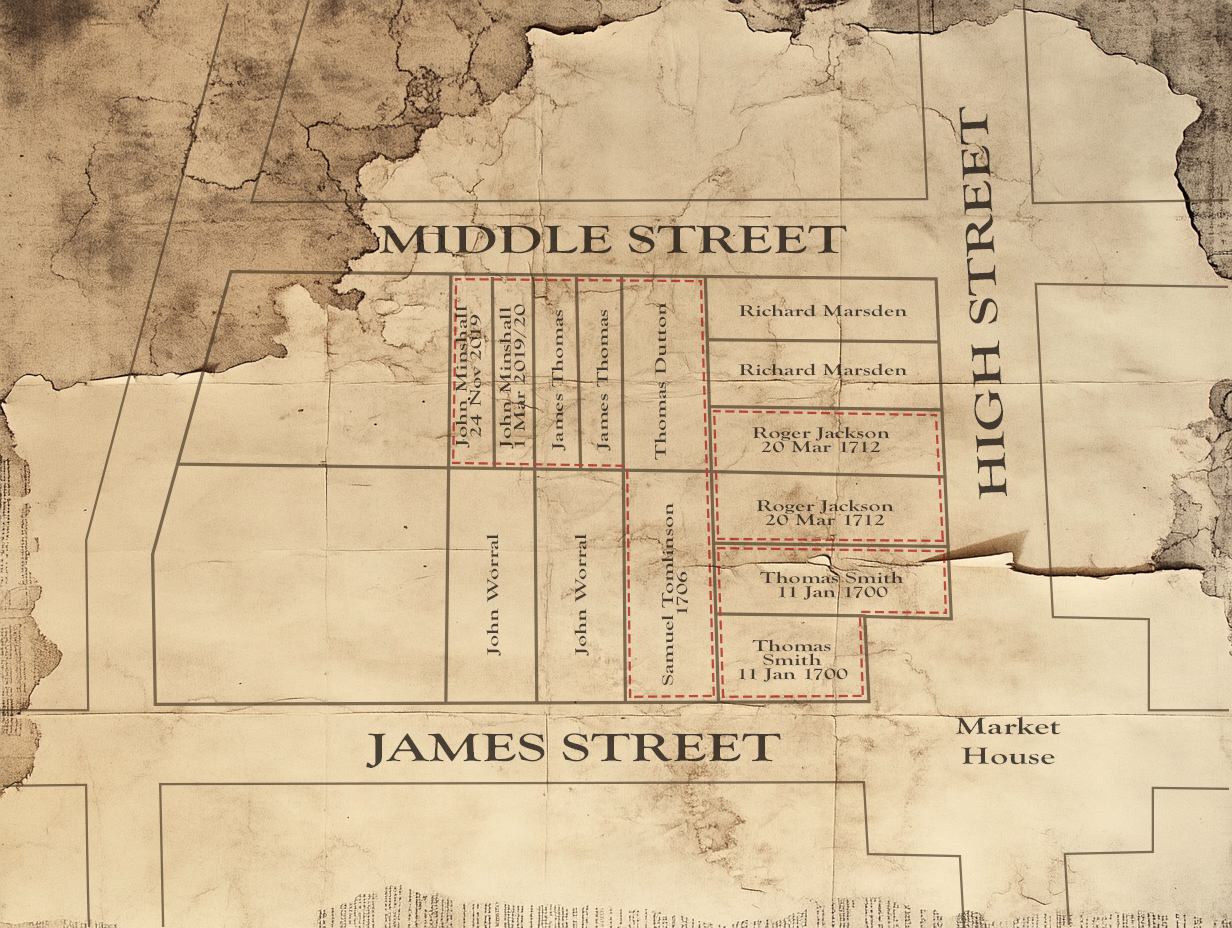
The six lots owned by John Minshall were assembled from various purchases, creating a unique patchwork of Chester Borough’s early history. Two of these lots were originally part of the land purchased from Jonas Sandelands. Interestingly, the Borough of Chester itself was established on a 20-acre patent granted in 1686 to Jonas’s father, James Sandelands. Minshall added to his holdings by acquiring two more lots from James Thomas, one from Thomas Dutton, and another from Samuel Tomlinson.
Samuel Tomlinson had built a home on the lot he sold to Minshall. This house became John Minshall’s residence and later likely served as the home for Stephen Cole and his family.
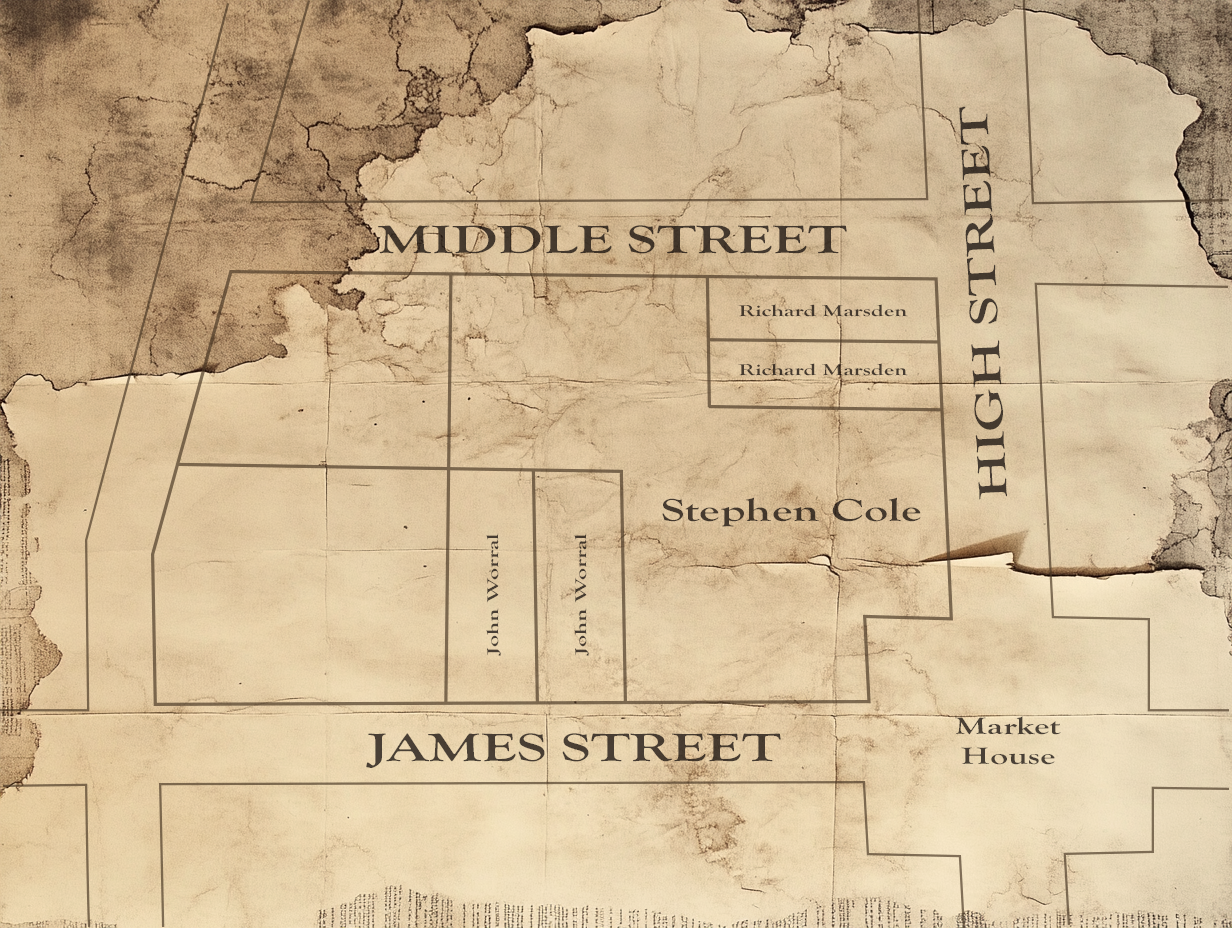
On March 7, 1726/7, Stephen Cole expanded his property holdings in Chester by purchasing two lots from John Baker and John Minshall. These lots had originally been part of the estate owned by Roger Jackson (Chester County Deed Book E:125).
A few years later, on March 13, 1729/30, Stephen added to his land portfolio by acquiring two additional lots. This purchase was made from Thomas Smith of Salem County, New Jersey, and his wife Grace, along with Thomas Empson of Graves End upon Duck Creek in New Castle County, Delaware (Chester County DB E:130). These lots had an earlier connection to Chester’s history, having been purchased in 1700 by Thomas Smith Senior from James Sandelands, one of the town’s notable early figures. These lots, and the house in particular, offer a glimpse into the layered history of ownership and habitation in Chester Borough during its formative years.
The deeds above indicate that Stephen Cole was commonly known and identified as a butcher—a profession that not only defined his livelihood but also underscored his role within the community. In the 18th century, a person’s trade was a cornerstone of their identity, frequently documented in legal records and reflective of their social and economic status.
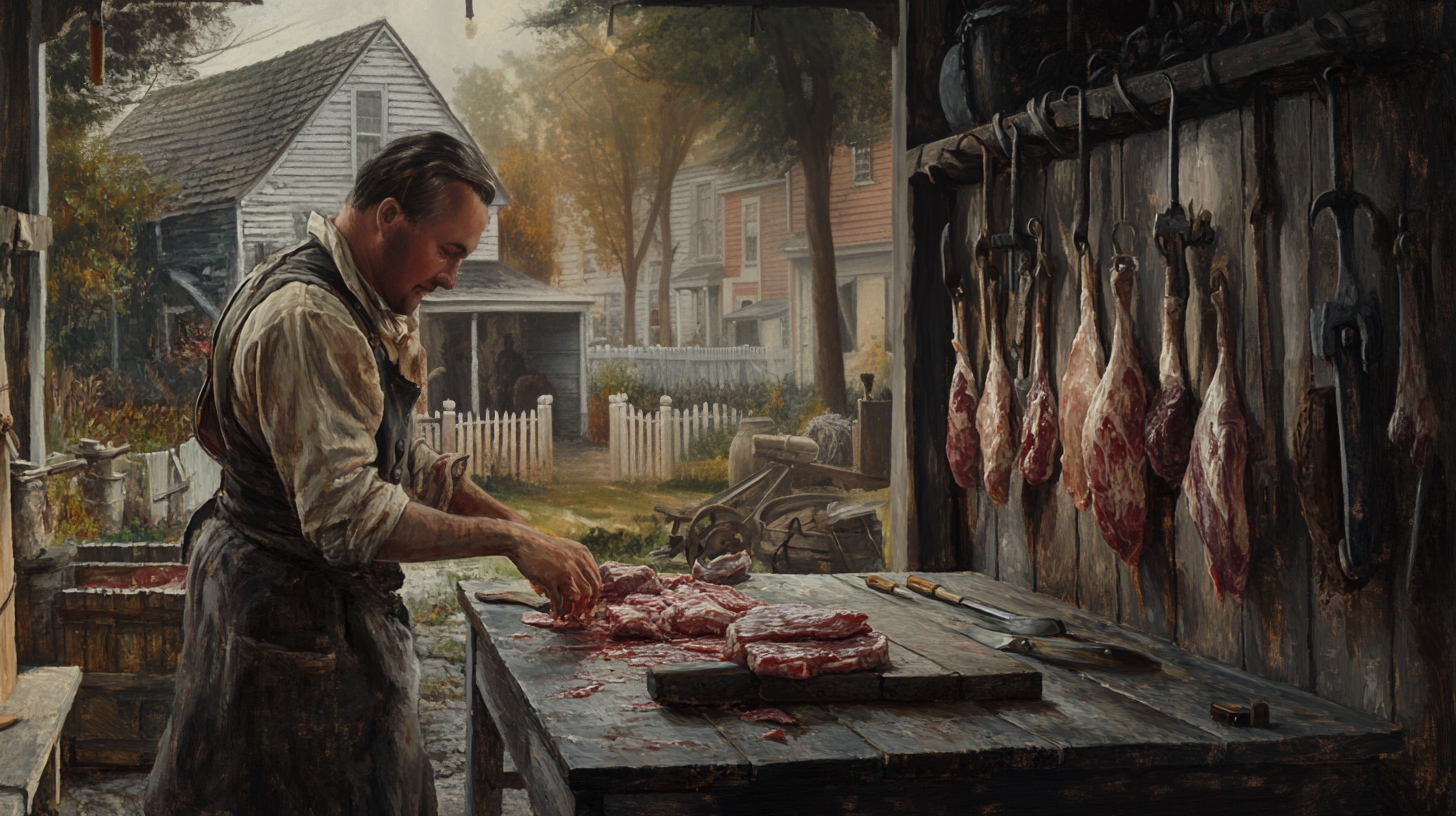
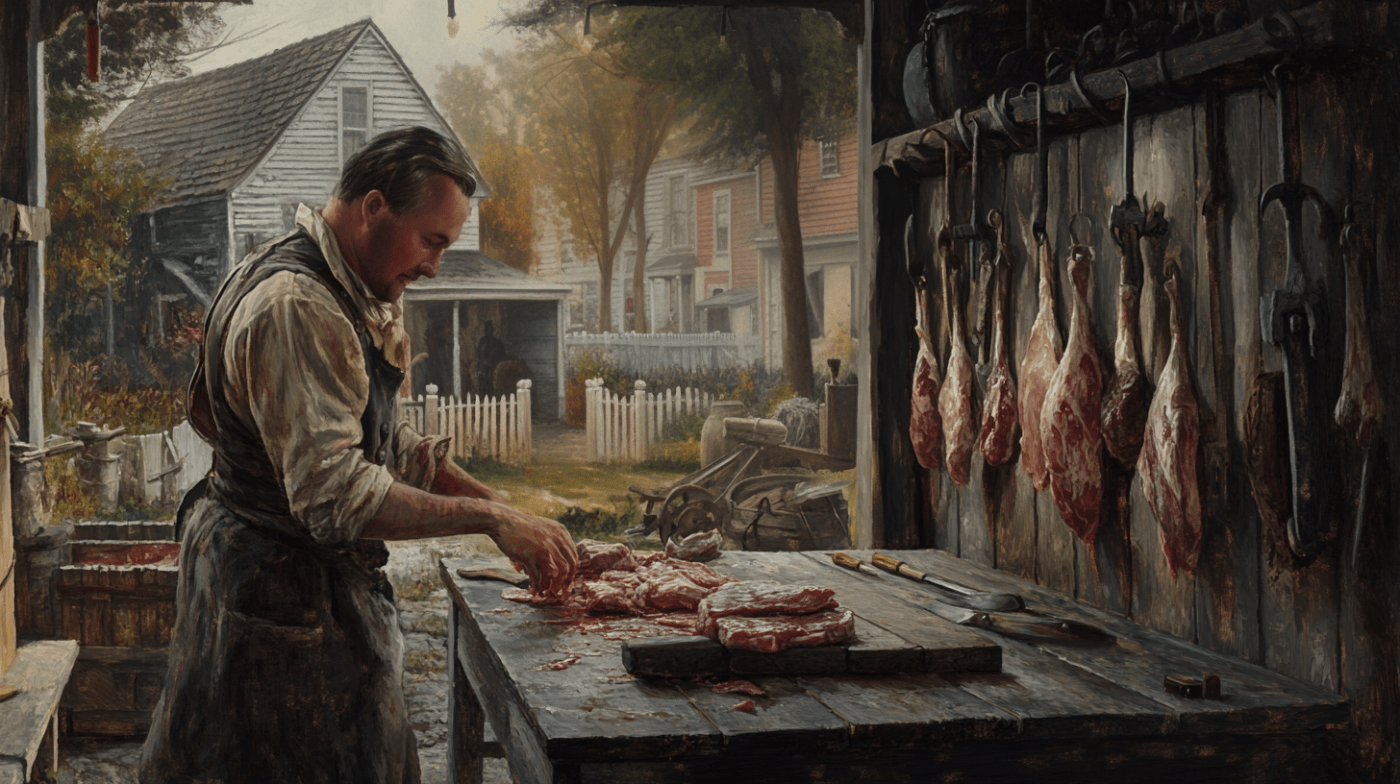
The properties Stephen acquired likely doubled as his butcher’s shop, a place of hard work and bustling activity. Butcher shops in colonial towns were often simple but efficient spaces, designed for processing meat and serving customers. The shop would have included a sturdy workbench, hooks for hanging meat, and possibly a cooling area for storing products temporarily. Though refrigeration didn’t exist, Stephen might have used techniques like salting or smoking to preserve meat. It’s easy to imagine the sounds and smells of the shop—tools clanging, livestock being delivered, and the earthy aroma of fresh cuts of meat—as Stephen worked to serve the residents of Chester.
To stock his shop, Stephen likely sourced his livestock from local farmers in Chester and neighboring townships. Farmers would have brought cattle, sheep, or pigs directly to town, and Stephen would have worked closely with them to purchase quality animals. Additionally, livestock markets in larger towns, including Philadelphia, may have provided an alternate source of supply. These markets were bustling centers of trade, where farmers, merchants, and butchers like Stephen negotiated deals that supported the regional economy.
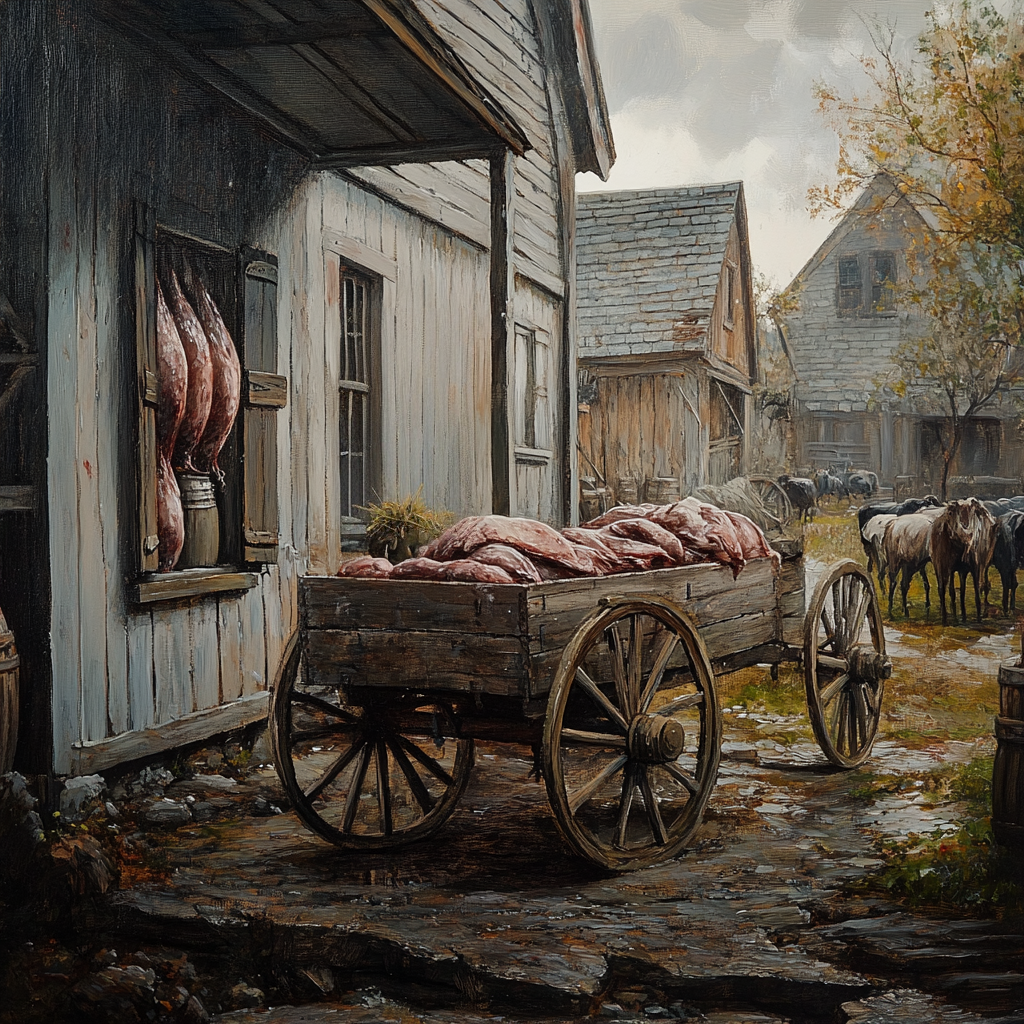
Stephen’s role as a butcher extended beyond his shop and into the broader economy of Chester Borough. The purchase of multiple properties at the town square suggests that his business was well-established and thriving. A successful butcher would have needed extra hands to manage the physical demands of the trade, from slaughtering livestock to cleaning the shop. Stephen may have employed apprentices or assistants, creating opportunities for others in the community. His shop would have been a key supplier to other merchants, inns, and taverns, ensuring that the town had a steady supply of meat. Moreover, Stephen’s work likely contributed to other industries—supplying hides to local tanners and bones to toolmakers.
While Stephen primarily served the Chester community, his influence likely extended to neighboring townships. The demand for quality meat would have reached beyond Chester, and Stephen may have built relationships with markets in surrounding areas. Additionally, his role as a butcher may have connected him to the Church of Chester, known as St. Paul’s Episcopal Church. Churches often played a central role in community life, hosting events and providing meals during gatherings or charitable efforts. Stephen’s trade would have made him a valuable asset to such activities, tying his professional contributions to the spiritual and social fabric of the town.
In circa 1725-26, Stephen Cole married Martha Hunter who was the daughter of John Hunter, a Tanner, of Radnor Township. John Hunter had migrated to Pennslyvannia with his family in about 1722.
Stephen is believed to have married Martha Hunter at St. David’s Episcopal Church in Radnor Township, a colonial Anglican church where her father, John Hunter, served as a vestryman in 1725. This connection to an influential family likely played a role in Stephen’s growing involvement with the Anglican Church and the broader community. Marrying into the Hunter family, with their ties to local church leadership, may have inspired Stephen to take on leadership roles within the church himself, setting the stage for his emergence as a community figure.
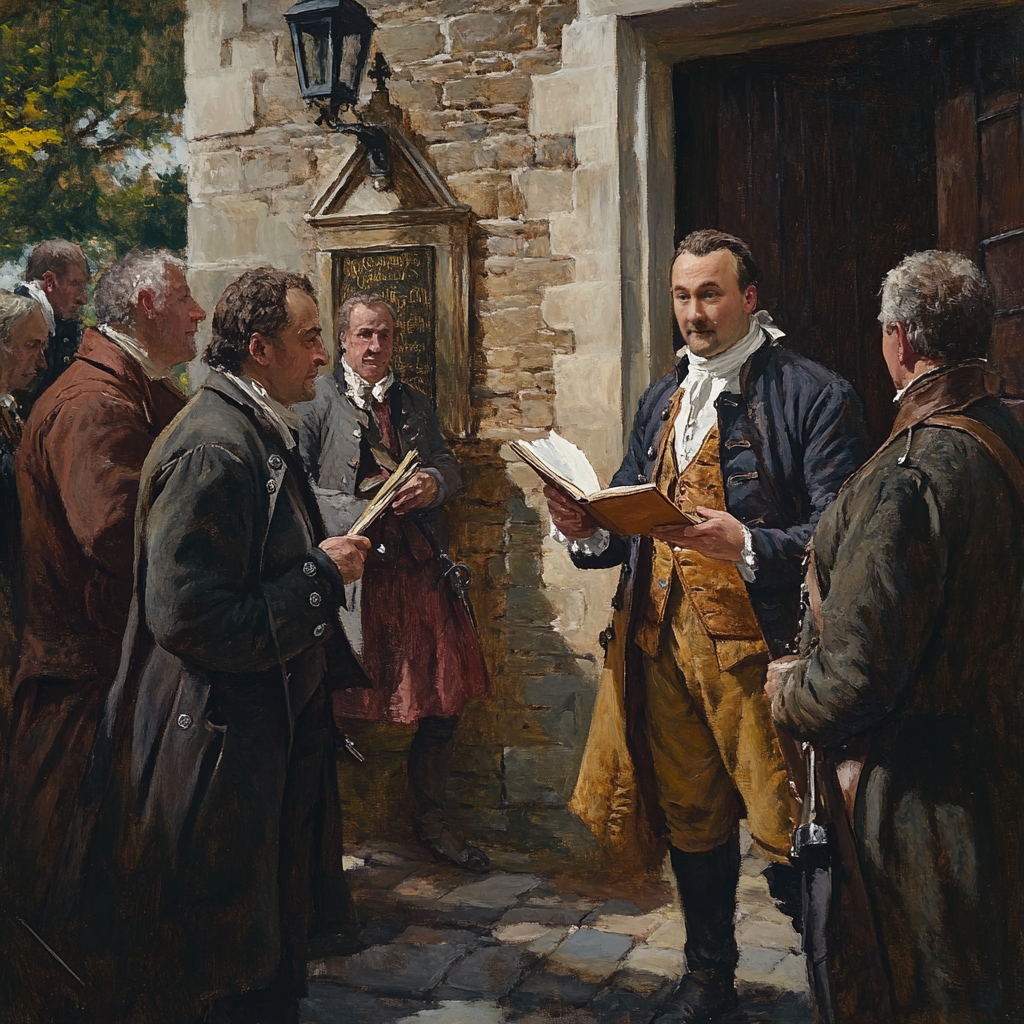
By 1729, Stephen Cole’s name appears in regional church records, reflecting his evolving role as a respected leader. He is styled as one of the Churchwardens for Chester in a letter from the Church of England to the High Worthy Bishop of Holy Trinity Church in Delaware. This significant position tasked Stephen with overseeing the maintenance and administrative affairs of the local Anglican church, highlighting the trust and esteem he had earned within the Chester community. Through his dedication and service, Stephen’s contributions to both the church and his neighbors further solidified his reputation as a man of influence in early 18th-century Pennsylvania.
By 1731, Stephen’s involvement extended beyond Chester to St. David’s Episcopal Church in Radnor Township. There, he is listed among a group of prominent men, including John Hunter—his father-in-law—and Anthony Wayne, who had migrated to America with John. In this record, Stephen pledged funds to support the church, further solidifying his reputation as a benefactor and supporter of Anglicanism in the region.
Stephen’s engagement with churches was not limited to financial contributions or honorary roles. By 1741, he is recorded as one of the subscribers promising funds for the purchase of a bell for St. Paul’s Episcopal Church in Chester. His dedication to the church culminated in his role as a vestryman in 1742, where he would have been actively involved in decisions affecting the church’s operations, possibly including the planning of a bell tower addition (which was built in 1745).
Stephen’s visible support and leadership in multiple congregations underscore his commitment to the Anglican faith and suggest that he saw his role in these churches as integral to the well-being of the broader community.
Stephen’s participation in these churches may reflect his broader aspirations as a community leader. His position as a butcher and property owner in the heart of Chester Borough likely afforded him significant social capital, which he leveraged to support local churches. This mutual relationship benefited both Stephen, by elevating his status as a man of respect, and the churches, which relied on capable and committed leaders to thrive.
Over the next decade Stephen and Martha would have the following children:
- John Cole, b. possibly born September/October 1728 in the Chester Township of Chester County, Pennsylvania, bap. 3 November 1728
- Elizabeth Cole (1st), b. in the Chester Township of Chester County, Pennsylvania, bap. 27 September 1730, she was buried at St. Paul’s on 27 June 1731, dying in infancy
- James Cole, b. possibly born February/March 1732 in the Chester Township of Chester County, Pennsylvania, bap. 30 April 1732
- Elizabeth Cole (2nd), b. ca 1734/35 in the Chester Township of Chester County, Pennsylvania
- Stephen Cole Jr, b. ca 1736/37 in the Chester Township of Chester County, Pennsylvania
- William Cole, b. ca 1738/39 in the Chester Township of Chester County, Pennsylvania
- Mark Cole, b. ca 1740/41 in the Chester Township of Chester County, Pennsylvania
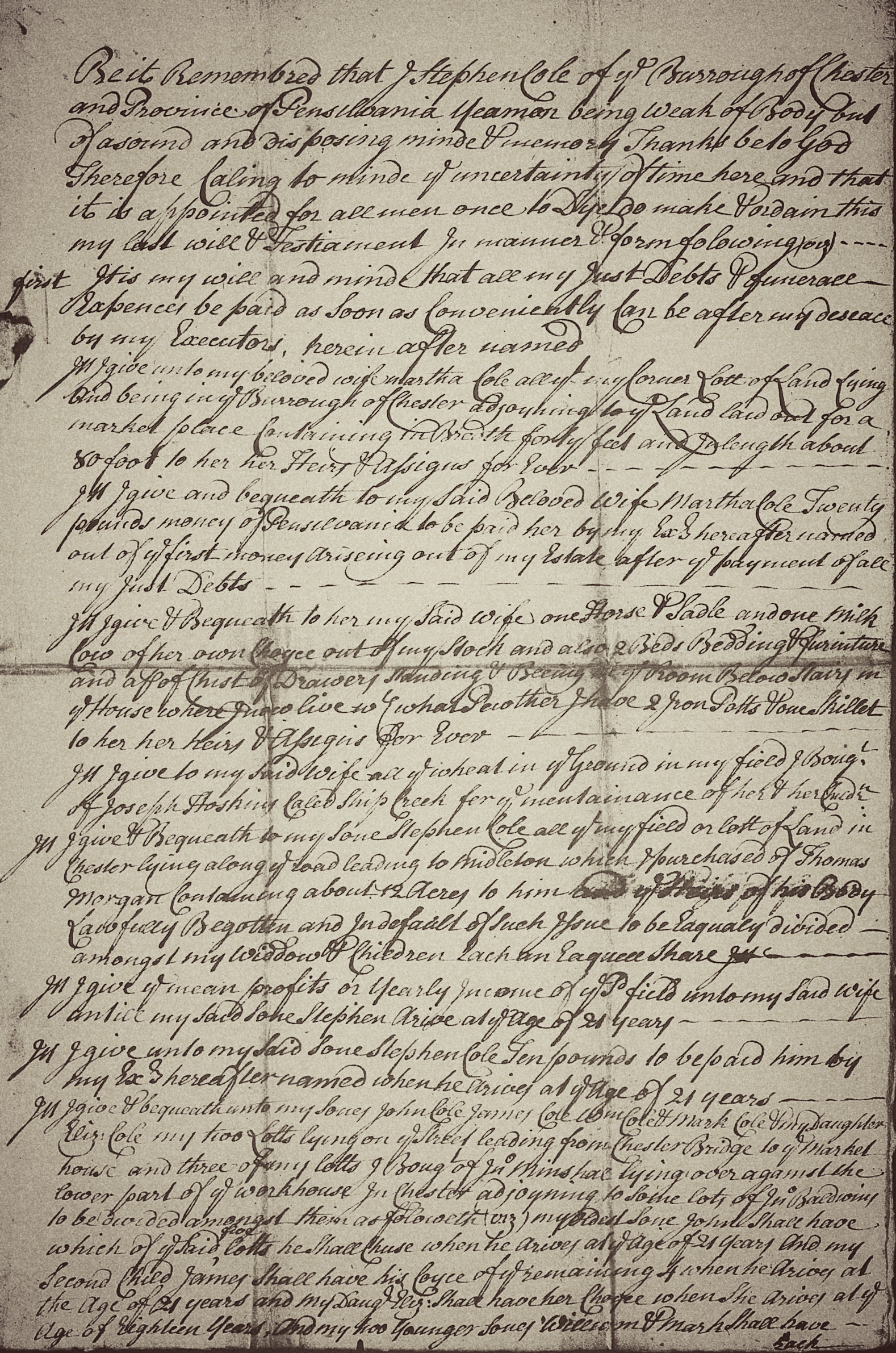
On 26 December 1744, Stephen Cole made his last will & testament:
Be it remembered that I Stephen Cole of ye Burrough of Chester and Province of Pennsylvania, Yeoman being weak of body but of a sound and disposing mind & memory. Thanks be to God therefore calling to mind ye uncertainity of time here and that it is appointed for all men once to dye do make & ordain this my last will & testament. In manner & form following, viz

First It is my will and mind that all my just debts & funeral expences be paid as soon as convienently can be after my decease by my Executors herein after named.

Item I give unto my beloved wife Martha Cole all of my corner lott of land lying and being in ye Burrough of Chester adjoining to ye land laid out for a market place containing in breadth forty feet and in length about 80 foot to her, her heirs & assigns forever.

Item I give and bequeath to my said beloved wife Martha Cole twenty pounds money of Pennsylvania to be paid her by my Executors hereafter named out of ye first money arising out of my estate after ye payment of all my just debts.

Item I give & bequeath to her my said wife one horse & saddle and one milk cow of her own choice out of my stock and also 2 beds bedding & furniture and a of chest of drawers standing & being in ye room below stairs in ye house where I now live & what pewter I have 2 iron potts & one skillet to her her heirs & assigns forever

Item I give to my said wife all ye wheat in ye ground in my field & being of Joseph Hoskins called Ship Creek for ye maintenance of her & her children.

Item I give & bequeath to my sone Stephen Cole all of my field or lot of land in Chester lying along ye road leading to Middleton which I purchased of Thomas Morgan containing about 12 acres to him and ye heirs of his body lawfully begotten and in default of such issue to be equally divided amongst my widow & children each an equal share.

Item I give ye mean profits or yearly income of ye said field unto my said wife until my said sone Stephen arrives at ye age of 21 years.

Item I give unto my siad sone Stephen Cole ten pounds to be paid him by my Executors hereafter named when he arrivesat ye age of 21 years.

Item I give & bequeath unto my sons John Cole, James Cole, William Cole & Mark Cole & my daughter Elizabeth Cole my two lotts lying on ye street leading from Chester Bridge to ye Market house and three of my lotts I bought of John Minshall lying over against the lower part of ye work house in Chester adjoining to some lots of John Baldwin to be divided amongst tem as followeth (viz) my oldest son John shall have which of ye said five lotts he shall choose when he arrives at ye age of 21 years and my second child James shall have his choice of ye reamining 4 when he arrives at the age of 21 years and my daughter Elizabeth shall have her choice when she arrives at ye age of eighteen years and my two younger sons William & Mark shall have each their choice of ye remaining lots as they arrive at ye age of 21 years, respectively but & if any of my said children should die before they arrive at ye respective ages mentioned and leave no issue then it is my will & mind of ye respective share of ye child said dying shall be equally divided amonst my widow & surviving children.

Item It is my will and mind of all ye residue & remaining part of my estate whether real or personal shall be sold by my Executor hereafter named and the money arising there from after ye payment of my just debts shall be put out to interest and be equally divided amonst my widow & five children viz my sons John Cole, James Cole, William Cole & Mark Cole and my daughter Elizabeth Cole my sons shares to be paid them when they arrive at ye age of 21 years respectively and my daugher share when she arrives at ye age of 18 years and ye interest of ye respective shares till they arrive at ye respective ages I give to my widow to enable her to bring up my said children in a suitable manner which I hereby order & appoint shall be done by my said widow and my sons put out to good trades by her with ye sonest of ye other Executor as they arrive at proper ages without my other consideration or charge brought against them then of mean profits already given.

Item it is my will & mind & I hereby give power & authority to my Executors hereafter named to sell ye before mentioned remaining part of my estate with full power to convey make over & execute all deeds & conveyances necessary for ye sure & good conveyance of all ye land they shall so sell.

And lastly I nominate constitute & appoint my dear & well beloved wife Martha Cole and my trusty friend Thomas Cummings and my trusty & well beloved friend ye Reverend Richard Backhouse of Chester to be joint Executors of this my last will & testament hereby revoking and making null & void all other wills & testaments heretofore made by me. In witness whereof I have here unto set my hand & seall this 26 day of December 1744.

Sealed Signed Published Pronounced and Declared by ye said Stephen Cole to be his last will & testament in ye prsence of John W. Mathers, James Mathers {proved 17 Jan} Signed Stephen Cole

Memorandum this third day of January 1744 I Stephen Cole of Chester being in perfect sound mind & memory do add to this my last will & testament above viz I give & bequeath to my son Stephen Cole all ye my forty foot lot of land I bought of John Minshall lying over against the workhouse adjoining to one of those I have already given to my other children & I desire this my said will may be taken as apart of my last will as much as of I had been in ye body thereof witness whereof I have set my hand & seal this 3rd of January 1744. Signed Stephen (his mark) Cole

In 1750, Martha Cole filed a petition in the Chester County Orphans’ Court to address the guardianship of her children following the death of her husband, Stephen Cole, six years earlier. By this time, two of her children, James and Elizabeth, had reached the age of 14, the age at which they were legally able to choose their own guardians. The court also appointed guardians for the younger children, Stephen Jr., William, and Mark, who were still under 14 and could not yet make that decision themselves.

This action was likely prompted by Martha’s remarriage to Robert Russell around 1749/50. Under colonial law, a widow who remarried faced legal restrictions on managing property or inheritances left to her children from her previous marriage. To ensure that Stephen Cole’s estate remained protected and the children’s interests were safeguarded, it was customary for the courts to assign trusted guardians, often family members or close community associates, to oversee the children’s inheritance.
James and Elizabeth chose William Hunter and James Hunter, Martha Hunter Cole’s brothers, to be their guardians. The court then appointed William Hunter and James Hunter to also be the guardians for Stephen, William, and Mark Cole.
 digging our roots
Leave a comment