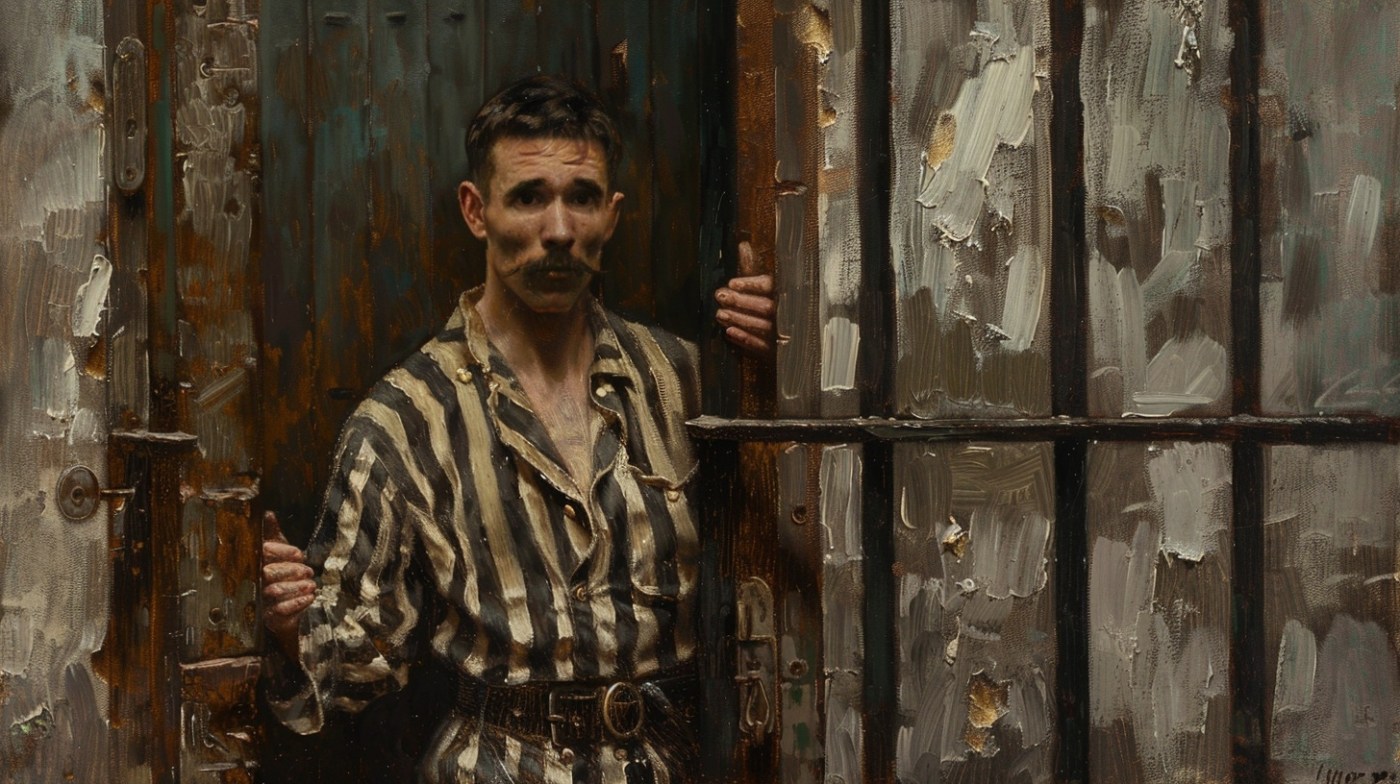
Charles Carter (Charlie) was born on 2 March 1868, either in or about 4 miles west of Cedartown in Polk County, Georgia. He was the second son of Joseph Thomas Carter and Adaline Alred.
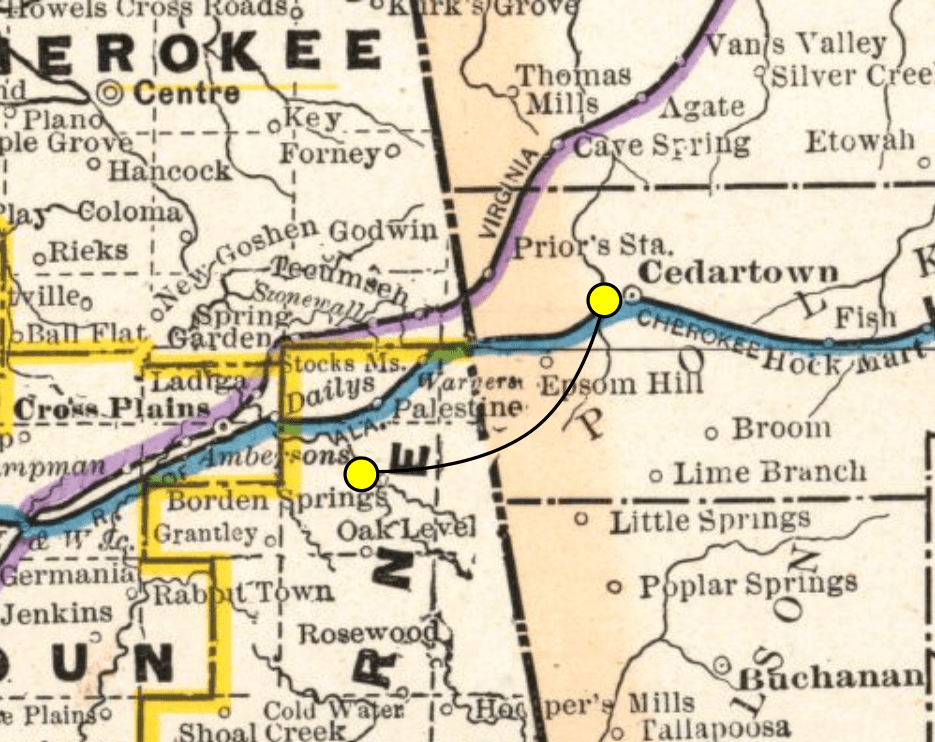
Around 1874, Charlie Carter moved with his parents to Borden Springs, Cleburne County, Alabama, situated approximately ten miles west across the Georgia and Alabama border. Borden Springs, nestled high in the foothills of the Blue Ridge Mountains, was a small community named after the notable Borden family who settled in the area during the early to mid-19th century.
Growing up in Borden Springs, Charlie worked as a farm laborer on his father’s farm during his early teens. On 24 December 1893, at the age of 25, Charlie Carter married a local girl named Ann Garmon (Annie), who was 19 years old at the time. Annie Garmon Carter had been raised by Hester Putnam Borden who was the second wife of John Borden, the namesake of Borden Springs. Hester Putnam Borden passed away in March of 1892.
A few months after his marriage, Charlie’s younger sister Mary Holly Carter married a nearby neighbor Charles J Rowe, in 1894, who was the son of John Lafayette Rowe, who was known by the locals as Jack Rowe.
The Assasain Is Still At Large
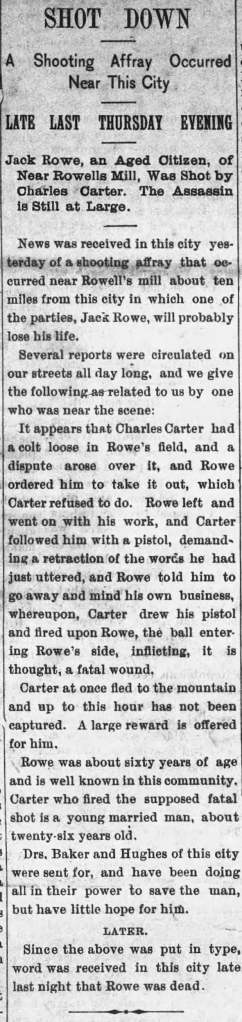
On or about September 19, 1894, in the vicinity of Borden Spring, roughly 10 miles east of Piedmont, Alabama, officials received a report of a shooting near Rowell’s Mill.
As news of the incident spread, locals reported that Charlie Carter had let a colt loose in Jack Rowe’s field, leading to a dispute. Jack Rowe ordered Charlie Carter to remove the colt, but Charlie refused. Rowe then resumed his work, but Charlie followed him, brandishing a pistol and demanding a retraction of Rowe’s earlier words. Rowe told him to go away and mind his own business.
Charlie Carter apparently drew his pistol and fired upon Rowe, the ball entering Rowe’s side, inflicting a fatal wound. Some time later, Jack Rowe did end up dying due to the shooting.
Charlie Carter apparently fled to the mountains and had not been located within a couple of days after the incident. Jack Rowe, approximately sixty years old and well-known in the community, was the victim of the shooting. Charlie Carter, who allegedly fired the fatal shot, was reported as a young married man around twenty-six years old.
Approximately eight weeks after the shooting, Charlie Carter was captured by Jeff Stewart and Pink Davis and delivered to the Edwardsville jail. The two men received a $300 reward offered by Jack Rowe’s friends for Charlie Carter’s capture.
Charlie Carter was found guilty of second-degree murder and sentenced on 23 March 1895 to five years in prison. His sentence was later reduced by 14 months, setting his release date for 23 January 1899.

During his booking into prison, Charlie Carter was recorded as weighing 125 pounds, with chestnut brown hair, blue eyes, and standing at 5 feet 7-1/2 inches (Alabama, U.S. Convict Records, 1886-1952; State Convict Records, Vol 4: 1895-1899 (archive)).
In 1897, it appears that Charles Carter was paroled by then-Governor Joseph F. Johnston. Charlie was discharged from prison on 28 April 1897.
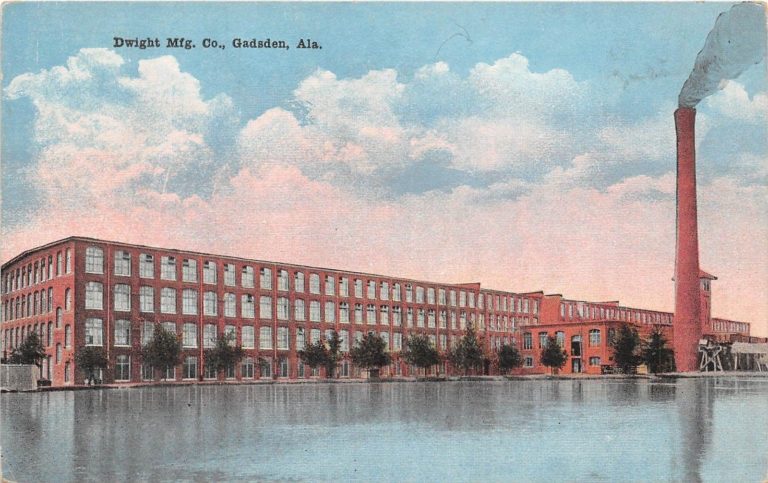
In the late 1890s, the Dwight Manufacturing Company planned to build a new textile mill in Alabama City, then part of Gadsden, Alabama. The mill was designed to produce ‘Cabot A’ sheeting for trade in the Orient and began construction in 1895. Alongside the mill, new homes with three to six rooms were constructed on the adjoining lands, forming what would become known as The Mill Village. These houses rented for three to six dollars a month, depending on the number of rooms.
These homes were built for the thousands of people who would relocate to Etowah County in search of employment at the mill and a higher standard of living than rural accommodations could offer. To secure the necessary workforce, the mill enlisted several men who traveled by horse and buggy into rural areas, seeking workers perceived to have the skills needed for the mill.
It is probable that one of these recruiters may have visited Borden Springs and convinced the Carters to seize the opportunity for better prosperity and escape the scorn of the Borden Springs community.
Around the fall of 1897, Charlie Carter, his father Joseph Carter, and his brother William Carter moved their families 35 miles west to Alabama City, Etowah County. The 1900 U.S. Census for Etowah County shows Charlie Carter living next to his father and brother on Kyle Street, which was located directly adjacent to the mill.
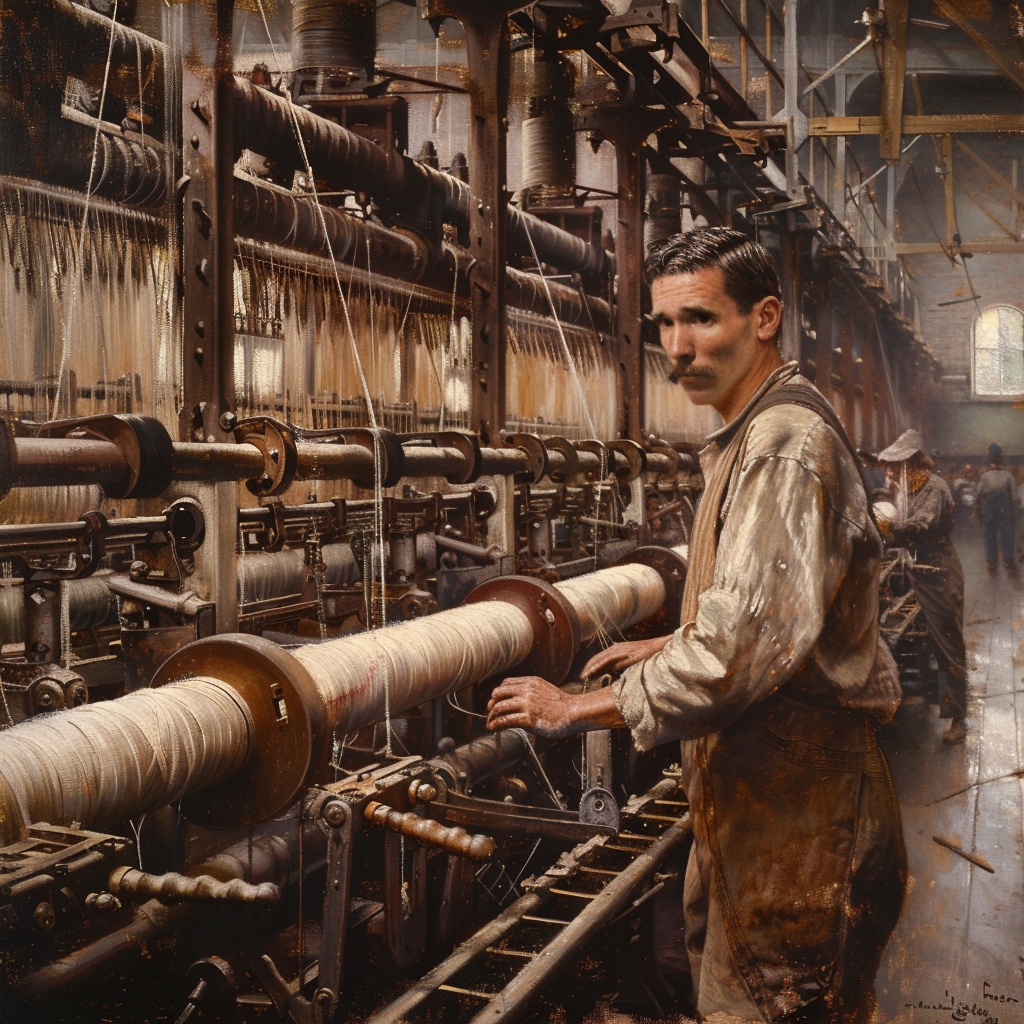
The census, records Charlie as a speeder tender at the cotton mill. A speeder was a machine used in the early stages of spinning cotten. The operator or tender managed this machine to draw out and twist the cotton fibers into roving, which was then ready for the final spinning process.
Charlie’s father Joseph Carter (Night Watcher), younger sister Mattie Carter (Spooler) and two younger brothers Herbert Carter (Doffer) and Ivy Carter (Spinner) worked at the factory as well.
The Carters all rented homes within The Mill Village. In 1900, these homes lacked indoor plumbing and electricity. The roads and streets were dirt, and the sidewalks were wooden, lined with trees on both sides.
Charlie Carter would endure several significant losses over the next decade. First, his father, Joseph Carter, presumably passed away before 1906. Then, in 1906, Charlie and Annie suffered the loss of their young son, Jessie Carter (1904-1906), as well as Charlie’s brother, Joseph Robert Carter.
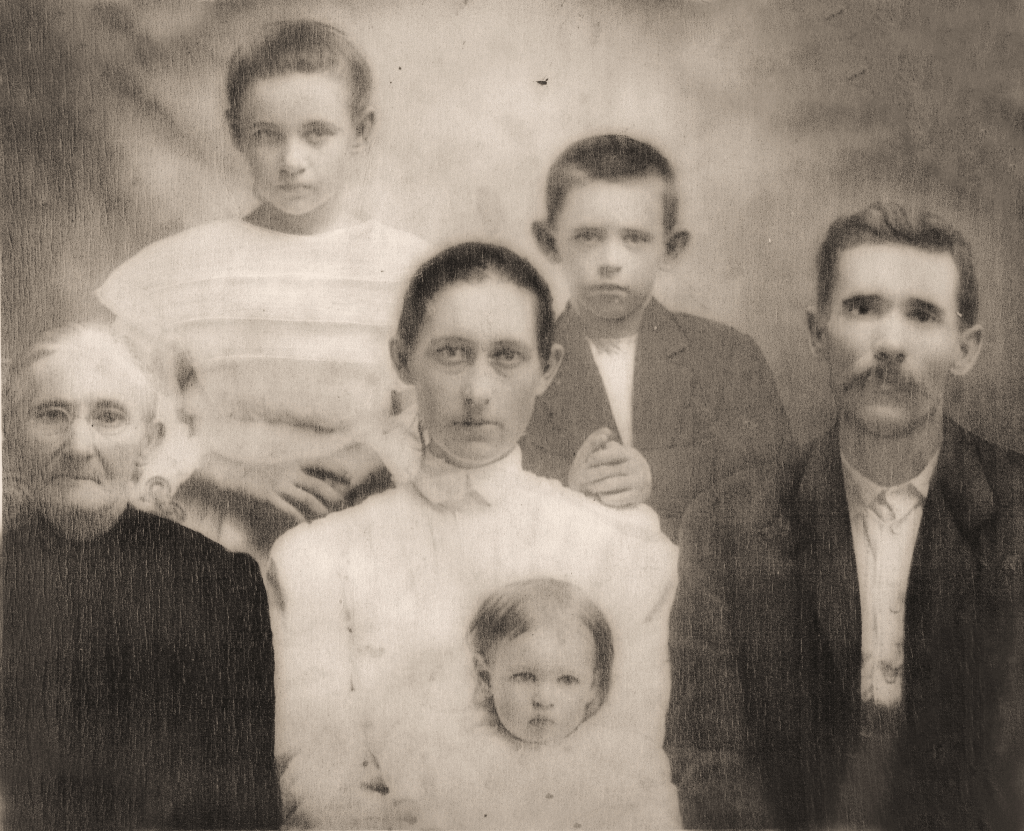
This is a verified photo of Charlie Carter’s family taken about the fall of 1908.
Pictured from left to right is Adaline Alred Carter, Lillie Mae Carter, Annie Garmon Carter, Bessie Irene Carter, Marvin Carter, and Charlie Carter.
Then a few months later on 13 February 1909, the unthinkable occurred, Annie Garmon Carter died.
It would appear that Charlie Carter and the family decided at some point in 1906 to make the Whorton Bend Baptist Church Cemetery, the family cemetery. In hindsight, this is where Charlie’s son Jessie Carter, wife Annie Garmon Carter, mother Adaline Alred Carter and Charlie himself are laid to rest. Additionally, his brothers Joseph Robert Carter, Ivy Thomas Carter and William James Carter are buried here too.

In 1910, Charlie Carter was living in the Gilberts Precinct of Etowah County, along with his three children: Lillie Mae Carter, Marvin Carter, and Bessie Irene Carter. His widowed mother, Adaline Alred Carter, and sister, Lillie Carter, also resided in the home. Nearby in Gilbert lived his brothers Ivy T Carter, Thomas J Carter, James W Carter, and Hubert Carter.
Then on 19 September 1915, Charlie’s mother Adaline Alred Carter died. According to the Birmingham Post-Herald 19 September 1915 edition, page 4, she was, “aged 68 years and died this morning at her home near Whortons”.
By 1920, Charlie and his brothers Hubert and Thomas had moved their families south to the more rural Riddles Bend Precinct of Etowah County.
On 20 January 1926, Charlie’s youngest daughter, Bessie Irene Carter, married James Larkin Sprayberry. In 1930, Charlie Carter was living with James Sprayberry, Bessie Carter Sprayberry, and their two children, James Louis Sprayberry and Pauline Sprayberry (the author’s paternal grandmother), in Riddles Bend.
By 1940, Charlie Carter was living with his other daughter, Lillie Mae, and her family, also in Riddles Bend.
On 9 March 1941, at the age of 73, Charles Carter passed away. He was laid to rest beside his wife, Annie Garman Carter, at the Whorton Bend Baptist Church Cemetery.
Charles Carter and Ann Garmon Carter had the following children:
Lille Mae Carter, b. 23 February 1898, Etowah County, Alabama; d. November 1985, Etowah County, Alabama
Marvin Carter, b. 29 October 1900, Etowah County, Alabama; d. 30 October 1971, Etowah County, Alabama
Jessie Carter, b. 1904, Etowah County, Alabama; d. 1906, Etowah County, Alabama
Bessie Irene Carter, b. 19 June 1906, Etowah County, Alabama; d. April 1987, Alabama
 digging our roots