In the mysteries of family lore, the figure of Charlotte Mott Smith looms large, shrouded in mystery and intrigue. According to legend, she was believed to be of Native American descent, with her son, Richard Isaiah Smith, purportedly born on a reservation in Florida. The narrative is further embellished by documents from a grandmother’s bible, which refer to Richard Calhoun Smith’s children from his union with Charlotte as “half-breeds,” hinting at her Indigenous heritage. Even Richard Isaiah Smith and his brother Clayton Smith, in an interview conducted in 2015, recalled growing up with the understanding that their mother was a Creek Indian.
However, as with many family legends, separating fact from fiction requires a closer examination of historical records and genealogical evidence. Extensive research and DNA analysis suggest that Charlotte Mott Smith’s lineage is predominantly of European descent, tracing back to white families.
During the mid-19th century, the time period associated with Charlotte’s life, there were no federally recognized Indian reservations in either Jefferson County or Nassau County, Florida, nor in the neighboring Georgia counties.
Nevertheless, it’s important to recognize the complex historical context surrounding Native American populations in Florida during this era. The Indian Removal policies of the United States government, notably the Indian Removal Act of 1830, led to the forced relocation of many tribes, including the Creek, from their ancestral lands to territories west of the Mississippi River. However, some individuals or families managed to evade removal and remain in their homelands, often assimilating into white communities or seeking refuge in remote areas.
In Florida, after the Second Seminole War, many Seminole and Miccosukee people remained in the state, particularly in remote regions like the Everglades. Additionally, it’s plausible that Creek and other Native American individuals found sanctuary in areas like Nassau County, which offered opportunities for independent living.
As for the claim of Charlotte’s child being born on an Indian reservation in 1872, it’s essential to consider the term “reservation” in its historical context. While there may not have been formal reservations in the region, there were undoubtedly communities with significant Native American populations, whether officially recognized or not. However, this lore of being born on an Indian reservation is likely not true.
In unraveling the mystery of Charlotte Mott Smith, it becomes evident that the truth lies somewhere between legend and reality. While her exact ancestry may remain elusive, her story reflects the intricate tapestry of cultural and familial connections that define the American experience.
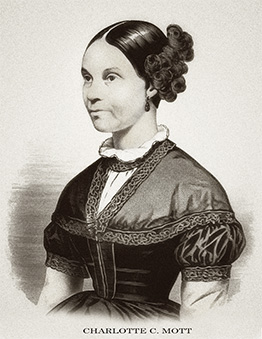
Charlotte C. Mott’s birth is estimated to have occurred between June 1843 and June 1844, most likely in Nassau County, Florida, in the vicinity of Brandy Branch (located north of Baldwin, Florida along the St. Mary’s River).
She is identified as the daughter of Abraham Mott III and Susan Grubbs Mott, based on information gathered from the 1850 and 1860 U.S. Census records. Additionally, this lineage is supported by atDNA research conducted by the author, who is a descendant of Charlotte Mott.
Charlotte Mott’s grandparents, from both the Mott and Grubbs families, had settled in the area of Monticello as early as 1828. (Mott – Jefferson County Grant)

Charlotte Mott’s parents moved to Brandy Branch area of Nassau County by 1835.
Around 1852/53, the Mott family moved approximately 10 miles west to the Traders Hill area. This transition is supported by deeds from Maxey Colson, Edward Mobley, and William Buford.
In circa 1860, Charlotte Mott married Richard Calhoun Smith, and they relocated to the outskirts of Callahan, Florida.
A year later, on 18 November 1861, Richard Smith volunteered and enlisted in the Confederate Army. He left Charlotte and was deployed to the front lines in Virginia for the next three and a half years.
Two years after the conclusion of the Civil War, Richard and Charlotte Mott Smith appear to have moved to Volusia County, Florida. This move would bring Richard Smith and Charlotte Mott Smith living in the vicinity of Richard Smith’s father John W. Smith. This is supported by the Voter Registration Rolls of Volusia County in 1867-68, where both John W. Smith and his son Richard C. Smith are living in the Haw’s Creek Precinct.
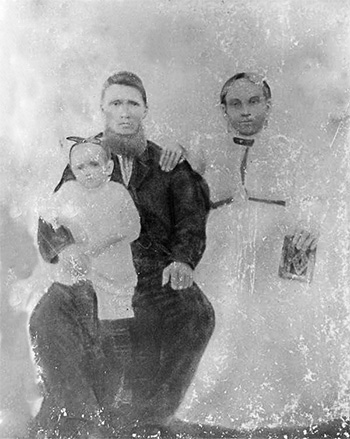
Haw’s Creek Precinct is also where Charlotte Mott Smith likely gave birth to her first child, John James Smith, believed to be shown in the photo above.
Richard Calhoun Smith and Charlotte C Mott Smith would have the following children:
John James Smith, b. 14 May 1867, Volusia County
Charles Hardy Smith, b. 11 October 1870, Volusia County
Richard Isaiah Smith, b. 25 November 1872, Volusia County; d. 12 June 1958, Geneva County, Alabama
Job Elbert Smith, b. 30 March 1875, Volusia County; d. 25 January 1951, Coffee County, Alabama
Zeliah Smith, 25 April 1877, Volusia County;
Alexander Abraham Smith, b. 10 November 1881, Volusia County; d. 10 November 1965, Coffee County, Alabama
By the second half of the 1870s, Richard and Charlotte Mott Smith appear to move further south to the outskirts of Spring Garden Centre, Florida. This area has ties back to when the Spanish owned the territory.
During the late 1870s, the United States government offered land patent grants in Florida as part of its efforts to encourage settlement and development in the region. These land grants, often associated with the Homestead Act of 1862, provided individuals and families the opportunity to acquire land directly from the government.
These patents granted ownership of specific plots of federal land to individuals who met certain requirements, typically including a minimum residency period and cultivation of the land.
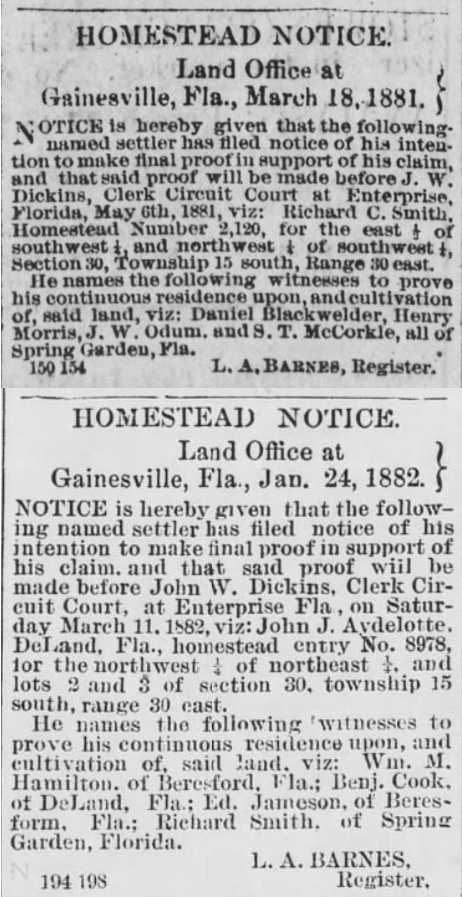
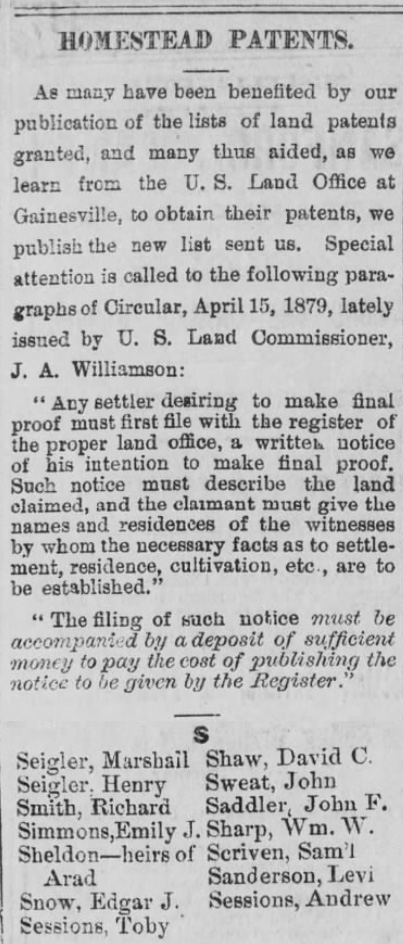
These two notices from, ‘The Florida Agriculturist’ 6 April 1881, page 6 and 1 March 1882, page 2, respectively do a good job tying Richard C. Smith as a resident of Spring Garden, Florida.
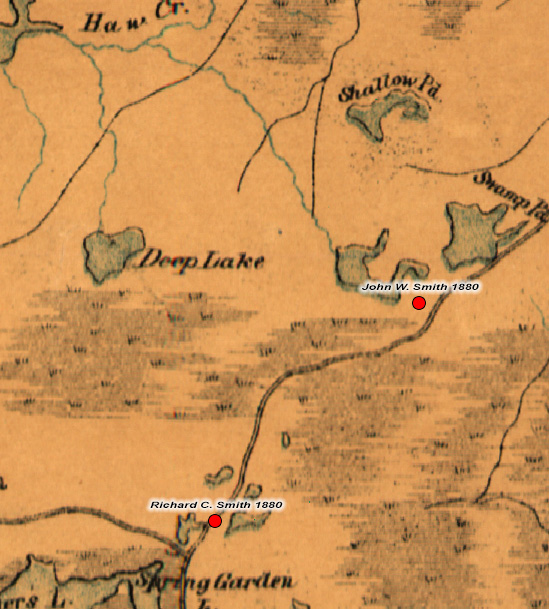
Richard Smith was applying for and would be granted these two tracts of land: East 1/2 of Southwest 1/4 and the Northwest 1/4 of Southwest 1/4, Section 30, Township 15 South, Range 30 East. This land was in the outskirts of Spring Garden but today the area is called De Leon Springs. Sandhill Trail runs right through this property (Google Maps link). The bulk of the property lies to the west of the road.
In 1993, my grand-uncle Murris Smith undertook genealogy research and passed down this lore:
Sometime in 1881, Richard Calhoun Smith left Volusia Co. Fla to home stead in Coffee County, Alabama. He did not bring his wife since she was pregnant with Alexander and a daughter Zaliah, 3 yrs old. He did bring with him his four sons, ages 6 to 12 years. He did go back to Fla. to bring his wife and children back to Ala. However, in the meantime, his wife had died. He returned to Ala. with son Alexander but there is no mention of Zeliah so we assume she had died also.
This lore while maybe partially correct, some parts can be proved otherwise. The lore suggest that Charlotte Mott Smith died sometime while Richard Smith was away in Alabama. However, there is a deed that was executed on 13 February 1883 between R.C. Smith & wife C.C. Smith of the County of Volusia and W.R. Revels. The Smith’s sold Mr. Revel a tract of land lying and being in the County of Volusia and State of Florida described as follows: “The East half (1/2) of the South West quarter (1/4) & North West (1/4) of the South West quarter (1/4) Section Thirty (30) Township fifteen (15) Range Thirty (30) East, (Note) except five acres in the South West corner of the north west quarter deeded to C.C. Crawford containing one hundred and twenty one (121) acres more or less”.
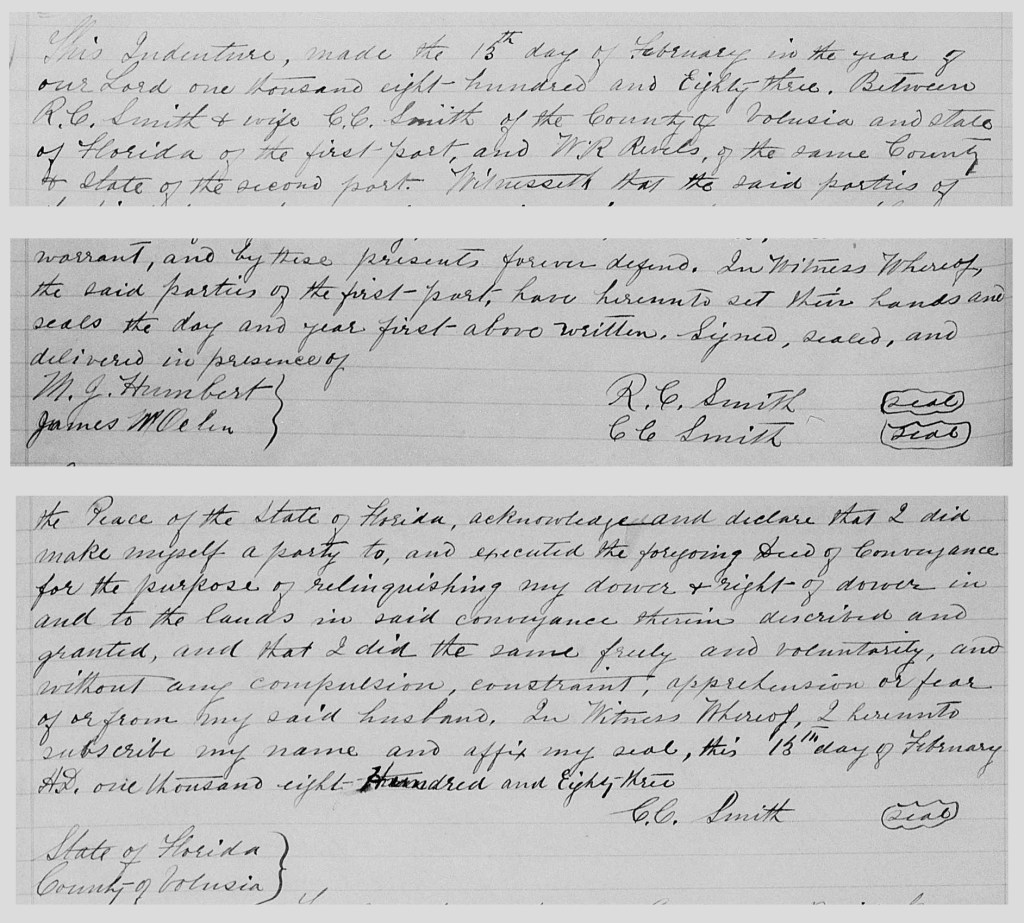
This deed alludes to two things. Firstly, it indicates that Charlotte Mott Smith was still alive as of February 1883. Secondly, it provides the only documentation known showing that she had a middle name starting with the letter C.
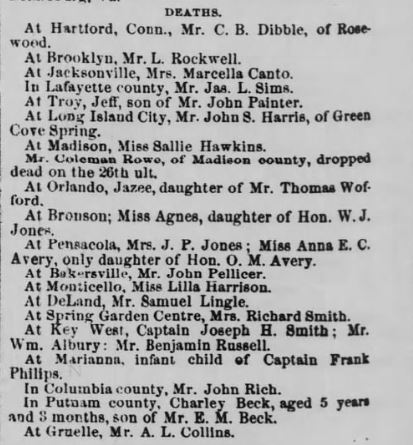
Charlotte Mott Smith died presumably in September of 1883. This claim is supported by death notices from the October 2nd 1883 edition of, ‘The Weekly Floridian’. She would have been around 39 years old.
 digging our roots
Leave a comment