
By April 1783, the skirmishes stemming from the Revolutionary War reached their conclusion, marking an end to the hostilities of the war. The Smith clan resided primarily in the northern region of Cumberland County, North Carolina, establishing their homes along Black River, Niells Creek, and Buies Creek.
In the days leading up to the war’s conclusion, on February 17, 1783, the state of Georgia enacted a significant piece of legislation titled “An act of opening the land office, and for other purposes…”.
Highlights (Marbury & Crawford pg 323-330 (Digest of the Laws of the State of Georgia))

~ An act for opening the land-office, and for other purposes therein mentioned
~ Whereas it will tend to the benefit and advantage of this state, that the unlocated lands within the same, be granted out, and that all due encouragement be given to the immediate settlement thereof.
~ ... and all and every person and persons applying for land agreeable to the terms herein after mentioned, shall be entitled to a grant of the same, that is to say, each master or head of a family shall be allowed as his own head right, and without any other or further charges than the office and surveying fees, two hundred acres: And such persons shall also be permitted to purchase at the rate of fifty acres for each and every head right in his family, on the following terms, that is to say, one shilling per acre for the first hundred acres, and one shilling and six pence per acre for the second hundred acres, two shillings per acre for the third hundred acres, and two shillings and six pence per acre for the fourth hundred acres, and so on in the same progression, according to the number of head rights in such family: Provided the quantity of land granted and sold to any one person shall not exceed one thousand acres, and that such person do live on and cultivate a part of the said land, twelve months before he or she shall be entitled to a grant for the same;
~ 3. And be it further enacted, That every person applying by head rights as aforesaid, shall previous to his obtaining a grant for his land, or having it in his power to dispose of the same, (otherwise than by will) settle and improve a part of such tract or tracts, as he may obtain a warrant and survey and survey of, for the space of twleve months as aforesaid, and shall actually cultivate and clear at the rate of three acres at least for every hundred acres of the said land.
~ 7. And be it further enacted, That all and every person and persons, before he, she or they, shall obtain a warrant or warrants for any land within this state, shall on oath declare, before the said justices holding a court as aforesaid, that he, she or they, hath or have not taken up or obtained land in this state for the head rights, or any of them, at that time applied for; ...
~ ... and such person or persons shall also at the same time produce a certificate, signed by two or more justices of the county, he, she or they, last resided in, or such other credentials as will satify the court of the honesty and integrity of the person or persons so applying;
~ That the limits, boundaries, jurisdiction and authority of the state of Georgia, do and did, and of right ought to extend, from the mouth of the river Savannah, along the north side thereof, and up the most northern stream or fork of the said river to its head or source; from thence in a due west course to the river Missisippi; and down the said stream of the Missisippi, to the latitude thrity-one degrees north; from thence, in a due east course, to the river Apalachicola, or Chatahouchee; and from the fork of the said river Apalachicola, where the Chatahouchee; and from the fork of the said river Apalachicola, where the Chatahouchee and Flint Rivers meet, in a direct line to the head or source of the southernmost stream of the river St. Mary; and along the source of the said river St. Mary, to the Atlantic ocean, and from thence to the mouth or inlet of the river Savannah ...

This act was signed in Savannah, February 17, 1783

An act to repeal and amend some part of an act entitled "An act for opening the land office."

~ 4. And whereas many persons now residents of other states have formerly obtained warrants, under which they have surveyed lands in the different counties of this state, and have never obtained grants for the same. Be it therefore further enacted by the authority aforesaid, That his honor the governor be empowered and required to issue his proclamation immediately after the passing of this act, and cause the same to be published in the several gazettes of the United States, requesting all and every such person or persons residents of other states; who hold lands by surveys as aforefaid, or other claims, that he, she or they, shall come in within the space of twelve months after issuing the said proclamation, and settle their respective claims according to the laws of this state, and on default of their not coming in within the time limited, every such survey or claim is hereby declared null and void, and any other person or persons entitled to land, shall be at liberty to apply and obtain grants for the said land, the same as for any other unlocated lands, within this state, notwithstanding said surveys or claims, ...

This act was signed in Augusta, August 1, 1783
Under the newly established provisions, which displayed a greater degree of leniency compared to the preceding requisites, every citizen of Georgia or any other state became eligible for a land grant. The head of the household was entitled to two hundred acres, while an additional fifty acres were allocated for each accompanying member, regardless of their racial background. The total amount, however, could not surpass one thousand acres.
In exchange for the grant, applicants were obliged to relocate their entire family to the designated land and pledge their allegiance to the state government through a solemn oath. Moreover, they were required to provide assurance that the land would be settled within a timeframe of twelve months.
Upon receiving news of this momentous development, which swiftly spread throughout the communities of North Carolina, it became evident that the Smith clan saw this as an opportune moment to embark on a relocation to Georgia in pursuit of enhanced prospects and brighter horizons.
The journey to Georgia appears to have started as early as February 1783. On February 19, 1783, Francis Scott Smith would sell 100 acres of his Neills Creek land to Richard Smith. (Cumberland DB 7:112). Shortly after, on February 27, 1783, Francis Smith would assign Israel Folsom as Power Of Attorney over real estate dealings in Cumberland County (Cumberland DB 7:120). This decision strongly suggests Francis Smith’s intention to be absent from the area, unable to personally oversee these matters. It is plausible that he embarked on this course of action to explore fresh prospects in Georgia.
Throughout the following year, Richard Smith gradually divested himself of his lands situated along Black River and Neills Creek. It becomes evident that Richard Smith remained in Cumberland County until at least February 1784. His final parcel of land was sold to Solomon Porch (Cumberland DB 7:179), concluding his property transactions in the area.
In all likelihood, during the spring of 1784, Francis Smith, Richard Smith, Needham Smith, William Womack, and their families set forth on a transformative expedition, destined for a fresh start in Wilkes County, Georgia.
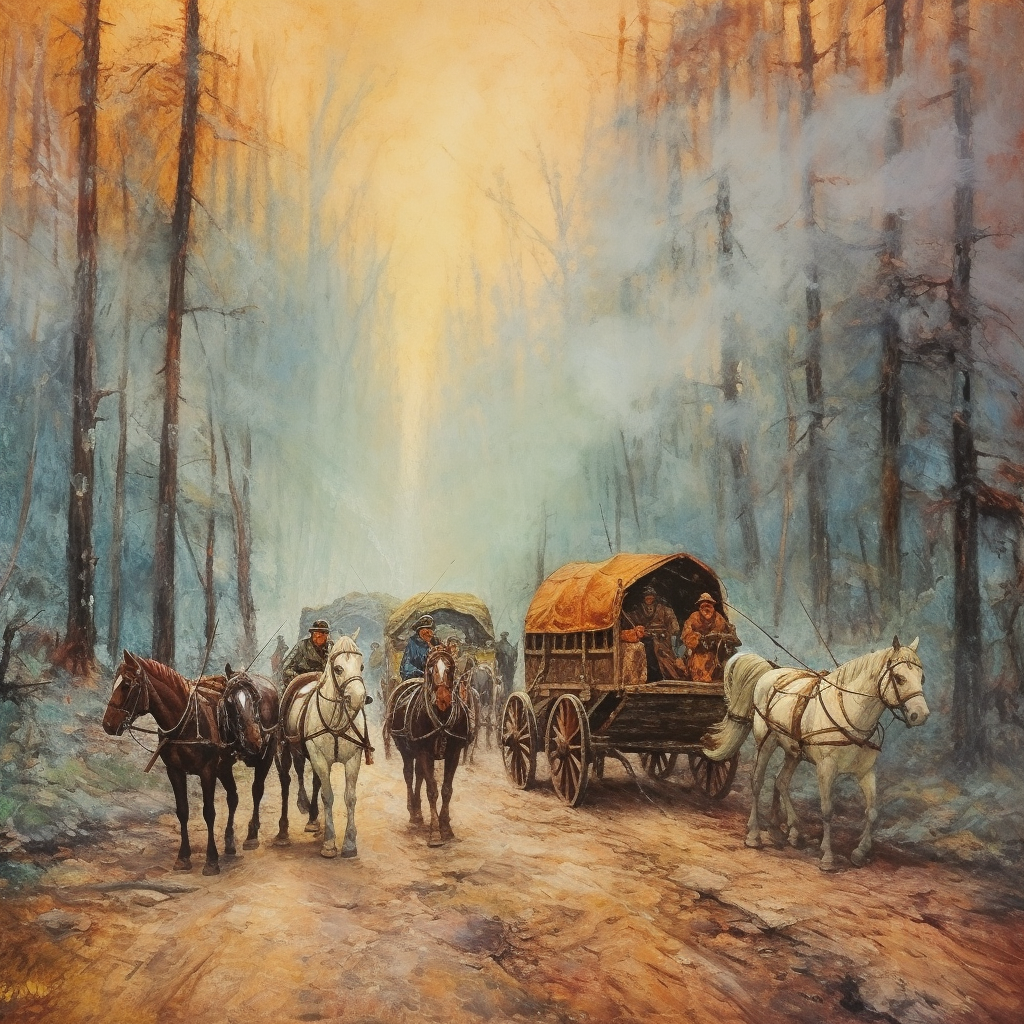
Drawn by the allure of fertile and affordable land, the Smith Clan meticulously loaded their belongings onto covered wagons, embarking on a journey that spanned three to four weeks, culminating in their arrival at their desired destination.
To acquire land, an individual seeking ownership would approach the land officer and submit a written declaration detailing the size of their family unit, encompassing indentured servants and slaves, who had not received any land from the state. Within their petition, the applicant provided a brief account of the desired land’s approximate location and pledged that its purpose was personal use, not speculative ventures. After affirming the veracity of their statements, the applicant received a warrant from the governor, instructing the surveyor general to conduct a survey of the designated tract.
On June 21, 1784, Francis Smith made his initial appearance in Richmond County, Georgia. He attended the land court proceedings (presumed in Augusta) to formally petition for a warrant, and his request was granted. Consequently, he received a warrant for 200 acres of land situated on Brier Creek within Richmond County, Georgia.
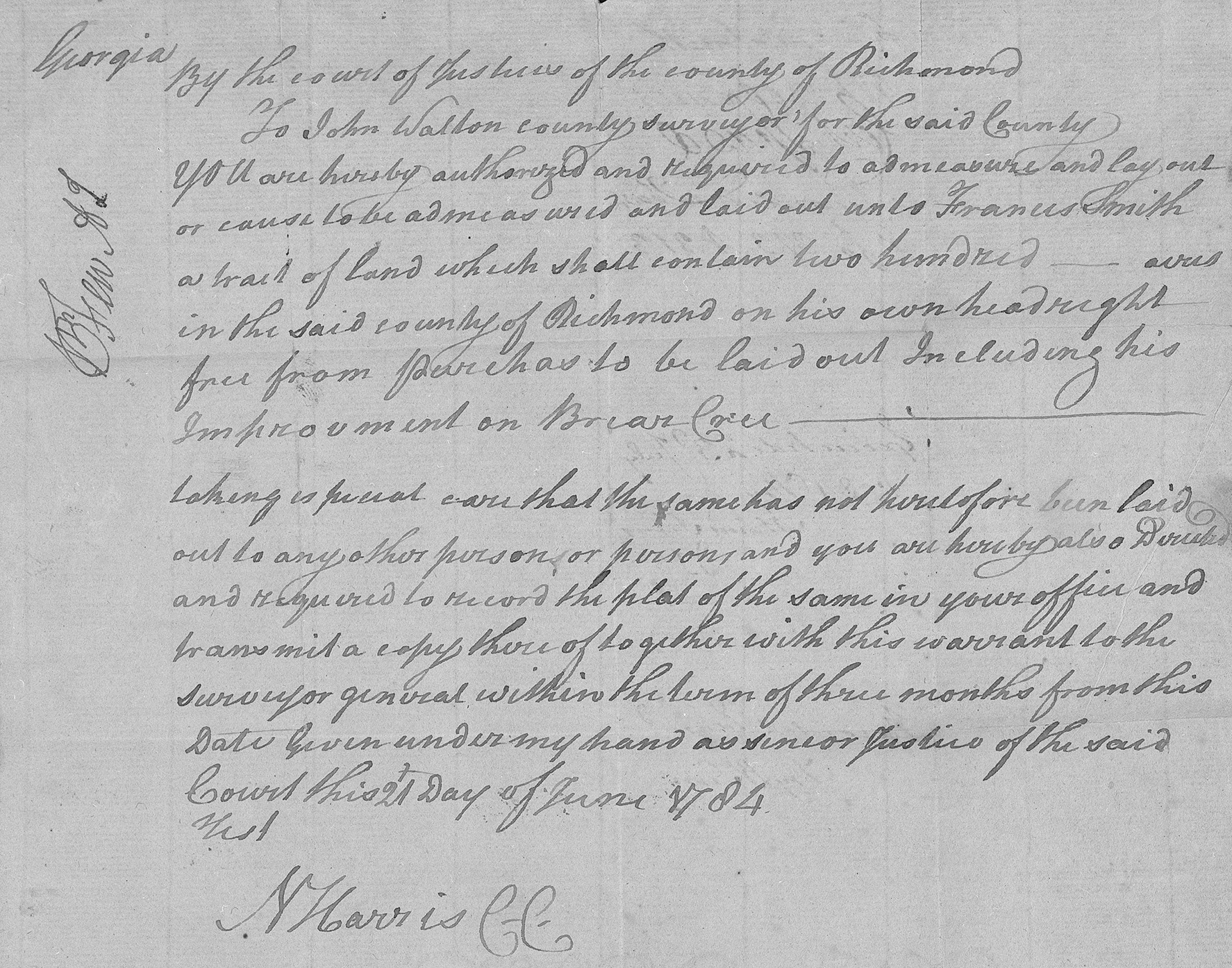
Brier Creek, known variably as Briar or Bryar in historical deeds and depicted as such on antiquated maps, serves as a tributary to the Savannah River. In 1784, parts of Brier Creek acted as the county line between Richmond and Wilkes County, Georgia.
Francis Smith then carried the warrant to the county surveyor to survey and establish the boundaries of the tract. Typically, the applicant accompanied the deputy to accurately indicate the specific lines for demarcation and to offer assistance in the survey process. This assistance primarily involved acting as chainmen, a role filled by the applicant and any available individuals enlisted to aid in the task. Prior to commencing their duties, chainmen were duly sworn in. The survey for this 200 acre tract was completed on 26 July 1784.


One can envision that Francis Smith and the rest of the clan wasted no time in commencing the arduous task of clearing the land and constructing temporary shelters, ensuring progress before the arrival of winter.
One month later, in September 1784, Richard Smith, William Smith, and William Womack embarked on a journey spanning 33 miles to the north-northwest, arriving at the town of Washington. It was in this locale that the land court for Wilkes County, Georgia convened, overseeing crucial proceedings regarding petitions for land.
Functioning as the county seat, this town, previously known as Fort Heard, assumed the role of the county government’s headquarters.
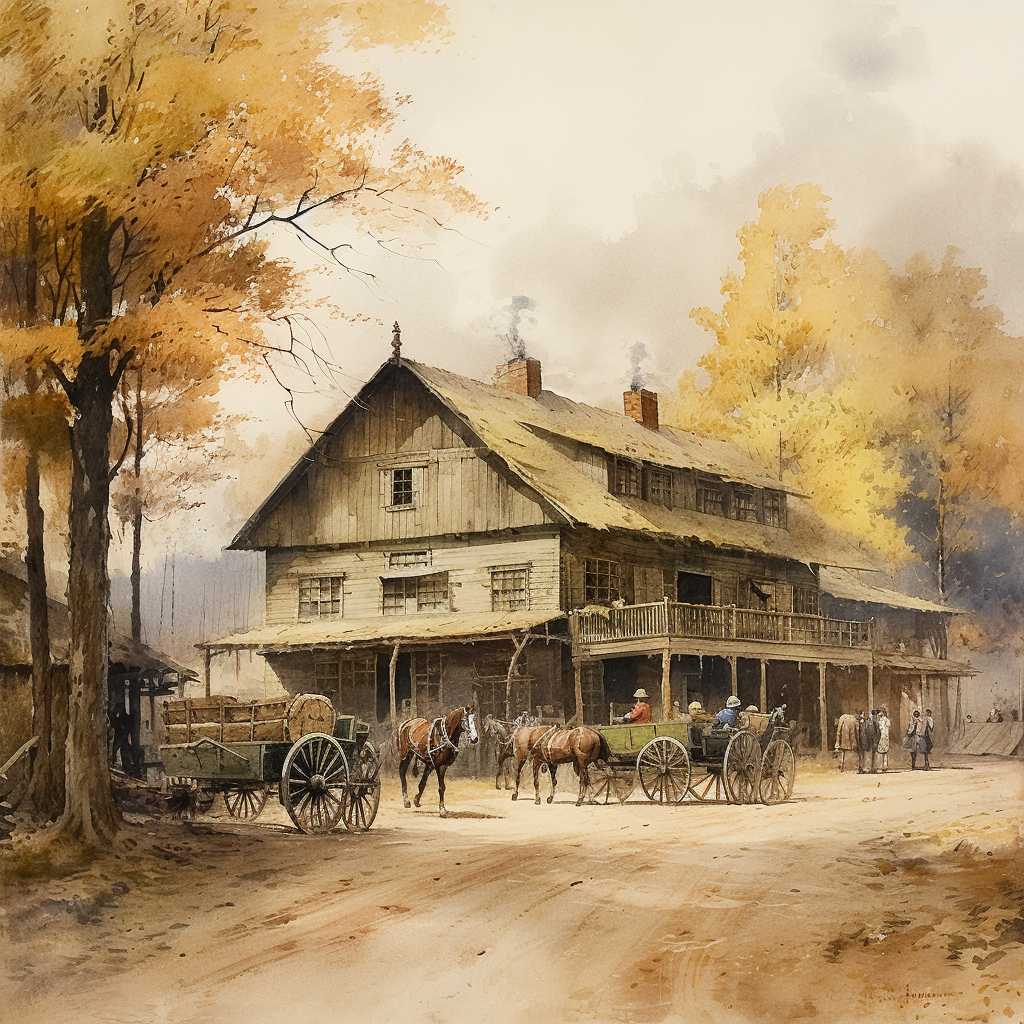
Court sessions were frequently conducted within the residences of the community, with regular gatherings speculated to have taken place at a local tavern until the construction of the first official courtroom in 1785.
During the September 10, 1784 land court session, various members of the Smith clan presented their land warrant petitions. The 1784 Wilkes County Land Court Minutes, below, provide a partial list of attendees.

Of interest on these two pages is Richard Smith, John Austin, William Smith, William Womack, Thomas Smith, and Martin Nall.
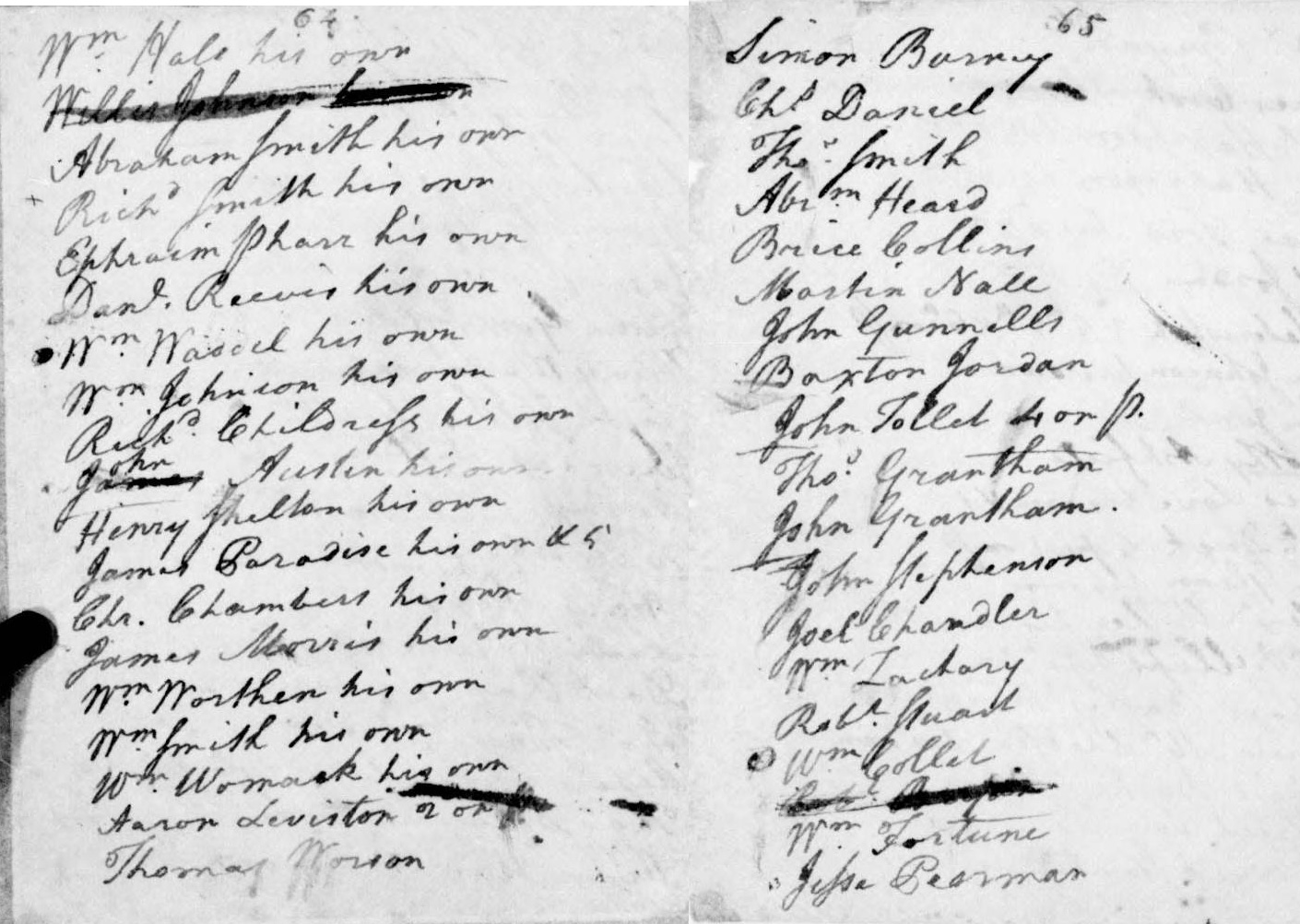
Richard Smith is believed to be the brother of Francis Smith. William Smith based on current avaliable research and historical documentation is believed to be Francis and Richard’s older brother.
William Womack is the son of Benjamin Womack who was a neighbor to the north of the Smiths and lived on Neills Creek.
Thomas Smith is of interest because he may be kin to the Smiths from Cumberland County, North Carolina. He is someone that I will research in the future.
John Austin and Martin Nall are marked here for potential research. They may appear on this September 1784 list by coincidence. John Austin may be a decendant of John Austin from Middle Creek in Johnston County, North Carolina. Martin Nall may be a decendant of the Nalls of Johnston County who have assoicated with the Smiths while they lived in Johnston County, North Carolina.
The below pages are minutes from the October 1784 session of the Wilkes County Land Court.
Names of interest on these two sheets are Shadrack Smith, Francis Grubbs, Rachel Cobb, Needham Smith, and Amy McColles (McCullers).
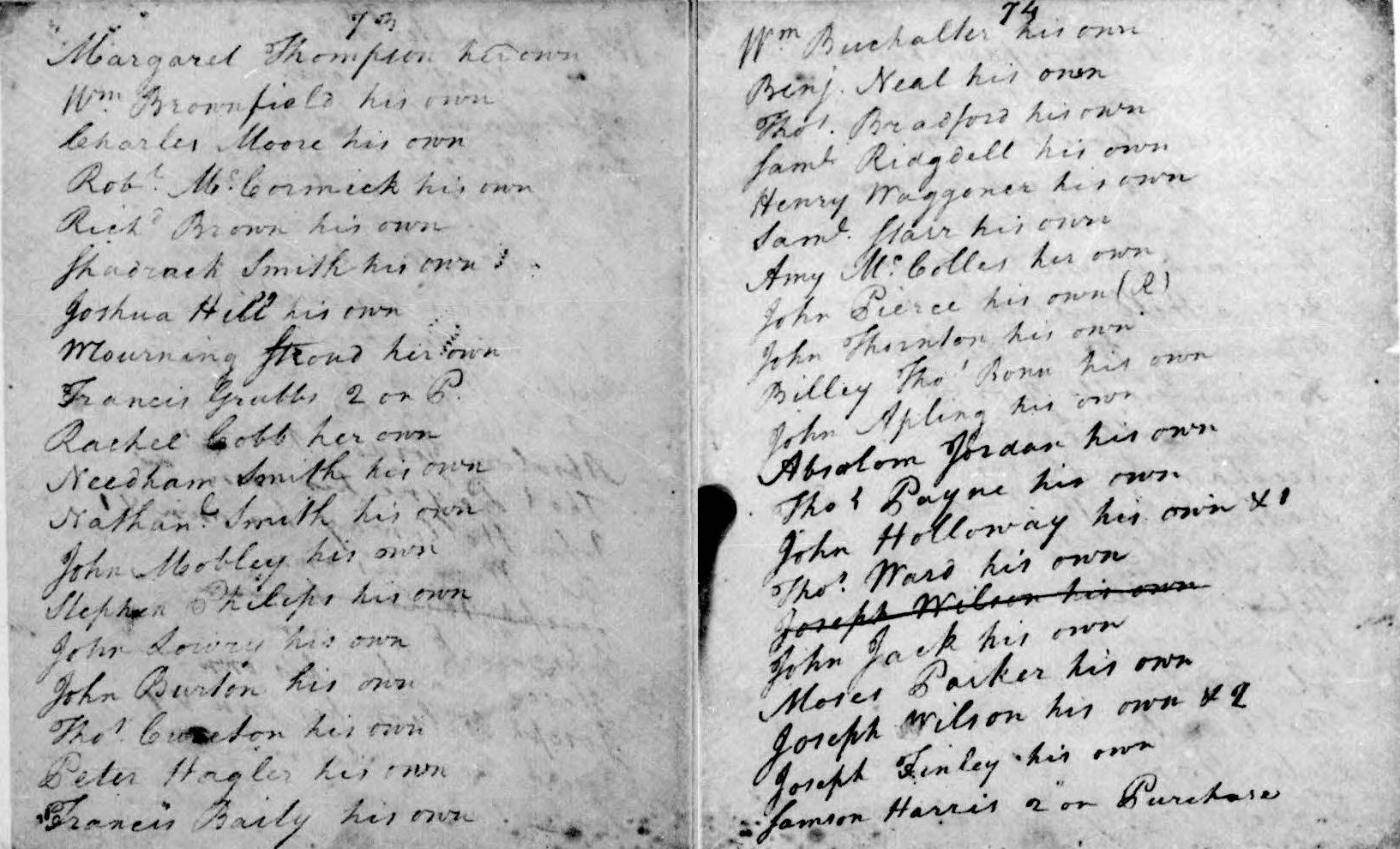
Shadrack Smith is believed to be the same individual who lived in Wake County, North Carolina, just across the county line from where the Smiths resided in Cumberland County, North Carolina.
Francis Grubbs, the author’s 4x great-granduncle, married Mary Cobb, daughter of Rachel Cobb. Benjamin Grubbs, the author’s 4x great-grandfather, lived nearby, just east across the county line in Richmond/Columbia County. Benjamin Grubbs‘ grandaughter Charlotte Mott would marry Richard Smiths presumed 2x great-grandson Richard Calhoun Smith.
Amy McCullers was married to David McCullers, who is believed to be from the McCullers clan in Johnston County, North Carolina. It’s possible that David McCullers’ father was the same David McCullers who was granted a 100-acre tract of property on Middle Creek in 1753, located about 3 miles north of where the Smith clan lived on Black Creek in Johnston County.
David McCullers, the younger, was granted 150 acres of land in 1770, located next to Richard Smith on Black River in Cumberland County, North Carolina. Future research may be warranted to try and determine if Amy is a Smith and married into the McCuller family.
Needham Smith, presumed to be the author’s 5th great-granduncle and Isaiah Smith Sr’s presumed uncle, migrated to Washington County, Georgia, and then to Houston County, Georgia.
Two months later in December 1784, Francis Smith would receive another warrant for 100 acres on Briar Creek in Richmond County. Both of these warrants were considered headright grants. 200 acres grant to him for his headright and then he would appears to have purchased 100 acres more based on the number of additional persons he could claim (i.e. wife and/or children).

Ten days later Francis Smith had his warrant surveyed. This 100 acres adjoined the 200 acres he previously obtained.
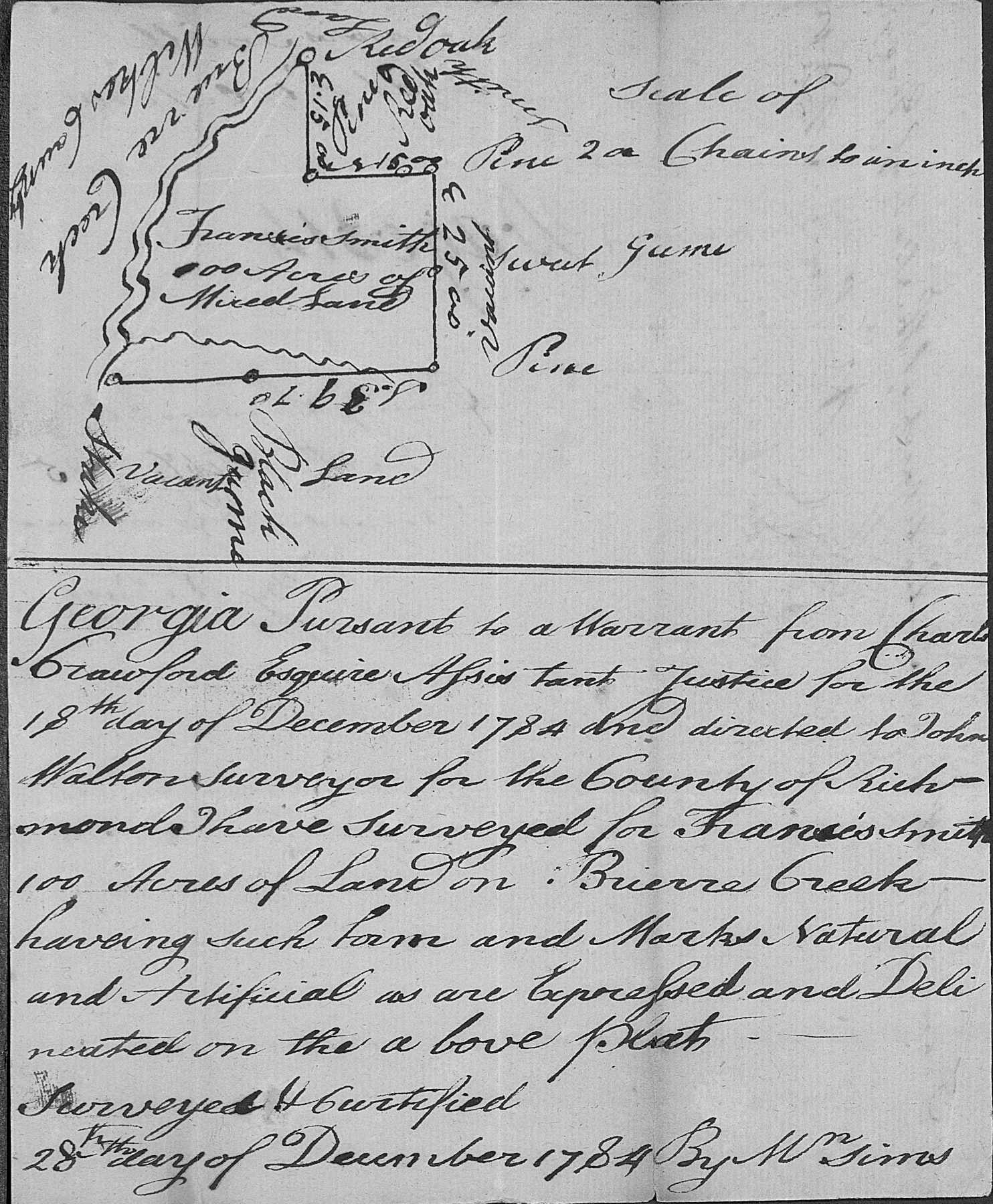
Several years later Francis Smith would obtain another headright grant for an additional 200 acres. This tract would adjoin his previous 200 acre track.

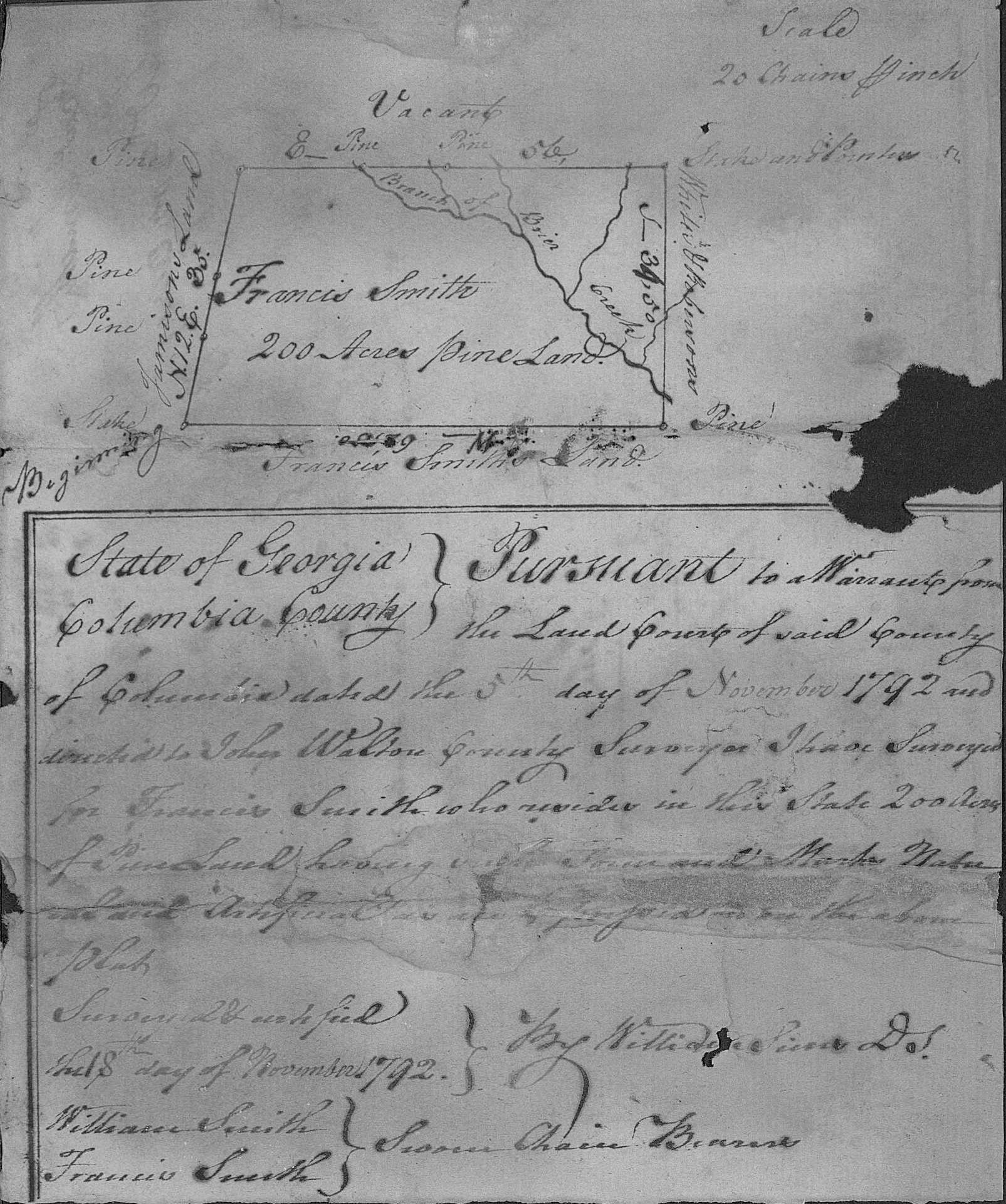

Future post on this topic will look at grants for the other members of the Smith clan.
 digging our roots
Leave a comment