Benjamin Harrison stood as the progenitor of a renowned lineage known as the James River Harrisons. His notable appointments include being appointed Clerk of the Virginia Council in 1632, tobacco viewer for the Upper Chippoakes district (Jamestown) in 1639, and holding a position as a representative in the House of Burgess for James City County in 1642.
In 1643 Benjamin Harrison (I) was granted 500 acres of land in James City County, which would later be known as Surry County, Virginia.
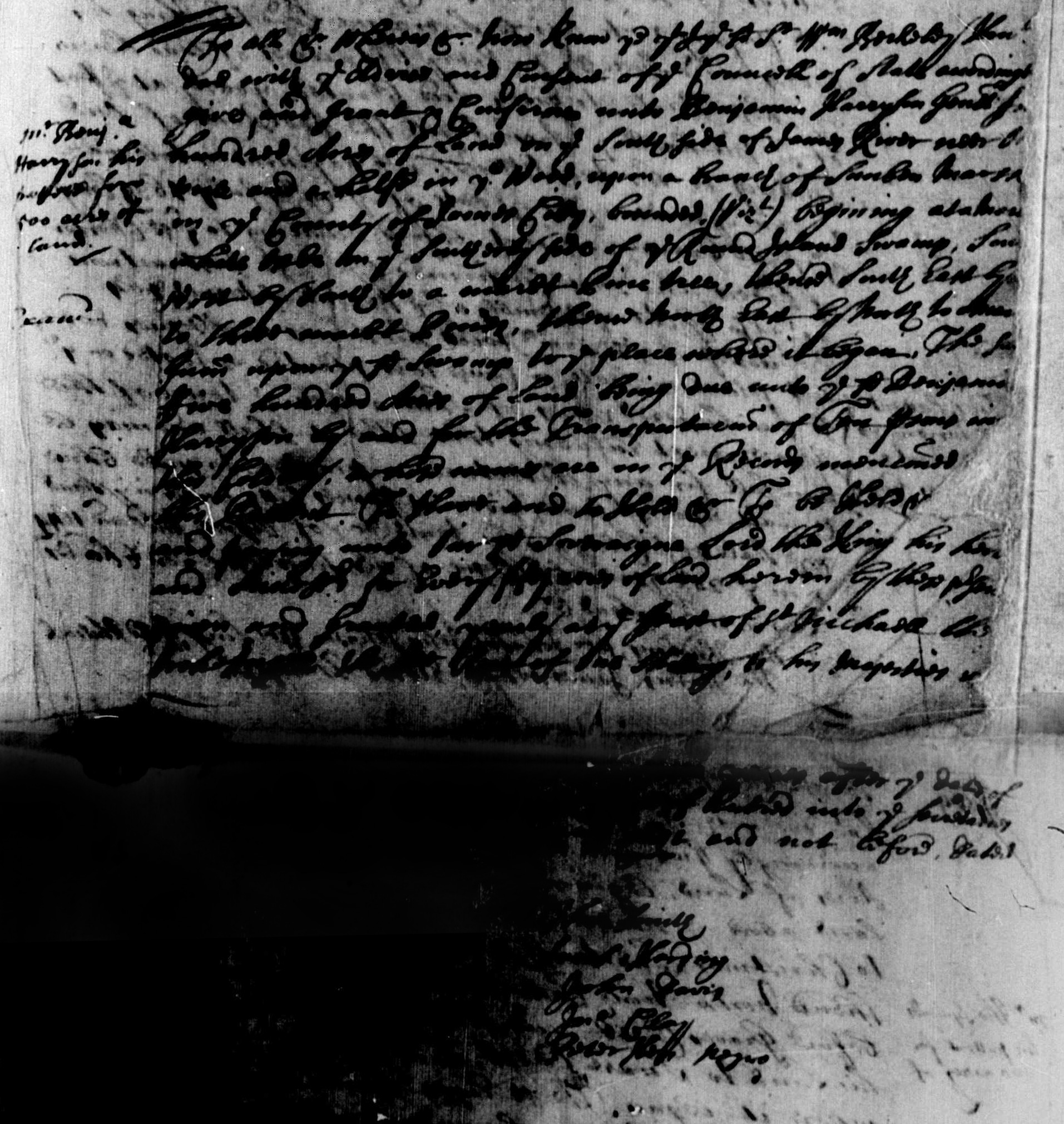
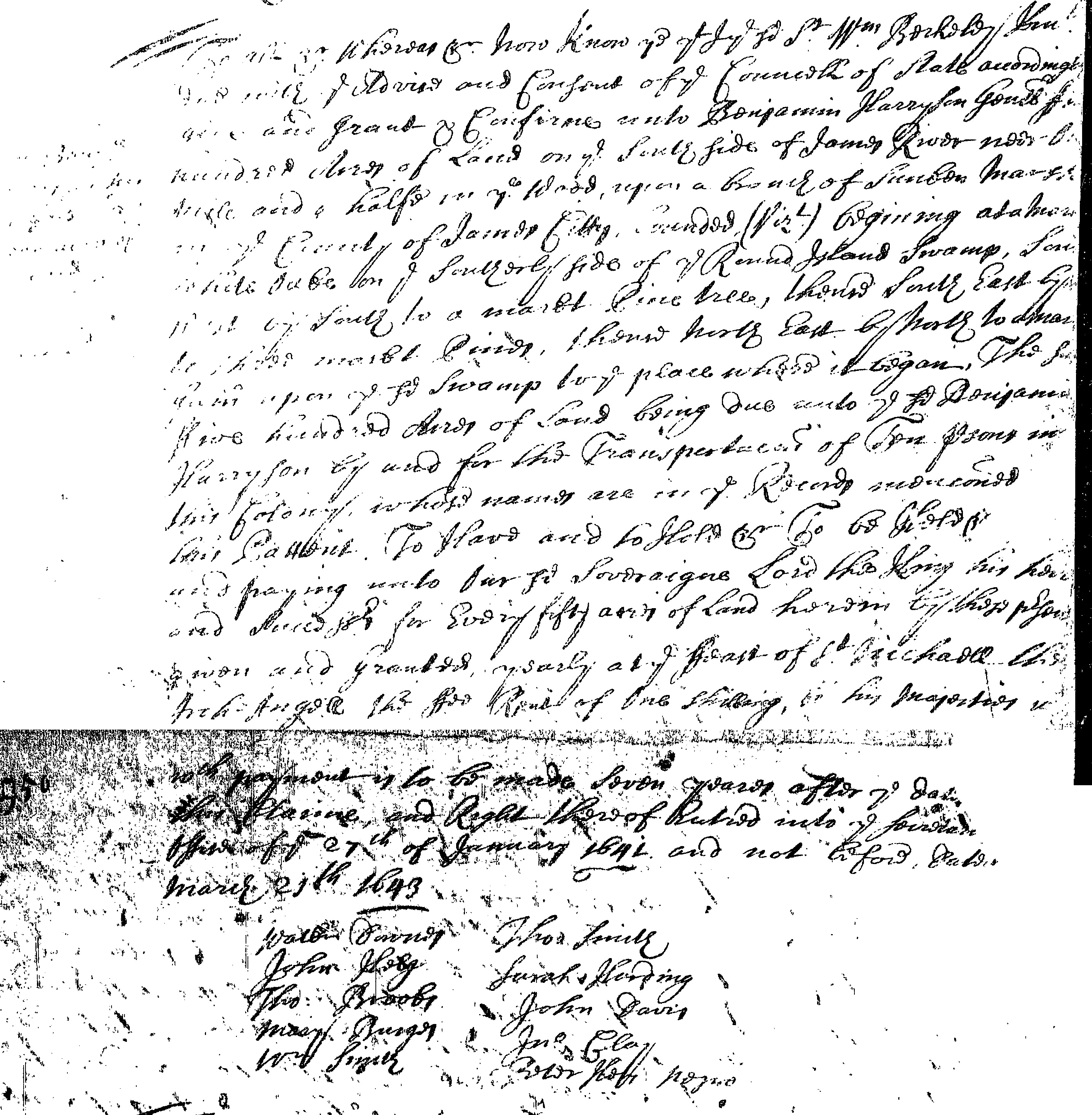
Colony of Virginia, Virginia Land Office Patent and Grant Index, Patents No. 1 (Vol. 2 1623-1643) page 949

To all &c Whereas &c Now know ye that I ye said Sir William Berkeley Knight doe with ye advice and consent of ye Counsell of State accordingly give and grant & confirme unto Benjamin Harryson [sic], Gentlemen five hundred acres of land on ye South Side of James River neare one mile and a halfe in ye wood, upon a branch of Sunken Marsh in ye County of James Citty, bounded (viz) beginning at a marked white oake on ye southerly side of ye Round Island Swamp, soutwest by south to a marked pine tree, thence south east by east to three marked pines, thence north east by north to a marked gum upon ye said swamp to ye place where it began. The said five hundred acres of land being due unto ye said Benjamin Harryson by and for the transportation of ten persons in this Colony whose names are in ye records mentioned under this Pattent. To have and to hold &c To be held &c yeilding and paying unto our said Sovereign Lord thee King his heirs and successors, for every fifty acres of land herein by these presents given and granted yearly at ye feast of St Nicholas the Archangell, the ffee rent of one shilling, to his majesties instructions with payment is to be made seven years after ye date this {illegible} and right thereof {illegible} into ye {illegible} 7th of January 1641 and not before date March 21th 1643.

Watkin Downes, John Hely, Thomas Brooks, Mary Buges, William Smith, Thomas Smith, Sarah Harding, John Davis, John Clay, Peter {illegible}, Negro.
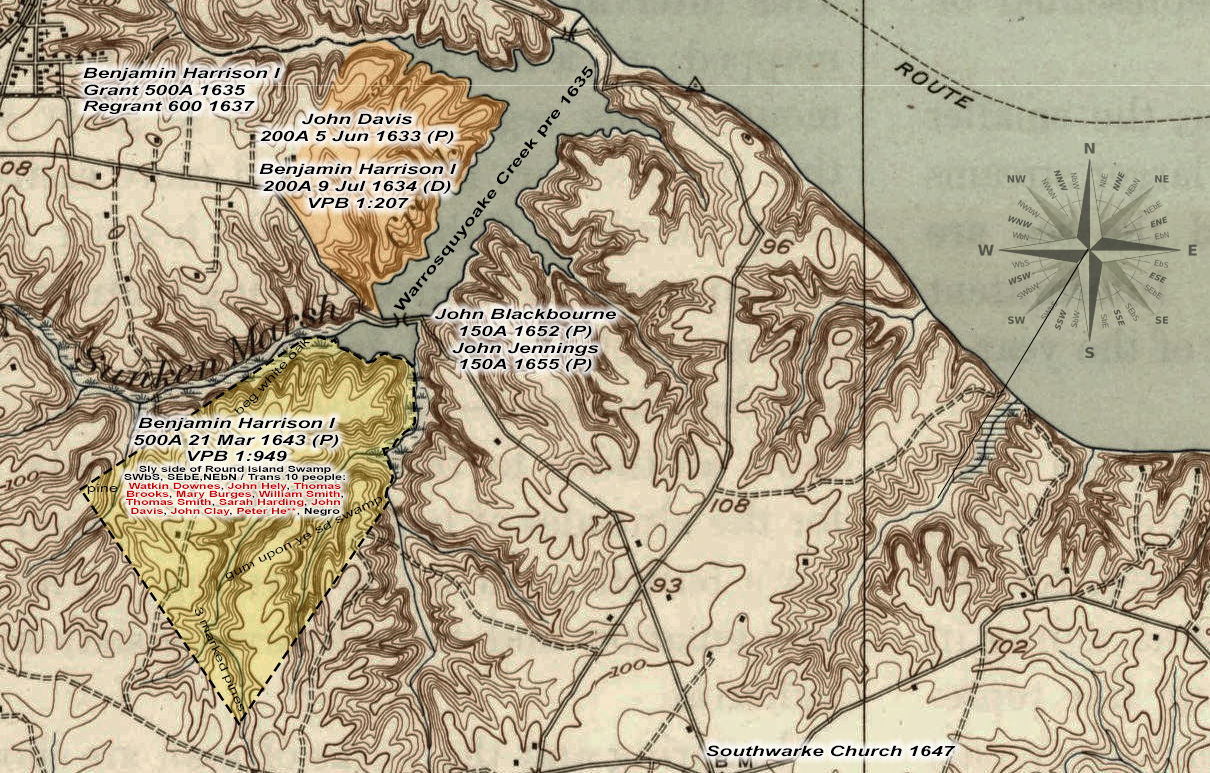
Situated south of the 200 acre parcel he acquired in 1634, this 500 acre tract of land was positioned on the western side of Sunken Marsh, previously known as Warrosquyoake Creek.
The prevailing theory posits that this land grant marks the initial documentation of William Smith’s (of Lawnes Creek) arrival in Virginia.
However, due to the absence of surviving records for James City County during this era, the connection between this William Smith and the William Smith of Lawnes Creek remains speculative, supported only by circumstantial evidence.
This circumstantial evidence is primarily derived from records found in Surry County and Isle of Wight.

John Davis is listed on the Harrison grant as an individual for whom Benjamin Harrison claimed for his Headright grant. It may be inferred that this John Davis is the same person who was awarded land as part of a dividend granted unto him by order of Court, being recognized as the heir to his uncle Walter Davis (VPB 1:207).
This land was north of the 500 acre Harrison grant.
This information suggests that the individuals whom Benjamin Harrison assisted in traveling to the Colony were likely a mixed class of people, and it cannot be assumed that all of them were indentured servants.
Additional circumstantial clues point to Thomas Brookes, who is also listed on the Harrison grant. Thomas Brookes married Joanna Jennings Owen around 1689, after she became widowed by Bartholomew Owen. Joanna Jennings Owen Brookes was the daughter of John Jennings, a neighboring landowner.

This information suggests that Thomas Brookes, along with possibly other individuals mentioned in the Harrison grant like William Smith, settled in James City, which eventually transformed into Surry County, upon their migration to the Virginia Colony.
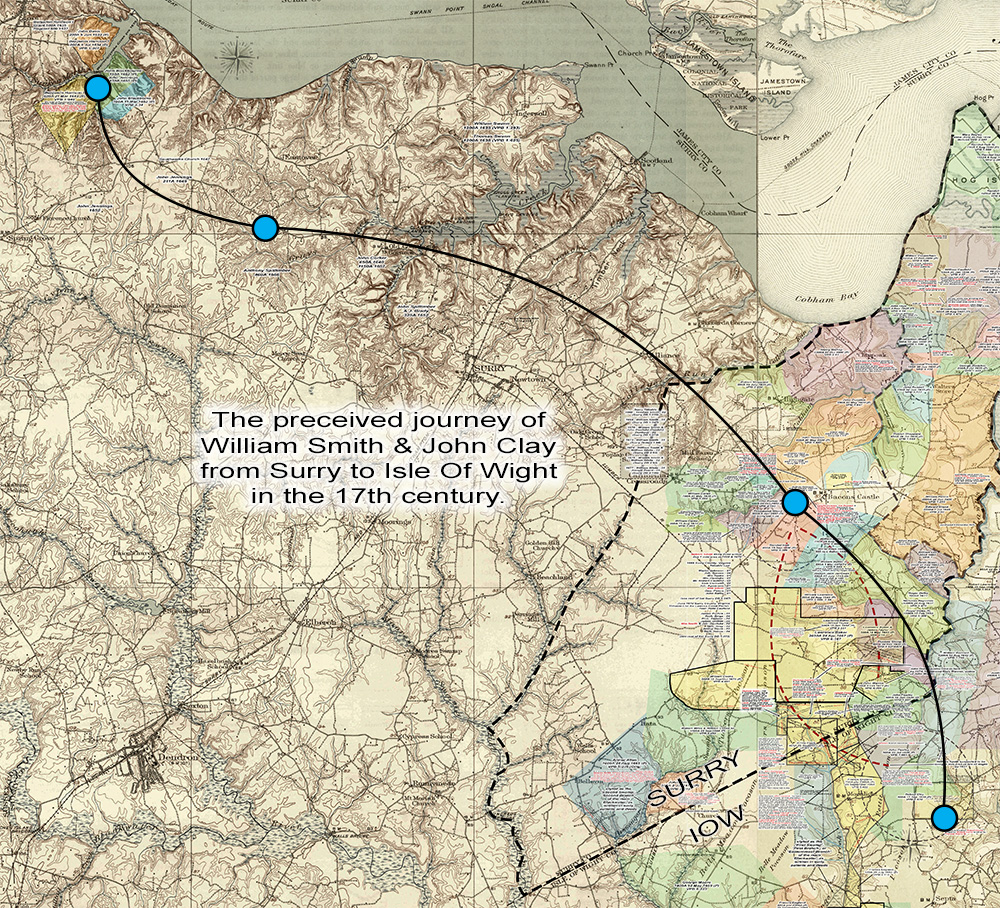
Subsequently, Thomas Brookes and Joanna Jennings Owen Brookes relocated to Henrico County, Virginia. Furthermore, Joanna Jennings Owen Brookes’ father, John Jennings, contracted a second marriage with Martha Harris, who was the daughter of Robert Harris of Isle Of Wight. This highlights the significant distance people corresponded and traveled from Sunken Marsh to Isle Of Wight.
A neighboring landowner of John Jennings’ Surry property was Anthony Spiltimber, who married Mary Harris, yet another daughter of Robert Harris of Isle Of Wight.
Also residing nearby was John Corker, who represented Pasbehegh, a suburb of Jamestown, in 1632 and 1633. By 1640, he held the title of ‘Clerk of the Assembly,’ and in 1645, he served as a Burgess for James City County. In 1656, he was appointed as a justice of the peace for Surry County and continued to serve as a vestryman of Southwark Parish (Surry County) as late as 1661.
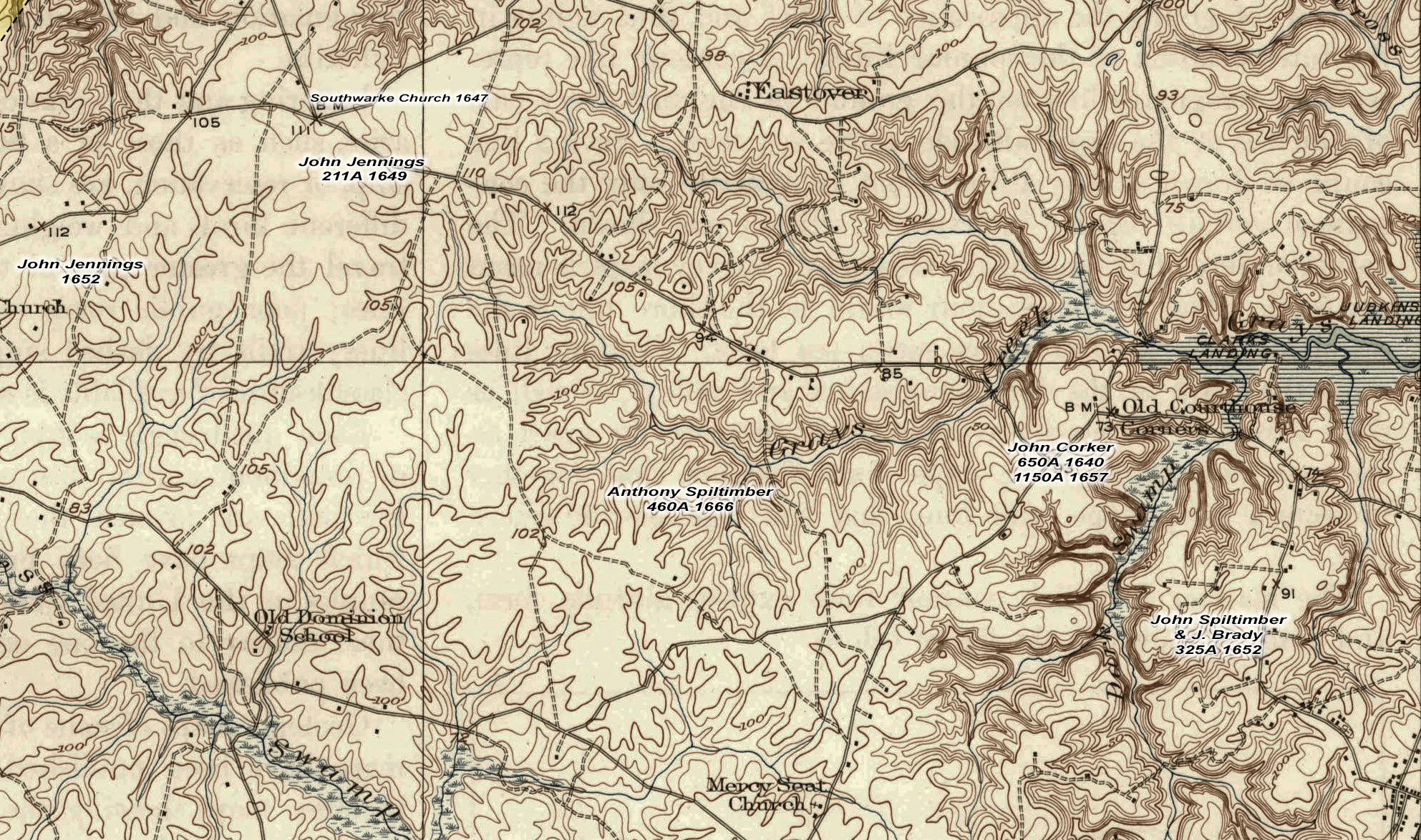
Robert Harris, of Isle Of Wight, is believed to have passed away prior to 1659, and it is conjectured (based where his sons were living after his death) that he owned property located east of the first swamp of the main Blackwater, as depicted on the map below. Part of Lawnes Creek is situated to the north of the proposed property.

On February 28, 1663, Anthony Spiltimber of Surry and his wife Mary, daughter of Robert Harris formerly of Isle of Wight, conveyed 250 acres on Lawne’s Creek to John Clay of Surry. This John Clay is presumed to be the same individual listed on the Harrison grant alongside William Smith. Subsequently, William Smith of Lawnes Creek Parish relocated to this area of Isle Of Wight by 1677, as depicted on the map above.
Before 1677, John Clay is believed to have resided in Lawnes Creek Parish near the agrarian community center around what will become Bacon’s Castle, the residence of Arthur Allen. In 1661, John Clay acquired a 50-acre tract of land from Walter Bartlett, which had originally been granted to John Dunstan Sr and bequeathed to Andrew Robinson (Surry County, Book 2, pg 240 / Book 1, pg 184). John Clay was also recorded as a vestryman of Lawnes Creek Parish in 1661 (Surry County, Book 1, pg. 168).
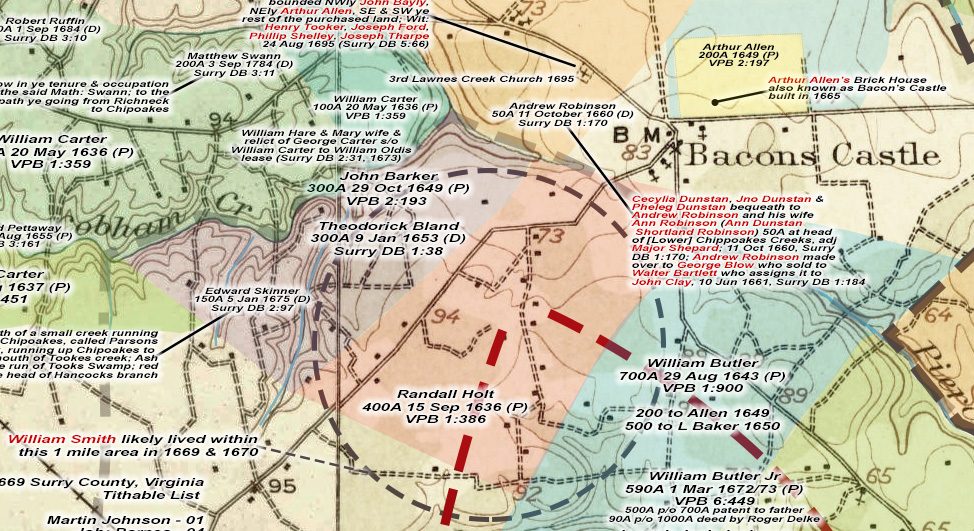
This information not only suggests that John Clay remained in Surry after migrating to Virginia, but it also indicates the possibility that he was acquainted with William Smith and Thomas Smith, who were also named in the Harrison grant. It should be noted that William Smith of Lawnes Creek Parish is presumed to have lived in this same area and was acquainted with the local residents (see William Smith of Lawnes Creek Parish). Additionally, this information presents plausibility that the Smith’s and Clay’s migrated and lived in similar patterns.
John Clay died in the summer of 1675 (IOW Wills, Vol 1, pg. 135) leaving his son William Clay the land purchased from Anthony Spiltimber and son John Clay the 50 acres ‘purchased from Andrew Robinson‘. Others mentioned in the will were son Thomas Clay, William Clay’s daughter Elizabeth Clay, goddaughter Mary Hardy.
William Clay married Judith Corker around 1668, daughter of William Corker, who served as a Burgess for James City County in 1658. William Corker’s father was John Corker. William Clay passed away shortly after in 1675, according to records from Isle of Wight Wills, Volume 1, page 137. The witnesses to William Clay’s will were George Hardy Sr. and Thomas Baker.
Another daughter of William Corker, Susanna Corker, married George Branch Jr. around 1677. George Branch Jr. was a neighboring landowner to the west of John Clay Sr. (property formerly owned by Robert Harris). George Branch Jr. inherited property that was passed down from his grandfather, Francis England. In 1688, Thomas Smith, the apparent son of William Smith of Lawnes Creek Parish, is documented as residing on this property (see Thomas Smith of Surry, Virginia).
Both Thomas Smith and George Branch Jr. would relocate from Lawnes Creek Parish to new property on Blackwater River.
George Branch Jr.’s son, Francis Branch, married Elizabeth Norwood around 1785 in Isle Of Wight County. Elizabeth Norwood was the daughter of William Norwood Sr., who resided in Surry County near Sunken Marsh and was a neighboring landowner of Benjamin Harrison, John Jennings, and John Blackborne.
This detail is significant as it again underscores the considerable distance (and connection) between residents of Sunken Marsh and those of the first swamp in Isle Of Wight. Additionally, it lays the groundwork for further investigation into a potential link between Joane Smith and Joane Blackborne (or sometimes referred to as Jane). My research aims to explore whether Joane Smith is indeed William Smith’s wife and if she is the same individual as Joane Blackborne, who was the widow of John Blackborne in 1656 (Surry County, Book 1, pg. 89).
The Thomas Smith listed on the Harrison grant is speculated to be either William Smith’s brother or cousin, based on William Smith of Lawnes Creek Parish naming his only known son Thomas Smith. Given the likelihood that some individuals on the Harrison grant were indentured servants, it would be irregular for a father and son to be indentured together. Therefore, it’s more plausible that they were brothers or cousins. Perhaps their fathers name was also Thomas.
To date, the only potential information regarding this Thomas Smith is a record indicating that a Thomas Smith owed money to Thomas Swann.
Surry County, Virginia - Surry County, Book 1, page 116

This bill bindeth me Thomas Smith, my Administrators to pay unto Thomas Swann or his assignes the sum of three hundred pounds of tobacco to be paid the tenth of October next. Witness my hand this seocnd of August 1653. Signed (Mark, TS , of) Thomas Smith. Witnessed by William Edwards. Recorded 10 January 1656.
Thomas Swann was a Burgess for Surry County in 1658 and his brother Matthew Swann would end up marring Mary Harris Spiltimber after 1672.
 digging our roots