
In 17th-century Virginia, the primary purpose of the tithable list was tax assessment and collection.
These lists identified individuals subject to taxation, known as ‘tithables,’ serving as crucial administrative tools for tax assessment, maintaining order, and gathering information about the colony’s population and resources.
During the 1650s and 1660s, colony law stipulated, “Bee itt enacted that for the better discovery of the number of tithables each county be devided into foure precincts in each of which a commissioner shall be appointed to whom the constable in each precinct shall warne the inhabitants by the tenth of June to bring in the lists of their tithables which if any shall neglect he shall pay double taxes for his whole family, and if he give in a false list he shall pay treble taxes for every person concealed.” (Hening, Vol 2, pg. 19)
It’s important to note that the recorded tithable lists did not precisely indicate where the tithables lived or who their neighbors were, unlike later United States censuses. Researchers must consult other genealogical or historical records to make further determinations.
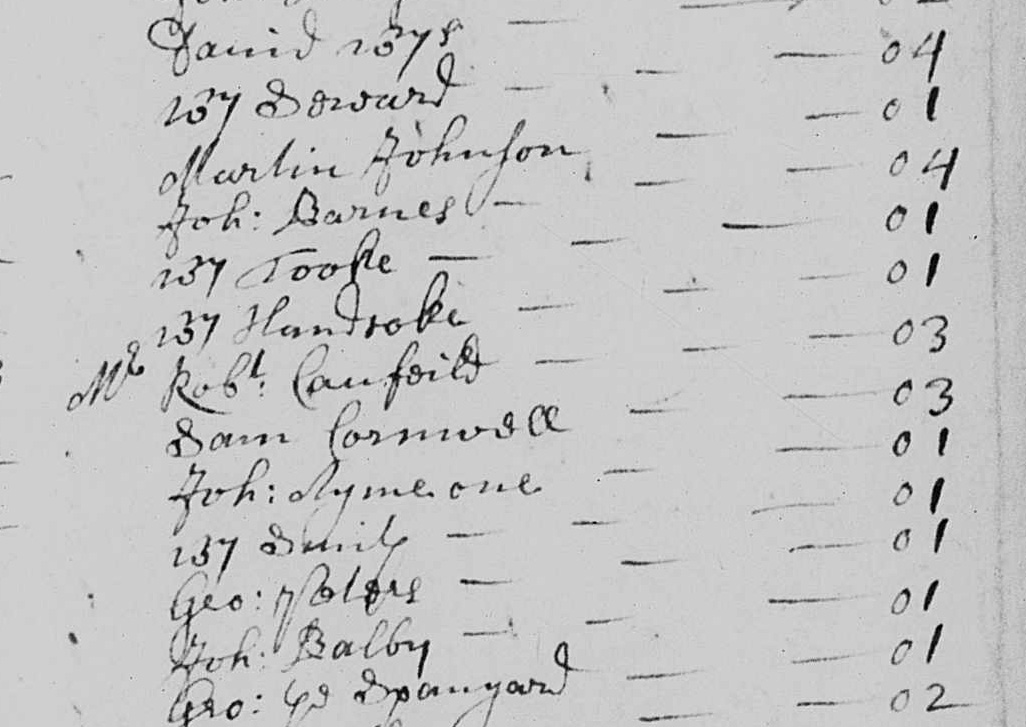
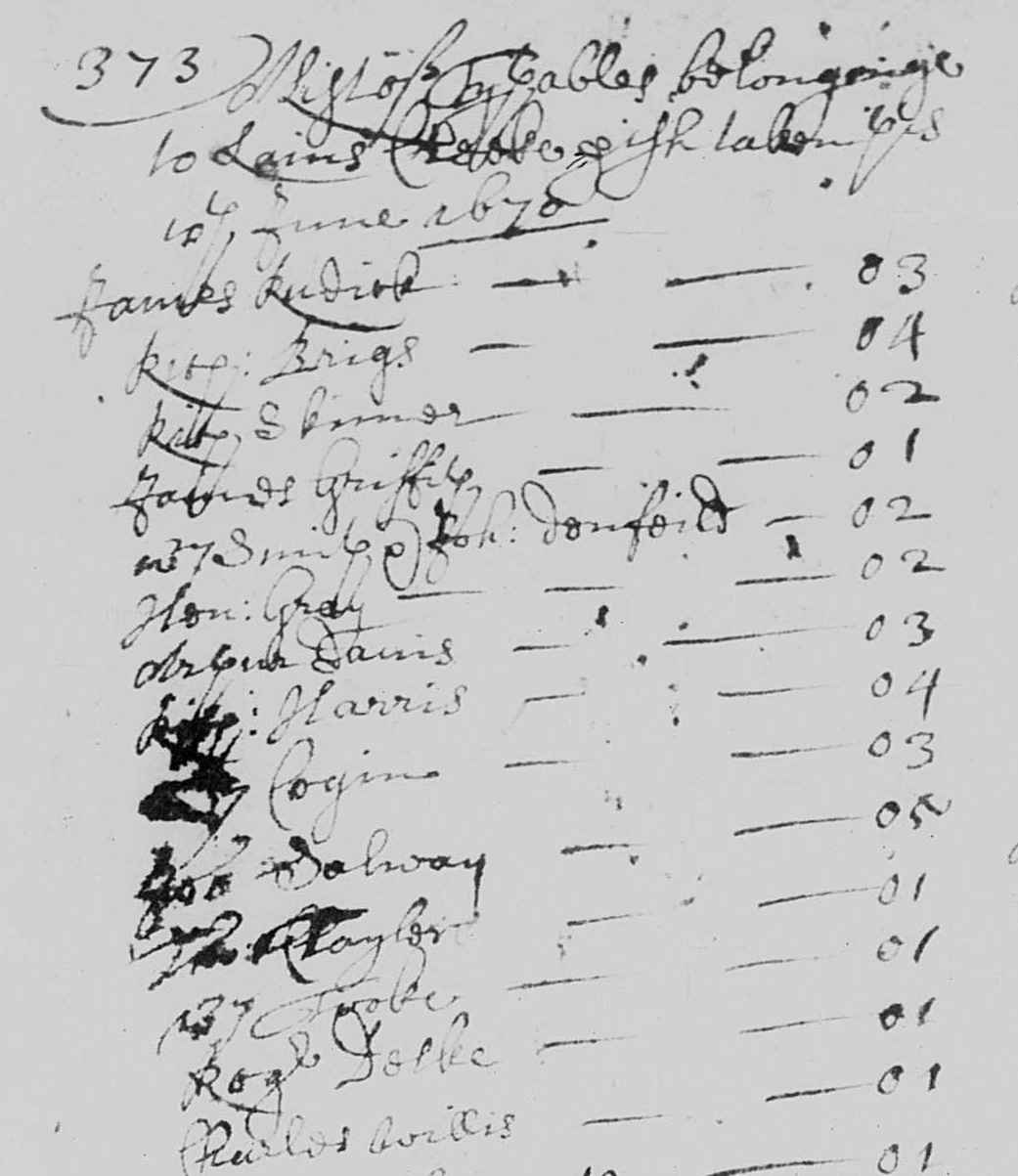
June 1669 likely represents the first documented appearance of William Smith in Surry County, Virginia historical records, as he appears as a tithable in the 1669 Surry County, Virginia tithables list.
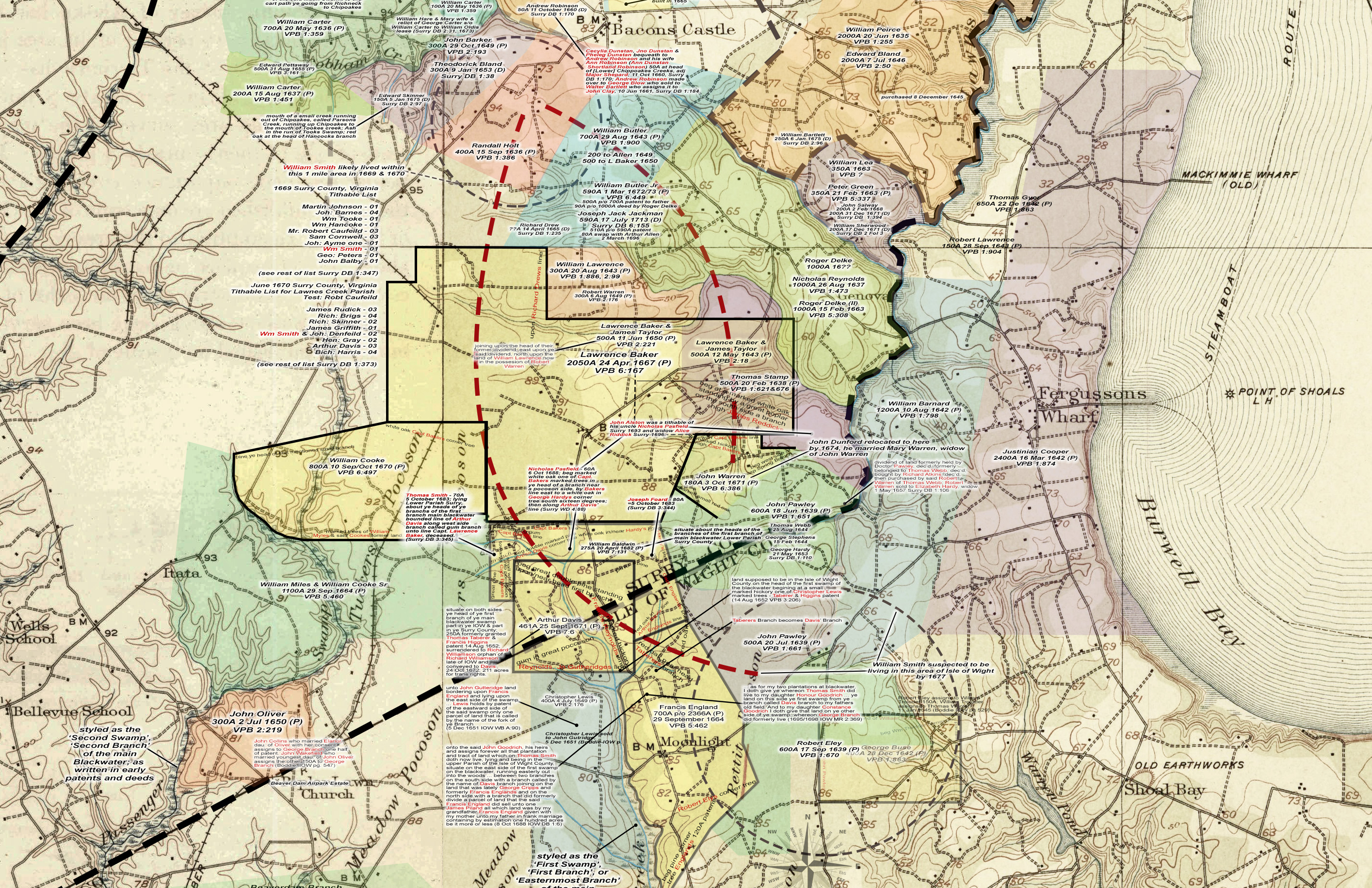
William Smith’s residence can be traced to Lawne’s Creek Parish, and situated in the region approximately south-southwest of Bacon’s Castle within Surry County, Virginia. This determination is based on an analysis of land grants and deeds, of others from that era, which have been cross-referenced with other pertinent Surry County records.
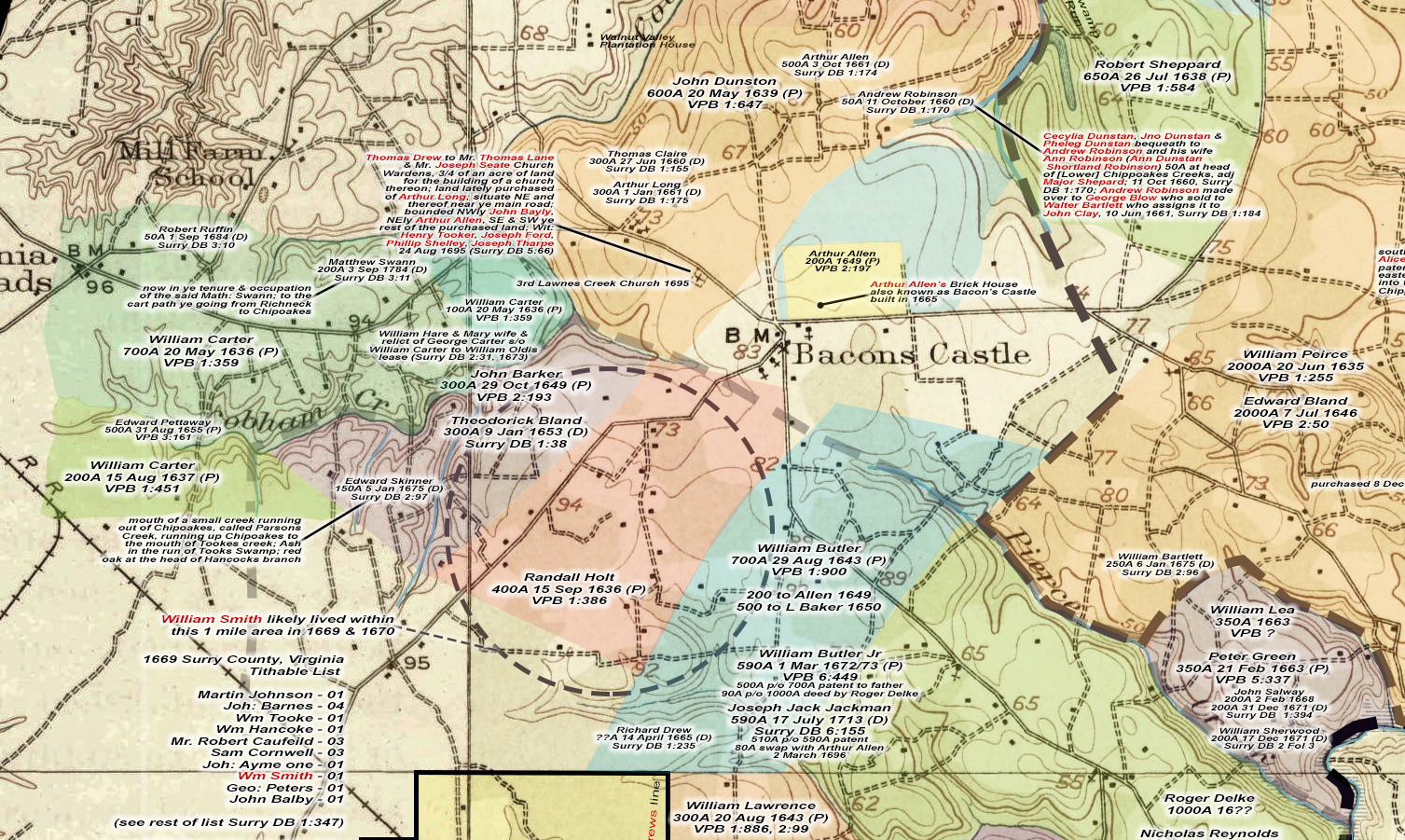
Bacon’s Castle was originally the home of Arthur Allen and earned its name when it became the temporary residence of rebels during Bacon’s Rebellion in 1676/77.
It’s plausible, due to the lack of patents or deeds that William Smith might have engaged in a ‘farm let’ agreement with local landowners.
This practice involved a type of land arrangement or lease agreement, allowing individuals, including former indentured servants or newcomers to the colony, to access land for farming without necessarily owning it outright.
This common 17th-century practice enabled those without immediate means to establish themselves as farmers.
The Bland family were absentee landowners with vast holdings across the colony, including the 300 acres adjoining Lower Chippoakes Creek. To the east of the Bland’s property, Randall Holt Jr. held the land patented by his father in 1636 (400 acres). In 1669, Randall Holt Jr. also possessed 1,022 acres on Hog Island, situated north of the mouth of Lawne’s Creek.
It’s likely that Randall Holt Jr. resided on his 400-acre patent, as evidenced by several of his children marrying into neighboring families. This choice brought him closer to the emerging agrarian community in the vicinity of his property and that of Arthur Allen. His son Thomas Holt married Frances Mason, the daughter of Francis Mason, and his daughter Jane Holt married John Hancock, the son of William Hancock.
In the 1670 Surry County, Virginia tithables list, William Smith makes another appearance, this time accompanied by a tithable named John Denfeild [sic], who we identify as John Dunford, approximately 23 years old (based on a deposition in 1680 indicating he was 34), likely a recent arrival to the colony.
This entry designates William Smith as the ‘head of the household,’ responsible for the tax obligations of both himself and John Dunford. While it doesn’t conclusively indicate that John Dunford resided in the same household as William Smith, it strongly implies such an arrangement. This connection could suggest a preexisting relationship between William Smith and John Dunford, possibly originating from shared circumstances in England or perhaps it merely indicates William Smith is providing lodgings and sustenance for John Dunford.
In early 1671, Surry County records show that William Smith purchased a horse from his close neighbor, John Dunston III. It’s worth noting that John Dunston’s sister, Ann Dunston, entered into two marriages: first with Richard Shortland and later with Andrew Robinson.
Surry County Virginia, Surry County Deed Book No. 2 Folder 3 (pages in the begining of Book 2)

Know all men by these presents that I John Dunston have bargained and sold by these presents doe bargaine and sell unto William Smith is heirs, exor's  & Adm's assigns one whiteish gray mare commonly called and knowne by ye name of Tibo with a crop on ye left eare warranting her to be with foale and doe oblige myselfe my heirs exor's & Adm's to warrant ye said sale against person or persons that doe or shall lay any claime to ye said mare and likewise doe acknowledge to have received full consideration for ye said mare and oblige myself ____ by myself or lawfull attorney to acknowledge this sale at ye next courte in Surry County to all. I have put my hand & seal this 22 January 1671. Signed: John Dunston (seal, red wax). Witness: John Freestone, William Edwards

Acknowledged in courte ye 5 March 1671
The subsequent month saw William Smith serving on a jury that conducted an investigation into the discovery of a deceased individual in the river at Thompson’s Landing. The jury was comprised of the following individuals: William Smith, Edward Pettaway, William Edwards, William Foreman, Edmond Howell, John Wilson, William Bridges, James Folwer, John Skinner, William Arnoll, John Freestone, and John Greenwood. (Surry DB 1:383, 22 April 1671)
In 1673, William Smith is documented in the Surry County Tithable List, this time without the presence of John Dunford. The records show William Smith continuing to reside in Lawne’s Creek Parish.
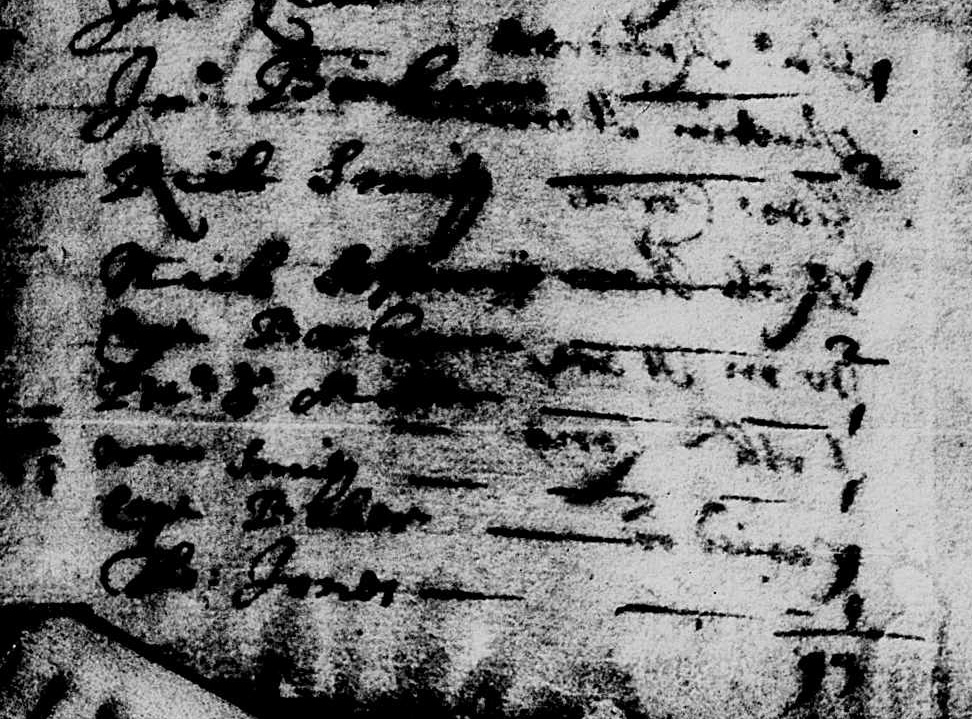
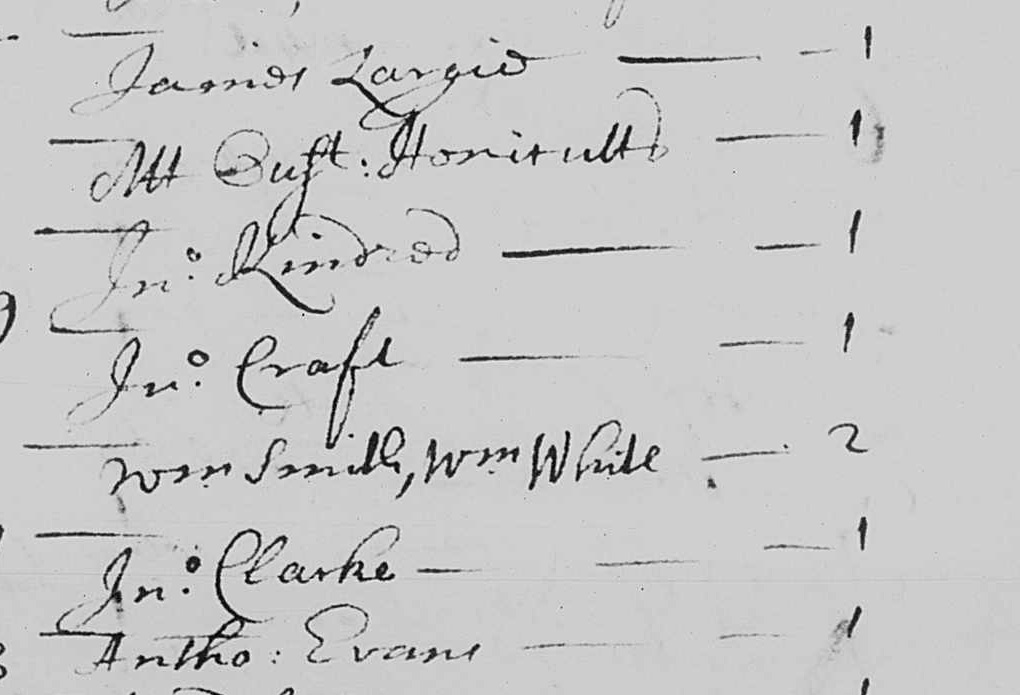
One year later, William Smith is listed in the 1674 Tithable List, this time alongside a new tithable named William White. Similar to previous instances, it would be advisable for future research to investigate the possibility of a preexisting relationship between William Smith and William White, possibly stemming from shared circumstances in England. However, it is likely that William Smith is primarily offering accommodations and support to William White.
During the summer of 1674, William Smith found himself summoned to appear in Surry Court on two occasions. The first appearance pertained to a dispute involving John Barnes, while the second was a nonsuit case against Andrew Robinson.
Surry County Virginia; Surry County Order Book 1671-1691, pg 60 (image 130)
June 1674 - Court

The Difference Inter: William Smith and John Barnes is ordered by ye Court to the next Court, that the said Smith may [illegible] of to made good his appointment.
Surry County Virginia; Surry County Order Book 1671-1691, pg 74 (image 137)
August 1674 - Court

Andrew Robinson arresting William Smith _____ and not entering a position against the said Smith _____ said Smith position a nonsuit is granted _______ _____ said Robinson. Damage of sixty pounds tobacco ___________
Surry County Virginia; Surry County Order Book 1671-1691, pg 76 (image 138)
September 1674 - Court

The Difference Inter: William Smith and John Barnes [illegible]
Also in September of 1674 William Smith is mentioned in the Surry County records.
Surry County Virginia, Surry County Deed Book No. 2 page 67 I William Swett aged about 37 years, doe here declair that I was in the company of John Dunston last May was two years in William Smith's house at Town and there did hear John Dunston say that he had given the foale of a grey mare that always came to Mr Masons house to the child of William Smith, ___ the foale be male or female and orded me William Swett to see it marked and delivered to the child, or for her use, and that I this deponant did brand the said colt with William Smith's marke. Signed: WilliamSwett. Jurant in Court September 4th 1674
The above entry informs us of two things. First is it appears that William Smith has a daughter as the foale is being given, “to the child, or for her use”. Second is it is believed that the term, “Town” is a reference to the agrarian community south and southwest of Bacon’s Castle. A few decades prior the term Town was often used as a refernce to Jamestown, which was across the James River, but not believed to be Jamestown in this instance.
In the subsequent year, 1675, William Smith once more appears in the 1675 Surry Tithable List, accompanied by William White as his tithable. Additionally, it is noteworthy that John Dunford also resides in the same precinct of Lawne’s Creek Parish, being recorded with two tithables of his own, namely Robert Temple and John Bishop.

As shown in the 1675 Tithable List, above, John Dunford who was previously a tithable of William Smith, is living in Lawnes Creek parish of Surry County, likely a mile north northwest of Robert Warren who patented 300 acres in 1649 (previously patented by William Lawrence in 1643).
By September 1674, John Dunford married Robert Warren’s daughter-in-law, Mary Warren, widow of John Warren. John Dunford likely moved to the 180 acre tract of land that Mary Warren inherited after John Warren’s death (see image further below). This is also where John Dunford would have been living as delinated by the above 1675 Tithable List.
John Dunford died before 13 March 1688 as evident of an estate inventory recorded in the Surry County Will and Deed Book 4, 1687-1694 page 43. Signed by Mary Dunfeild [sic] and witnessed by Henry Tooker, Joseph Ford, Thomas Drew and Walter Taylor.
The next tithable list on record is 1677 and William Smith is no longer listed as a tithable in Surry County for that year and follow on years for the next couple of decades.
It is presumed that William Smith moved his family across the county like into Isle Of Wight County, Virginia.
By September of this year, 1677, William White who had been a tithable under William Smith in the 1674 and 1675 Surry Tithable List, passed away. His last will and testament provides some lineage information for William Smith
Surry County Virginia, Surry County Deed Book 2 pg 153

John Lord Goodmen: William White being in perfect senses et memory praised be God, doe make this my last will and testament.

Primarly: Committing my soul into the hands of my mercifull savior and my body to the earth decently to be buried by friends.
2nd: I bequeath unto Thomas Smith the son of William Smith a heifer with her increase.
3ly: I bequeath unto William Smith all my aparell, Lin preen et wollen chain, a piece of wollen cloth for a coate et breeches.
Lastly: I give et bequeath unto my loving wife all ye rest of my personal estate et ye wholy et sold by weather moveables or immovables.

Signed Will: White, Witness: Robert Parke

Proved in Court September 16th 1677 by ye oath of Mr. Robert Parke
William White’s will informs us that William Smith has a son named Thomas Smith and both are presumed to be still alive, presumed to be living across the county line in Isle Of Wight.
William Smith’s move to Isle Of Wight has been hard to validate because of the lack of available county records from the late 1600s. Research is left to some abstracts that have been published over time.
One such abstract comes from:
Wills And Administrations Of Isle Of Wight County, Virginia, 1647-1800 by Blanche Adams Chapman, page 20

Abstracted from Isle Of Wight Will And Deed Book #2, page 207

LINSEY, Ann: Leg. dauther Mary a heiffer to be purchased of Mathew ffones; Henry Wheeler's son John; son John; daughter Mary to be placed in the care of Elizabeth Baker of Surry; daughter Ann in care of Mrs. Mary Hardy; my four children. George Hardy, Sr. Ex. D. April 22, 1679. R. November 10, 1679.
Wit: William Smith, Henry Wheeler.
Mathew Fones may have lived in that area of Isle Of Wight where the county line with Surry stops following the creek and becomes a diagonal line. This broad area is also where George Hardy and William Bennett, amongst others lived and had relationship connections back to Mathew Fones. Mary Hardy was wife of George Hardy who lived next to the Surry County line and Elizabeth Baker was the wife of Lawrence Baker of Surry.
Research continues to try and uncover more details about William Smith from Lawnes Creek Parish.
Research theories I continue to work on are:
- William Smith potential to be the progenior of the Smith clan who migrated to America
- William Smith potentially migrated to America between 1640-1643, ref land patent to Benjamin Harrison
- Who is Thomas Smith that is listed with William Smith? Brother / Father
- Smiths and Clays may have some type of connection as they both migrate to the sames places in Surry and Isle of Wight.
- Is Joane Smith, William Smith’s wife
- Did William Smith die before 1688
 digging our roots
Thomas Smith bought a watermill from Robert Flake in the Isle of Wight. It is though he married Elizabeth Forbush. His brother was John Smith who likely married Sarah Hunnicutt. Thomas is mentioned in the Forbush wills. Another brother was likely Nicholas Smith who at least has one record witnessed by this William. We know Thomas is John’s brother because some of the children in John’s will match the names of the land records with Thomas in the water mill.
If we are to conclude that William is Nicholas father. Then it is important to note that Nicholas was incolved with John Smith. This John Smith was the son of John Smith Sr. and married to Mary. His first wife was named Katherine ( currently unknown ) and his seocnd wife was Deborah the widow of Luke Mizell.
The most likely senario is that William was a son of Thomas Smith and his wife. The tithables show William , John, Richard, and Christopher all in the same area.
In my research I identified another son of William named James. He also later appears in tithables.
LikeLike
WILLIAM COLLINS estate appraisal presented by NICHOLAS SMITH, by WILLIAM SMITH,ROBERT KING, JOHN WESTON. Dated Oct. 21, 1687 Recorded 1687. Will Book B, pt. 2.
Robert King is his later stepson.
Williams age 1687 – 21 ( age to be in estate by law ) = 1666
Nicholas age 1666 -21 ( most men actually married at 25 on average in Surry ) = birth before 1645
Elizabeth Flood first married Thomas King who died in 1680
After Thomas died, she remarried to Nicholas Smith. This would be before September 2, 1680, for on that day she filed an inventory of Thomas King’s estate as ‘Elizabeth, wife of Nicholas Smith and relict of Thomas King.
The William here is possibly his father as his son William of the same name was not yet born.
LikeLike