Floyd Benjamin Smith entered this world on the 22nd of June, 1919, in Sampson, Geneva County, Alabama. His parents, Richard Isaiah Smith and Dora Carl Bradley, welcomed him as their eighth child among twelve siblings.
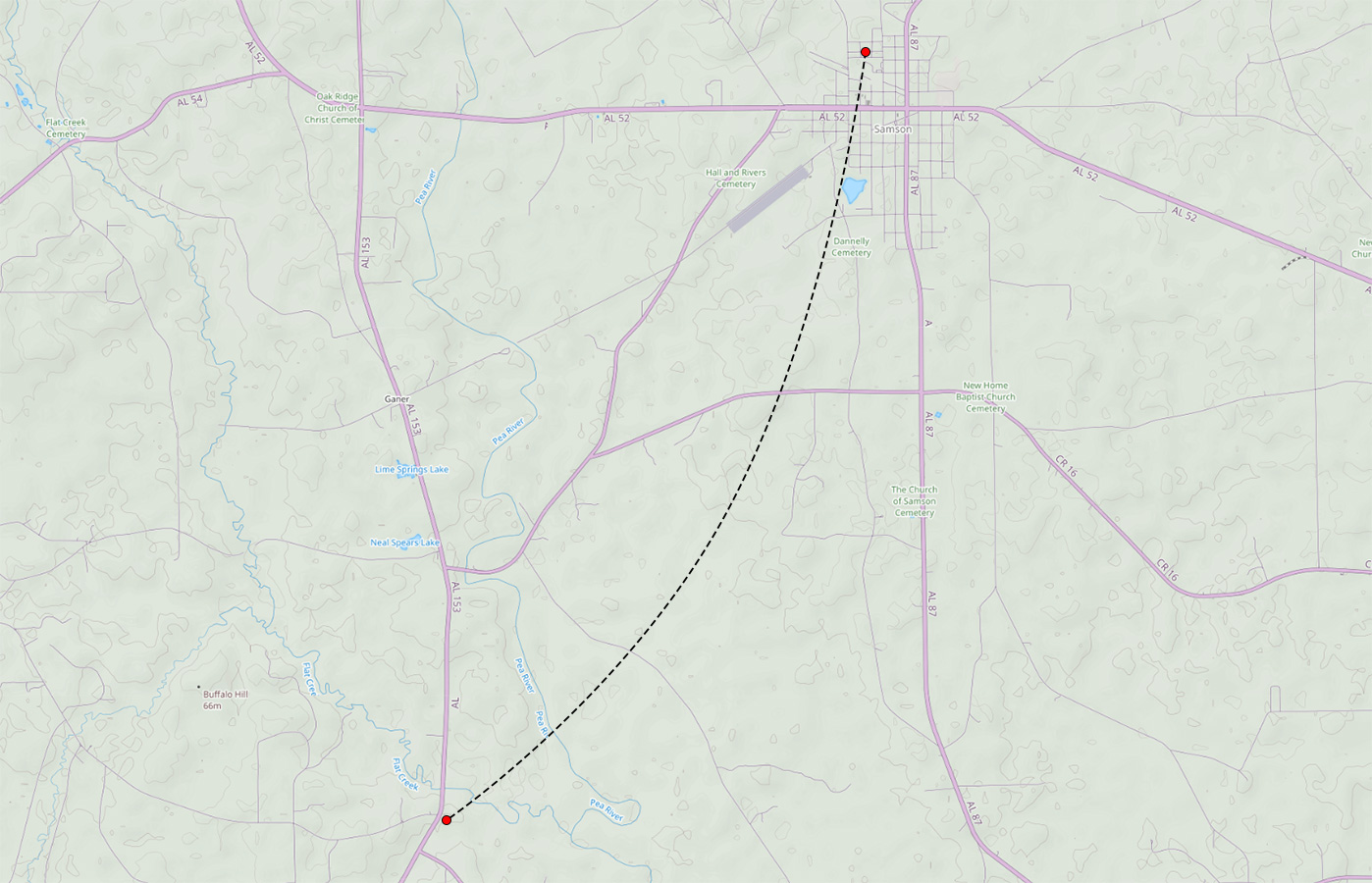
In the early stages of his life, Floyd Smith found himself growing up in the northwest section of Samson, situated just north of the current site of Samson Middle School. The family residence, captured in the site’s header image, stood on the plot of land nestled between W Palafox St and W Farmer St.
In response to financial hardships, Floyd’s parents opted to move to the countryside, as Clayton Smith, Floyd Smith’s brother, mentioned in a 2015 interview. They purchased a parcel of land at the intersection of highway 153 and route 10, where Floyd Smith’s father constructed an automobile service station, which doubled as the family’s living quarters at the back.
Floyd Smith and Lonell Wise exchanged vows on December 13, 1937, in DeFuniak Springs, Florida. Lonell Wise, a resident of Hacoda, Alabama, became Floyd Smith’s beloved wife.
Despite enduring the heartache of three miscarriages, including a pair of twins, Floyd Smith and Lonell Wise Smith finally experienced the joy of parenthood with the arrival of their first child, Betty Jean Smith, in 1940. Three years later, in 1943, they were doubly blessed with the birth of their second child, Aaron Smith.
Floyd Smith and Lonell Wise Smith would divorce sometime before Floyd was called to duty to join the Army during World War II.
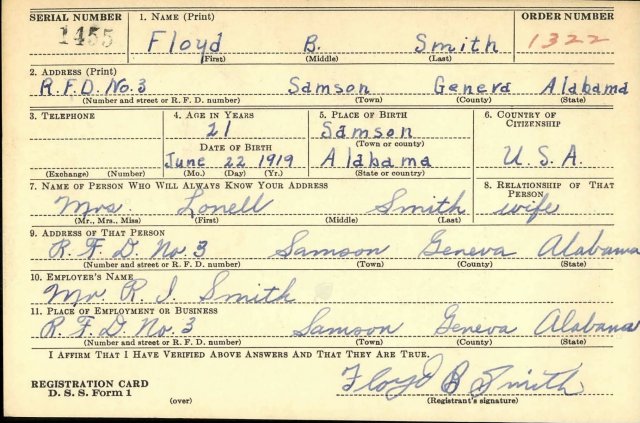
In October 1940, in response to escalating global conflicts, President Roosevelt enacted the inaugural peacetime selective service draft in the United States. Complying with his civic duty, Floyd Smith dutifully filled out his registration card on October 16, 1940.
Just over a year later, on December 8, 1941, the United States officially entered World War II following the devastating attack on Pearl Harbor in Hawaii.
Floyd Smith’s induction into the United States Army took place on April 11, 1944, at Fort McPherson in Atlanta, Georgia. Fort McPherson served as a significant center for induction and training during the war. Over the course of the following 14 weeks, Floyd completed Basic Training, presumably at Fort McPherson. According to his separation record, he went on to attend Infantry Basic 521 before being reassigned to an Infantry Replacement Training Center, where he underwent an additional 17 weeks of intensive Infantry Basic Training.
Apart from providing comprehensive chemical warfare instruction for units and individuals slated to become replacements, the camp also served as a basic training facility for recruits and housed prisoners of war.
Based on deductive reasoning, it is highly likely that Floyd Smith conducted his Infantry training at Fort McClellan in Alabama. Additionally, it is probable that he spent time training at Camp Sibert in Atalla, Alabama, a facility renowned for its training of mortar infantrymen as well as its role as a chemical weapons training center.

While undergoing infantry training at Fort McClellan, the sole Replacement Training Center in Alabama during World War II, Floyd Smith had a serendipitous encounter with a young woman named Pauline Sprayberry. This fateful meeting took place at a fair in Gadsden, Alabama, where their paths intersected.
(Floyd and Pauline pictured at the fair in 1944)
Pauline Sprayberry, a native of Gadsden, Alabama, grew up in the neighboring town of Rainbow City, situated just south of Gadsden.
Fort McClellan is to the south east of Gadsden about an hour away. Camp Sibert is in Attalla which is just west Gadsden.
In the fall of 1944, Pauline Sprayberry would have just turned 15.
By the autumn of 1944, Private First Class Floyd Smith received a new assignment to Troop H of the 12th Calvary Regiment, an infantry regiment operating within the 1st Cavalry Brigade, under the larger umbrella of the 1st Cavalry Division. It is plausible that PFC Smith was deployed to Fort Bliss, Texas, the base of the 1st Cavalry Division, which had already been deployed in the Pacific Theater at that time.
Within his new role, PFC Smith assumed the designation of Heavy Mortar Crewman 1607. His responsibilities encompassed the setup, aiming, and firing of weapons to strategically target enemy positions. As a member of an 81MM crew, he would ensure the placement of explosives and handle the supply of ammunition for the mortar. Additionally, he would operate the weapon by inserting shells into the mortar and engaging the firing pin.

On January 20, 1945, PFC Smith embarked on his journey to the Asiatic Pacific Theater Operations. He reached his destination on February 18, 1945. It was on this date that the 1st Cavalry Division found itself engaged in urban warfare against the Shimbu Group, a detachment of the Imperial Japanese Army entrusted with defending the southern region of Luzon, starting from Manila and extending southwards.
By March 7, 1945, with the enemy forces expelled from Manila, the 1st Cavalry Brigade departed the city to rejoin their Division, located approximately a mile and a half east in the foothills of the Sierra Madre. Following the Battle of Manila, the remaining Japanese troops retreated into the mountainous terrain of southern Luzon. It was there that the 1st Cavalry Division encountered the Shimbu Group once again. After a week of intense confrontation, on March 14, 1945, the XI Corps assumed responsibility from the XIV Corps, relieving the 1st Cavalry Division of its duties.
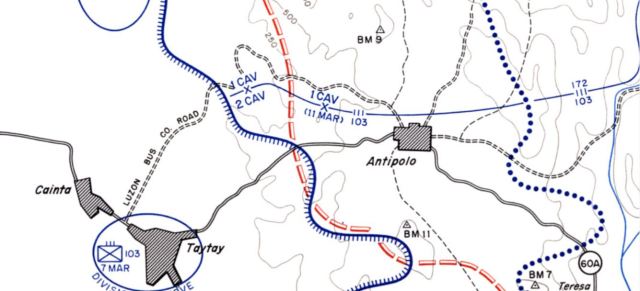
According to available research, it appears that Floyd Smith might not have reunited with his unit during the mentioned timeframe. Records from the XIV Corps indicated on March 8, 1945, that none of its units, except for those returning from casualties, had received any replacements since their arrival in Luzon.
It is presumed that Floyd Smith joined his regiment during the 1st Cavalry Division’s period of rest and rehabilitation after their involvement in the battles of Manila and against the Shimbu Group.
Subsequently, on March 23, 1945, the 1st Cavalry Division assumed the positions previously held by the 11th Airborne Division in the Santo Tomas-Tanauan area at the northern end of the Lipa Corridor. The 12th Cavalry Regiment, part of the 1st Cavalry Brigade, proceeded north of Mt Maquiling towards Los Banos. On March 30, 1945, the 12th Cavalry, along with the 1st Cavalry Brigade, advanced to Calauan, located seven miles beyond Los Banos, and then embarked on a southward march along a secondary road towards San Pablo. The rocky, steep slopes of the hills between Calauan and San Pablo were heavily fortified by entrenched Japanese forces. However, from April 1 to April 5, in an offensive operation, the 12th Cavalry successfully overran these positions, with approximately 140 Japanese soldiers killed, at the cost of 20 killed and 65 wounded among their own ranks. On the final day of the engagement, the 12th Cavalry established contact with the patrols of the 5th Cavalry, who were advancing northward from San Pablo, seven miles south of Calauan.
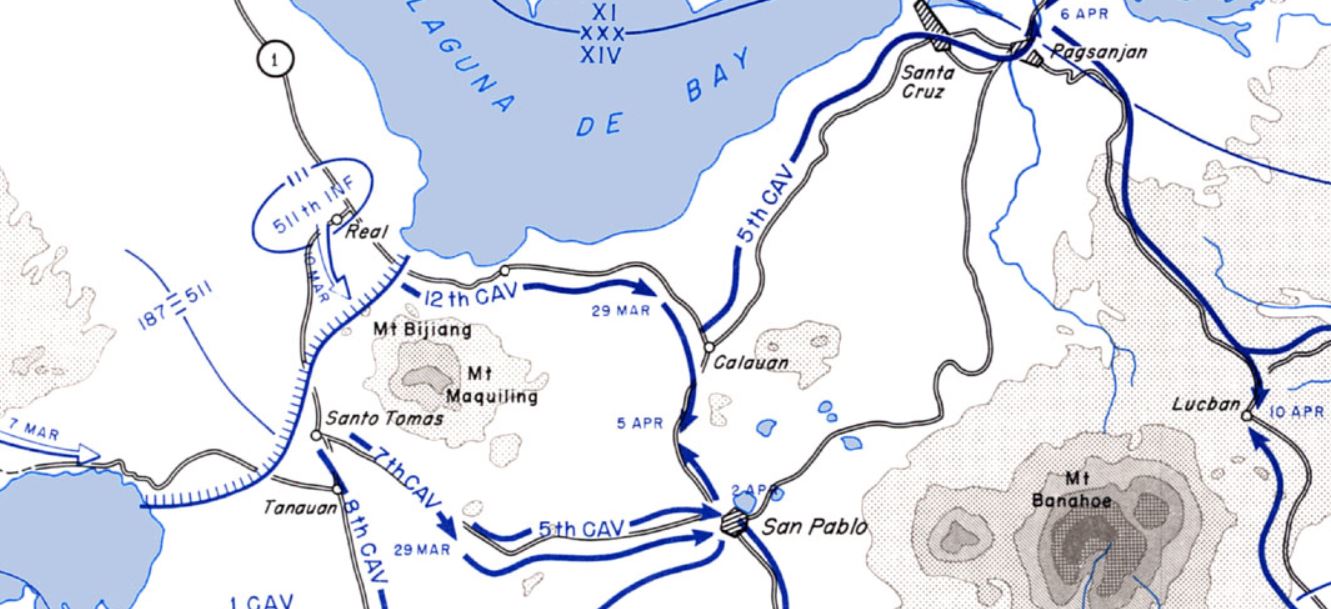
On April 1, 1945, the 12th Cavalry initiated its assault on the heavily fortified Imoc (Imok) Hill, located approximately 4,000 yards southwest of Calauan. After four days of intense fighting, the 12th Cavalry successfully cleared the Imoc Hill area near Calauan.
The Luzon Campaign officially concluded on July 1, 1945, with the 1st Cavalry Division stationed in Lucena, Tayabas Province, Luzon. The division commenced a period of rehabilitation and training in preparation for the planned invasion of Japan’s home islands, scheduled for November 1945.
However, on August 6 and August 9, 1945, the United States deployed two nuclear weapons over the cities of Hiroshima and Nagasaki, respectively. Japan subsequently announced its surrender to the Allies on August 15, 1945, just six days after the Nagasaki bombing.
General MacArthur entrusted the 1st Cavalry Division with the task of accompanying him into Tokyo and participating in the Eighth Army’s occupation of Japan. Detailed orders were issued on August 17, 1945, prompting immediate preparations for deployment. A large convoy departed from Batangas Bay on August 25, 1945.
On September 4, 1945, the advance party of the 1st Cavalry Division embarked on landing crafts and unopposedly reached the Yokohama docks. By nightfall, the division had established initial staging areas throughout the harbor. The 12th Cavalry was assigned the mission of seizing five airfields near Tachikawa, which they accomplished by the evening of September 4.
The initial units, including the 12th Cavalry and the artillery battalions, settled in more permanent quarters at the Japanese Military Preparatory Academy in Asaka, located fourteen miles northwest of Tokyo’s center. The remaining time of the 12th Cavalry was dedicated to occupation duties.
Official records indicate that Private First Class Floyd Smith concluded his service in the theater on December 22, 1945. He returned to the United States on January 4, 1946, likely arriving at the Separation Center in Camp Shelby, Mississippi, where he received an Honorable Discharge on January 12, 1946.
Following the war, Floyd Smith relocated to Columbus, Georgia, which aligns with information suggesting that his older brother, Rassie Lee Smith, served as a soldier stationed at Fort Benning prior to World War II.
Information from Floyd Smith's service records:

Discharge papers
Floyd B Smith 34 978 648 Private First Class
Troop H 12th Cavalry
Honorable Discharge

Army Serial No 34 978 648
SSN 420######

PFC CAV AUS (AUS is COMPONENT)
Date of Separation 12 January 1946
Civil Occupation - Auto Serviceman (this should link back to his employer before the war which was Richard Isaiah Smith)

Date of Induction: 11 April 1944
Date of  into Active Service: 11 April 1944
Place of Entry Into Service: Ft McPherson, GA

Military Occupational: Heavy Mortar Crewman 1607
Quals & Date: Combat Infantryman Badge; D-R June 14

Battles and Campaigns: SOU Philippines; Luzon
APTO MED; Philippine Liberation Ribbon with one Bronze Star; Good Conduct Med; World War II Victory Med

Departed 20 Jan 1945 APTO; Arrived 18 Feb 45
Departed 22 Dec 1945 U.S.; Arrived 4 Jan 1946

Date of Separation 12 Jan 1946

Reason for Separation: AR 615-365 COVN OF GOVT RR1-1 (DEMOBILIZATION)

No time lost under AW 107
Lapel Button Issued
ASR (2 SEP 45) 59

Assignments
3.5 mo - PVT - Basic 521
** mo - PVT - Inf Basic 521
14 mo - PFC - Heavy Mortar Crewman 1607

Heavy Mortar Crewman: As a member of an 81 MM crew set up, aimed and fired, weapon to place explosives on enemy positions. Supplied ammunition for mortar. Fired weapon, dropping shells into mortar to strike firing pen.

CIVILIAN STATUS

Reassignment 9/14/53 from Automotive Equipment Servicer, 2636
To Automotive Equipment Servicer, 2635

ASU 3440
Enginner
Administrative & Management Div.
Motor Pool, Main Post Engineer
Motor Pool

The Infantry Center
Fort Benning, Georgia

Highest Grade Completed 6
Year left school: 1936
Name of School: Samson, Ala

Other training: Electric Welding Jones Const. Co. School
Panama City, Fla 1942 - 2 weeks

Was employed by Smith's Filling Station, Sampson for five years. Serviced vehicles with gas, oil, and water. Grease and lubricated vehicles, making minor repairs whenever necessary.
Within a span of five months after his homecoming from WWII, Floyd Smith’s path crossed once again with the girl he had encountered at a fair during his basic training. On May 27, 1946, Floyd Benjamin Smith and Pauline Sprayberry exchanged vows and were married in Gadsden, Alabama.
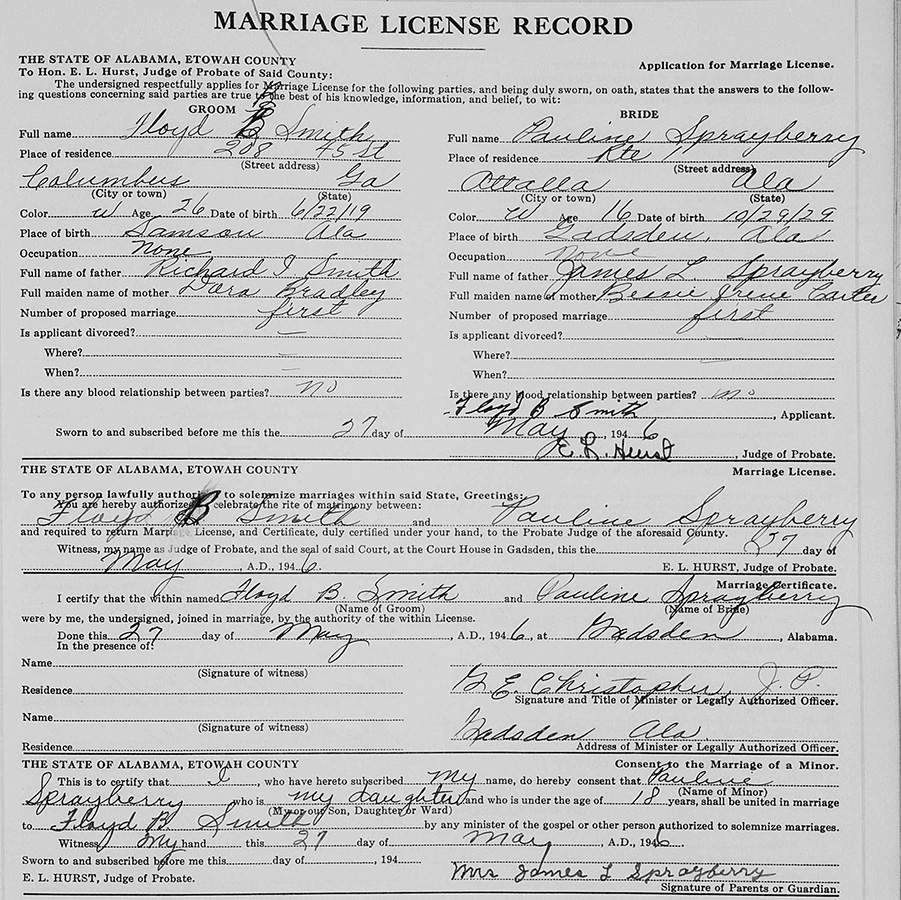
A year later, Floyd Smith and Pauline Sprayberry Smith welcomed their first child, Roy Lee Smith, into the world.
Roy Lee Smith’s name paid tribute to Floyd Smith’s older brother, James Lee Roy Smith, who tragically passed away on May 20, 1923, at the tender age of 11. The incident unfolded within the family home when lightning struck the house, causing an electric current to surge through a ceiling light and down its pull switch. At that moment, Rassie Lee Smith and James Lee Roy Smith were playing beneath the light, both of them rendered unconscious by the sudden discharge of energy. While Rassie eventually regained consciousness, James Lee Roy Smith, sadly, did not survive the incident.
In early 1949, Floyd Smith and Pauline Sprayberry Smith’s relationship became strained, leading Floyd to contemplate separating from Pauline. During this time, he made plans for a visit to Pauline’s parents, James Larkin Sprayberry and Bessie Irene Carter Smith, in Attalla, Alabama. Little did Pauline know about Floyd’s intentions when they arrived at her parents’ house. Upon their arrival at her parents’ house, Floyd casually mentioned that he needed to run a quick errand to the store, leaving Pauline unaware of his true intentions. However, little did she know that it would be the last time she would see him, as Floyd did not return.
A few months later, on July 5, 1949, Jimmy Wayne Smith was born in Gadsden, Alabama.
Floyd Smith and Pauline Sprayberry Smith’s divorce was finalized in 1950, marking the official end of their marriage. However, fate had a different plan for Floyd Smith’s love life. By 1953, he reunited with Lonell Wise Smith, and they decided to marry once again. From their second union, Lonell Wise Smith gave birth to three sons: Danny Smith, Terrell Smith, and Wendell Smith. The family embarked on a new chapter, embracing the opportunities that lay ahead.
In the following years, Floyd Smith and his family embarked on a nomadic lifestyle, residing in various locations and taking on different occupations. They called places like Phenix City, Alabama, and Columbus, Georgia, home for a while. Their journey even led them to Florida, where Floyd Smith found employment with the Florida Forestry. During a particular period, they settled in the vicinity between Cross City and Old Town, Florida, where Floyd Smith pursued his passion as a fishing guide on the scenic Suwannee River.
Floyd Smith eventually found his permanent home in Defuniak Springs, Florida, where he settled for the remainder of his life. He became the proud owner of a 20-acre parcel of land situated at the end of Smith Road, located off route 10/Interstate 90 in western Defuniak Springs, Florida. As time went by, his sons Roy Lee Smith and Jimmy Wayne Smith purchased approximately 3/4 of an acre each from their father, choosing to build their own lives on this cherished family land.
Sadly, Lonell Wise Smith fought a valiant battle against cancer, but ultimately succumbed to the illness. In her final days, she was lovingly brought back to Smith Road, where she passed away on June 14, 1992.
Almost a decade later, Floyd Benjamin Smith joined his beloved wife in eternity, passing away on January 4, 2001.
 digging our roots
Leave a comment